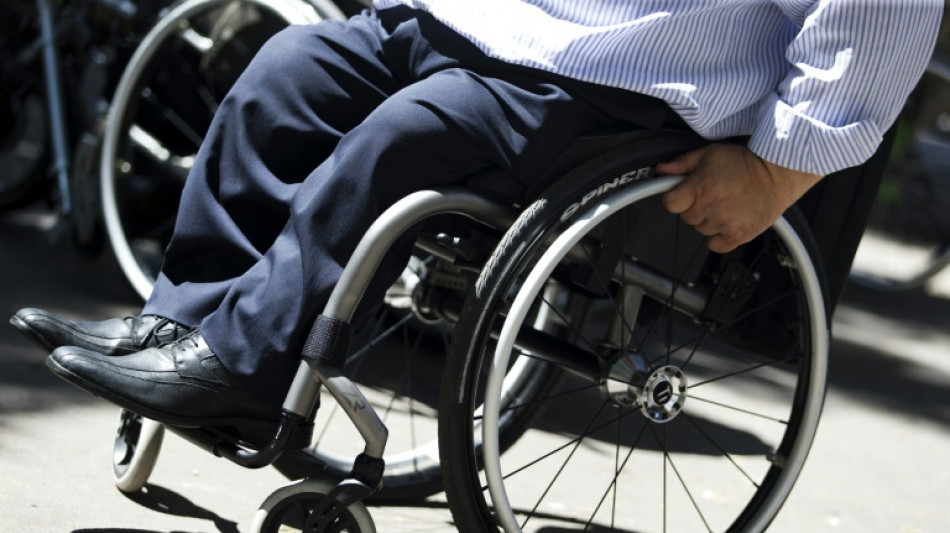
New hope to help advanced Parkinson's patients walk, sleep again / Photo: © AFP/File

 'Glad it's over': Kim powers to Games gold and military exemption

 After 11 World Cups, football finally comes home for one Indian fan

 Marc Marquez wins sprint at Japan MotoGP, Martin grabs pole

 Alcaraz fends off Arnaldi to reach Japan Open quarters

 Antonelli tops times in final practice at Bahrain GP

 Gauff digs deep to beat Osorio in China Open second round

 Fresh protests to hit Spain after housing measures defeated

 'He's here with me': Japan cycle queen dedicates gold to late brother

 Japan Olympic chief says 'lot more' athletes at Games than expected

 Asian carmakers besting US rivals at home, China poised to strike

 Widgets & Web Offers All-Inclusive Investor Relations Websites for Public Companies, IPOs and SPACs

 Adams named new US captain to 2030 World Cup

 China a better influence in Latin America than US: poll

 Judge pauses construction of border project in Texas national park

 Belgium's De Bruyne fires double to sink Turkey, France held by Italy

 US jobs data boosts stocks as oil prices dip

 US Supreme Court to hear high-stakes climate case

 Trump expected to name intel chief Clayton as AI czar: reports

 Argentina unveils passports-for-investment scheme

 Brazil election debate chaos sparks censorship row

 England's Carse charged by cricket body over nightclub incident

 Amazon vows $1 bn for data center towns, decries 'myths'

 Oil prices drop on G7 fuel release, US jobs data boosts stocks

 G7 agrees deal to ease global energy supply concerns

 Spain's government dealt blow as lawmakers reject housing bills

People with advanced Parkinson's disease often struggle to walk more than a few steps or sleep through the night, but new research offers hope of relief from these two debilitating symptoms.
Suffered by millions worldwide, the degenerative disease erodes motor functions and in its later stages often confines patients to a bed or wheelchair.
This is due to a condition called orthostatic hypotension, which occurs when a person stands up and their blood pressure drops, causing dizziness and even fainting after a couple of steps.
For Parkinson's sufferers, it happens because a regulator in the brain -- which normally ensures sufficient blood flows to the brain when we stand up -- has been disrupted.
But new French research published in the New England Journal of Medicine last week found that a spinal cord implant could help advanced Parkinson's patients get back on their feet.
- Quality of life improved -
Earlier this year neurosurgeon Jocelyne Bloch and Gregoire Courtine revealed that such an implant had enabled three paralysed people to walk again.
Both were also involved in the latest research, which tested a similar implant on a 48-year-old woman.
While the woman did not have Parkinson's, she had such similar symptoms -- including orthostatic hypotension -- that she was initially diagnosed with the disease.
For paralysed people, the spinal cord implant mimics how the brain sends electrical pulses to muscles, reconnecting a severed link.
But for orthostatic hypotension, it stimulates the regulator in the brain that senses the need to send more blood when people stand upright.
Before receiving the implant, the woman would faint after a taking a few of steps.
Three months after the surgery, she was able to walk more than 250 metres (820 feet) with the help of a walking frame, the study said.
"She is not cured, she would not run a marathon, but this surgery has clearly improved her quality of life," Bloch told AFP.
However it is a single case and further research is needed, particularly involving Parkinson's patients.
It is not yet certain that the form of orthostatic hypotension seen in Parkinson's patients can be fixed solely by stimulating the regulator the implant targets.
- Anti-insomnia pump -
Insomnia is another common scourge of the 10 million Parkinson's sufferers globally, more than three quarters of whom have sleep-related symptoms, according to the Parkinson's Foundation.
Sleep can be affected by uncontrolled shaking which wakes patients up, while another factor is a lack of a dopamine, common in people with Parkinson's.
The medication apomorphine is normally used to replace dopamine, lessening symptoms such as shaking and stiffness.
But when taken orally, the drug can cause dopamine to spike and then drop, leading to muscle spasms.
A device similar to an insulin pump that delivers continuous apomorphine throughout the night could solve the problem, according to a study published in the journal Lancet Neurology on Thursday.
Co-author Emmanuel Flamand-Roze led previous research indicating that such a pump would help with Parkinson's, but the new study looked at how it helped with sleep.
The randomised study found that those using the pump had "significantly improved" sleep compared to those who received a placebo.
Flamand-Roze told AFP that "the constraints linked to wearing a small pump" are much lower during the night, compared to carrying such a device around all day.
However because the study had a small sample size -- fewer than 50 people -- and focused on people at an already advanced stage of Parkinson's, further research is needed.
L.Dubois--BTB