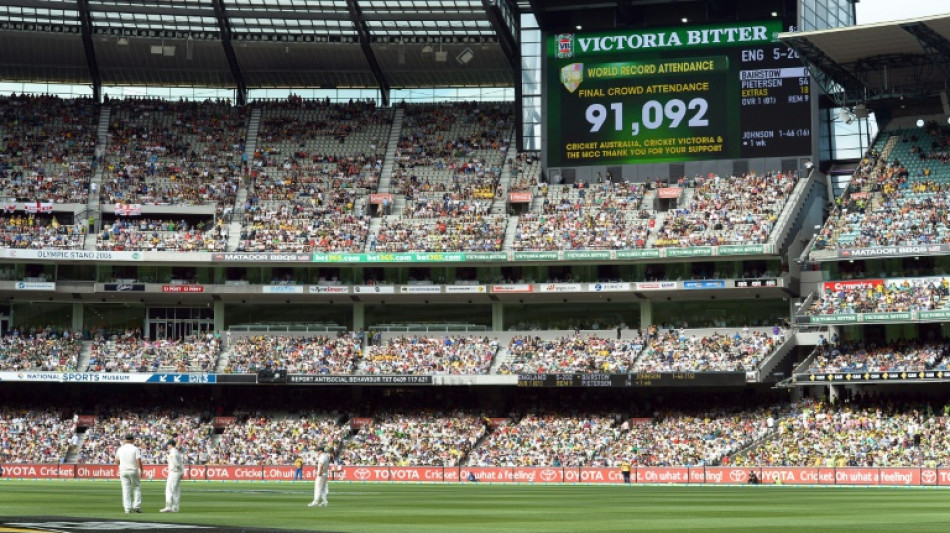
Australia primed for 'unparalleled' decade of major sporting events / Photo: © AFP

 'Glad it's over': Kim powers to Games gold and military exemption

 After 11 World Cups, football finally comes home for one Indian fan

 Marc Marquez wins sprint at Japan MotoGP, Martin grabs pole
 Alcaraz fends off Arnaldi to reach Japan Open quarters
 Antonelli tops times in final practice at Bahrain GP
 Gauff digs deep to beat Osorio in China Open second round
 Fresh protests to hit Spain after housing measures defeated

 'He's here with me': Japan cycle queen dedicates gold to late brother
 Japan Olympic chief says 'lot more' athletes at Games than expected
 Asian carmakers besting US rivals at home, China poised to strike

 Widgets & Web Offers All-Inclusive Investor Relations Websites for Public Companies, IPOs and SPACs

 Adams named new US captain to 2030 World Cup

 China a better influence in Latin America than US: poll

 Judge pauses construction of border project in Texas national park

 Belgium's De Bruyne fires double to sink Turkey, France held by Italy

 US jobs data boosts stocks as oil prices dip

 US Supreme Court to hear high-stakes climate case
 Trump expected to name intel chief Clayton as AI czar: reports

 Argentina unveils passports-for-investment scheme

 Brazil election debate chaos sparks censorship row
 England's Carse charged by cricket body over nightclub incident

 Amazon vows $1 bn for data center towns, decries 'myths'

 Oil prices drop on G7 fuel release, US jobs data boosts stocks

 G7 agrees deal to ease global energy supply concerns

 Spain's government dealt blow as lawmakers reject housing bills

Australia will over the next decade host a bumper schedule of major international sporting events as part of a long-term plan to boost tourism, health and the economy while also enhancing its global image.
The country's welcoming climate, sports-loving people, stable political environment and quality infrastructure have long made it an attractive destination.
But the sheer volume of big sporting events heading to Australia is unprecedented for the nation of 26 million people.
Australian Olympic Committee chief Matt Carroll calls it the green and gold -- the nation's sporting colours -- "runway" culminating in the Brisbane Olympics in 2032.
"More than 30 major global sporting events are coming to Australia across the next 10 years," he said.
In addition to the annual Australian Open tennis and Formula One, the country will host cricket's men's Twenty20 World Cup, Women's Basketball World Cup and the UCI road cycling world championships this year.
It will then jointly hold football's Women's World Cup with New Zealand in 2023, a British and Irish Lions rugby tour in 2025, Commonwealth Games in 2026, Netball World Cup in 2027 and Presidents Cup golf a year later.
An expected announcement next month that it will also stage back-to-back men's and women's Rugby World Cups in 2027 and 2029 will further cement Australia's status as a sporting powerhouse.
"Sport brings health, educational and wellbeing benefits to the community and can play a pivotal role in getting Australians active, reducing obesity and other health-related problems including mental illness," said Carroll.
- 'Feel-good factors' -
Bidding for big events is part of Sport 2030, a government roadmap established in 2018 that recognises the broader economic and social implications of sport, which is already deeply embedded in Australia's culture and identity.
But hosting a huge competition such as the Olympics comes with a financial price tag.
"The return on investment is a complex issue," Popi Sotiriadou, an associate professor of sport management at Queensland's Griffith University, told AFP.
"There are things that we can't measure -- you can't put a money value on national pride. There are so many of what we call 'public goods' that do not necessarily translate to dollars.
"There are legacies in terms of feel-good factors, people feel that connectedness with each other.
"And with any big sporting events we have that trickle-down effect, that inspirational effect of elite athletes' success, the promotion of community, the boost to tourism, we have trade benefits, employment benefits, infrastructure benefits, better public facilities."
Sports Minister Richard Colbeck called the coming blitz of events "unparalleled in our history" as Australia seeks to "grow our reputation as the pre-eminent sporting host nation in the world".
According to government data, 14 million Australians participate in sport every year, millions attend live games and the sector generates about three percent of gross domestic product.
It is big business, delivering Aus$83 billion (US$61 billion) of combined economic, health and educational benefits annually, with a return on investment of Aus$7 for every dollar spent, Sport 2030 says.
- Experienced host -
Australia has long been praised for its ability to host big-ticket showpieces, stemming from the 2000 Sydney Olympics, which were widely seen as setting a benchmark.
Then-International Olympic Committee president Juan Antonio Samaranch famously declared them "the best ever" -- and not only from an operations perspective but everything from venue design and construction to management and marketing.
More than 20 years later, those skills have been honed even further.
Rugby Australia chief executive Andy Marinos, who is involved in the Rugby World Cup bid, said it made a big difference having strong government and public support.
"That's one of the benefits of operating in a country like Australia," he told SportsPro magazine. "Because there's such familiarity with having to host and engage on major events.
"The states and certainly the federal government are quite well versed in it so they understand that once you put a very compelling economic impact assessment in front of them, the decision-making process is relatively straightforward."
H.Seidel--BTB