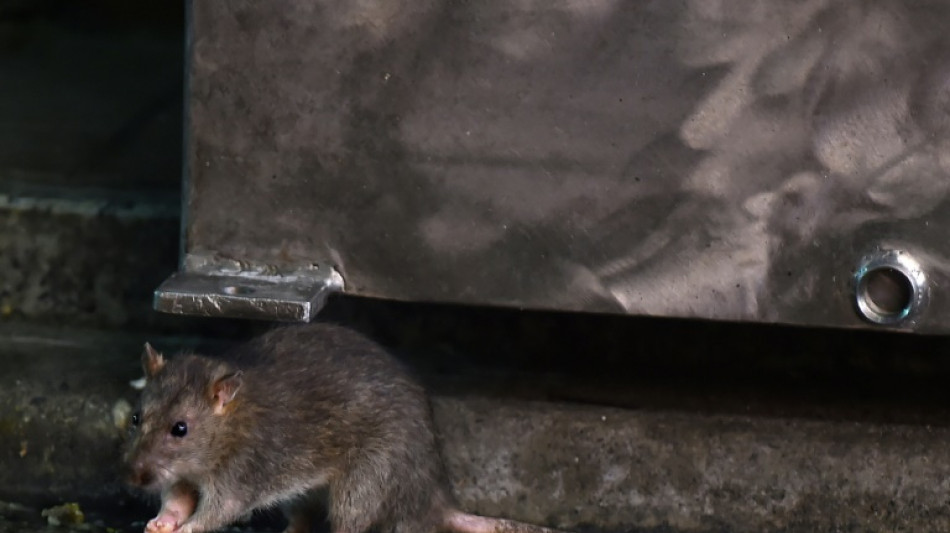
Much-maligned rats unlikely to spark next pandemic: study / Photo: © AFP/File

 World No.1 Sinner pulls out of Shanghai Masters to delay return

 Red Bull's Verstappen grabs pole position for Bahrain GP

 India beat Pakistan in blockbuster as golfer Kim wins 'crazy' gold

 India beat arch-rivals Pakistan to win Asian Games cricket gold

 Ethiopia's Tigray rebels abandon regional capital as govt advances: journalist

 Tom Kim powers to Games gold and exemption from military service

 Split loyalties for Indian football fans at Brazil friendly

 India-Pakistan blockbuster brings cricket fever to Japan baseball field

 Wong waiting on Rafa after winning Asian Games tennis gold

 With Russia next door and rising costs, Latvia goes to the polls

 Penalty hero rues empty seats as Games hosts Japan win football gold

 North Korea fires ballistic missile after Seoul's apology demand

 US regulator finds Boeing 737 MAX software bug 'not a safety concern'

 Ohtani 'managing' injuries as Dodgers launch MLB post-season

 Botched US execution leaves murderer unconscious on ventilator: lawyers

 Cornell rape case exposes sexual violence at US colleges

 France held by Italy in Zidane's homecoming after Olise stunner

 Ethiopian pro-government militia claims Tigray airport as regional tensions spike

 Ohtani shaking off injuries as Dodgers launch MLB post-season

 Sea levels to rise in California as coastal wave surges up west coast

 New rallies urged in France as protests disrupt over 730 schools

 Djokovic survives China Open scare, Sabalenka starts strong

 King Charles to evoke colonial 'darkest days' on Caribbean tour

 Tesla shares jump after global car sales top estimates

 DR Congo Ebola outbreak killed more than 4,000: official figures

Rats have been seen as filthy disease-spreaders since at least the time of the plague, but new research shows that rodents and other city-dwelling animals are less likely to cause the next pandemic than previously thought.
Researchers at Georgetown University in Washington DC studied data on about nearly 3,000 mammals, expecting to find that those living in urban environments hosted more viruses that could be caught by humans, because they were in such close contact.
They found that urban animals did in fact carry 10 times as many kinds of disease -- but also that more than 100 times as many studies had been published about them.
When the researchers corrected for this massive bias -- a long-standing scientific preference to study animals scuttling under our feet rather than hiding in rainforests -- they were surprised to find that rats were no more likely to be the source of a new human disease than other animals.
However, "it's still not good idea to get too close and friendly to urban wildlife," said Greg Albery, a disease ecologist who led the study published in the Nature Ecology and Evolution journal on Monday.
"These urban animals are unlikely to be the source of the next 'Disease X', but they're still often a source of well-known important diseases," he told AFP, giving the example of leptospirosis, a bacterial disease commonly spread by rats.
The threat from another common target of city disdain -- the pigeon -- was "almost certainly" also exaggerated due to research bias, he said.
Because we have been studying animals living in cities for so long, "we know so much about their parasites that there are relatively few unknowns there; rural wildlife is much more uncertain and more likely to provide us with the next 'Big Threat'."
Jonathan Richardson, a professor of urban ecology at the University of Richmond, said it was an important study because the authors "rightfully highlight the over-representation of data coming from urban mammal research".
But he told AFP that it is still fair to describe rats as "disease sponges" because humans are in such regular contact with them.
Richardson said his research has found that urban rats harbour more than 200 pathogens and parasites that could jump over to humans, while nearly 80 percent of rats in some cities carry leptospirosis.
- 'Important pathway into humans' -
Albery and his study co-author Colin Carlson published research last week showing climate change could increase the risk of new epidemics.
They found that as animals like bats flee to cooler areas, they will mingle with other species for the first time and create new opportunities for diseases that could later infect humans.
Albery said urban mammals could play a role in that process.
"If a bat meets a rat and gives it a novel disease, and then if that rat has greater access to human areas, that provides an important pathway into humans," he said.
His global warming research also showed that new opportunities for viruses to jump between animals would now take place closer to populated areas, rather in forests.
"The host-pathogen network is about to change substantially, so what we know now about urban parasites is likely to become outdated quickly," Albery said.
"We need improved surveillance both in urban and wild animals so that we can identify when a pathogen has jumped from one species to another -- and if the receiving host is urban or in close proximity to humans, we should get particularly concerned."
J.Horn--BTB