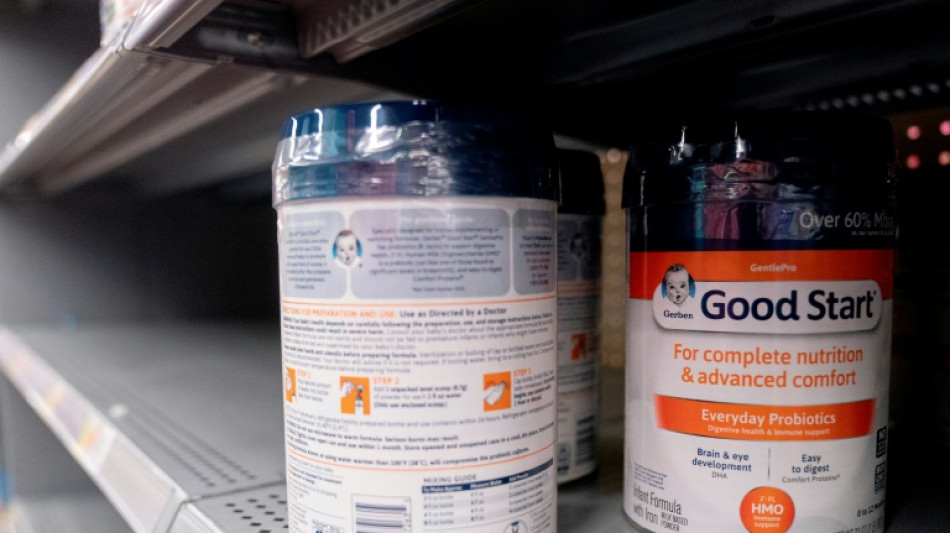
US baby formula shortage could last for some time: official / Photo: © AFP/File

 Prague’s Concert for the Future Kicks Off on Wenceslas Square

 Prince William and Princess of Wales to Announce Earthshot Prize Winners in Mumbai

 Indonesia Forest Fires: Health Crisis, Diplomatic Strains and the Search for Solutions

 BYD Dolphin G Leasing Deal: Plug-in Hybrid Supermini Available from £174 a Month

 JUEL Group Expands from Real Estate to Hospitality with Hyatt Centric Malta Opening

 French Economy Shrinks 0.1% as Consumer Confidence Slumps

 Wall Street Ends Turbulent Week Higher Despite Inflation and AI Jitters
The nationwide shortage of baby formula in the United States could last for some time, a top White House economic adviser cautioned on Friday.
The problem "is not going to solve itself in a day or week," Brian Deese told CNN.
US families have grown increasingly desperate for formula amid a perfect storm of supply issues compounded by a massive recall.
While he would not offer a specific timeline, Deese said, "We are looking at every possible angle that we can to try to address this issue."
The average out-of-stock rate for baby formula last week hit 43 percent, according to Datasembly, which collected information from more than 11,000 retailers.
The scarcity initially was caused by supply chain problems and labor shortages, but the problem has been worsening since February 17 when manufacturer Abbott announced a "voluntary recall" for formula made at its factory in Michigan after the death of two infants,.
That recall included Similac, a brand used by millions of American families.
A subsequent investigation cleared the formula, but production has yet to resume.
"We've got to see how this progresses in real time," Deese said.
It is the latest crisis to confound President Joe Biden's push to get the US economy on sound footing amid the highest inflation in four decades and the ongoing global supply chain bottlenecks.
The United States produces about 98 percent of the formula it consumes, and the Biden administration plans to increase imports of the powdered milk.
"The most important step that we can take right now is to give retailers more flexibility on the types of formula that they can sell, and consumers more flexibility for the types that they can buy," Deese said.
Officials also are working with manufacturers and he noted that domestic output has been recovering.
Over the past month "there has been more production of formula than there was in the weeks preceding the recall," Deese said.
G.Schulte--BTB



