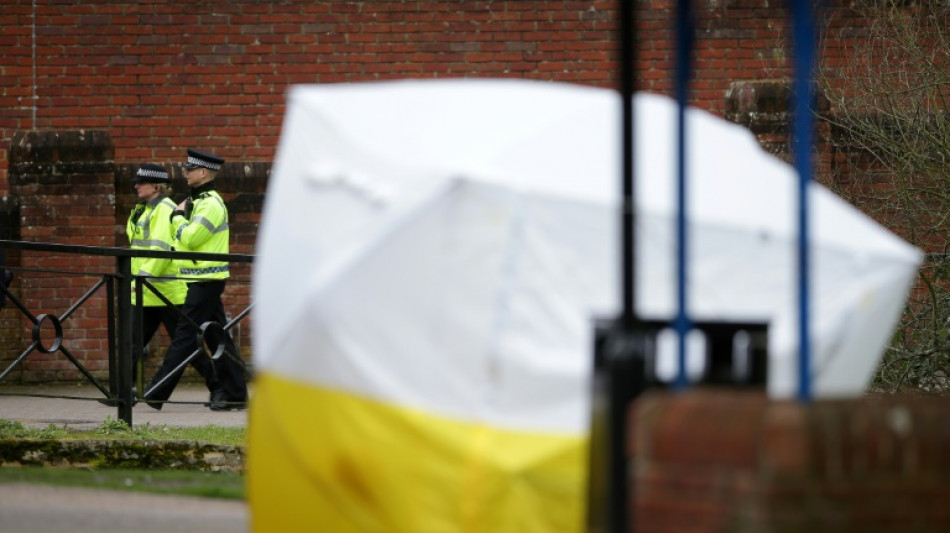
Public hearings start into death of Brit by Russian nerve agent / Photo: © AFP

 Yamal on target as Spain hold off Czech Republic

 Latvian exit polls suggest pro-European choice

 Lula, Bolsonaro wrap up campaigns ahead of knife-edge election

 Tuchel hails 'complete' England after Croatia demolition

 Fury to invite Trump to lead ring walk before Joshua showdown

 Fashion industry in 'precarious moment', says Vivienne Westwood supremo
 Seventh heaven for England in Nations League rout of Croatia

 Storms, flooding cause chaos on Greek holiday island of Crete

 #IAmJaneDoe: online support campaign in US university rape case

 Brazil shine on Selecao's first visit to India

 Zverev sets up Djokovic quarter-final at China Open, Rybakina out

 Happier at home, Bordeaux hammer Lyon in Top 14

 Lula, Bolsonaro in final push for votes ahead of knife-edge election

 Boisterous fashion week barnstorms 'sleepy' Nigerian capital

 UAE investigators say flydubai co-pilot was planning 'terrorist act'

 Rahul smacks century in India v Windies ODI

 Daryz seeks to join exclusive club of dual Arc winners

 Russia warns diplomats to leave Kyiv over new strikes threat

 Olympic champ Zheng rebukes rowdy home crowd at China Open

 World No.1 Sinner pulls out of Shanghai Masters to delay return
 Red Bull's Verstappen grabs pole position for Bahrain GP

 India beat Pakistan in blockbuster as golfer Kim wins 'crazy' gold

 India beat arch-rivals Pakistan to win Asian Games cricket gold

 Ethiopia's Tigray rebels abandon regional capital as govt advances: journalist

 Tom Kim powers to Games gold and exemption from military service

Public hearings begin on Monday at a British inquiry into the 2018 death of a woman who was exposed to the nerve agent Novichok used in an attempt to kill a Russian double agent, which plunged relations between London and the Kremlin to new lows.
The intended target of the poison attack was former double agent Sergei Skripal, who lived in Salisbury, southwest England, and on whom Russian President Vladimir Putin had sworn vengeance.
Skripal and his daughter Yulia were both found unconscious on a bench in the city centre in March 2018. They survived after intensive treatment in hospital, and now live under protection.
Mother-of-three Dawn Sturgess, 44, died in July 2018 after spraying herself with what she thought was perfume from a bottle discarded in a park that contained the deadly chemical weapon.
UK authorities believe that the agents targeting the Skripals had thrown it out.
Britain blames the Novichok attack on two Russian security service officers who allegedly entered the country using false passports. A third has been named as the operation's mastermind.
All three men are thought to be members of the Russian intelligence agency GRU.
The inquiry into the death of Sturgess in Salisbury comes with diplomatic relations between the West and Russia in the deep freeze, after Moscow sent troops into Ukraine in 2022.
The first week of public hearings will take place in Salisbury Guildhall, before moving to the International Dispute Resolution Centre in London on October 28.
An international arrest warrant has been issued for the suspects, but Theresa May, who was prime minister at the time of the attack, warned justice was unlikely.
"I would hope by the end of it (the public inquiry) the family and friends of Dawn Sturgess feel it has got to the truth," she told the BBC.
But "closure to all the people affected would only finally come with justice, and that justice is highly unlikely to happen," she added.
Russia, whose constitution does not allow the extradition of its citizens, has always denied culpability and called the inquiry a "circus".
The Salisbury incident resulted in the largest-ever expulsion of diplomats between Western powers and Russia, and a limited round of sanctions by the West.
Those sanctions have now been far outstripped by the West's response since Putin ordered troops into Ukraine in February 2022.
Wiltshire Police Chief Constable Catherine Roper said it was "important to remember that at the heart of this inquiry are Dawn's family and loved ones whose lives have been irreversibly changed".
"The purpose is to provide Dawn's family, friends and our wider communities in Wiltshire the opportunity to access the fullest possible information surrounding Dawn's death," she added.
The inquiry will also "bring back some difficult memories for those who were living and working in Salisbury and Amesbury in 2018," said the police chief.
B.Shevchenko--BTB



