Zimbabwe healthcare bleeds amid mass nurse exodus / Photo: © AFP

 Zverev thrashes Shang to set up Djokovic quarter-final at China Open

 Turkey football ref chief jailed pending trial for graft

 North Korea says test of intermediate-range strategic missile included use of AI

 Rampant Sayers leads Hong Kong to third men's rugby gold in a row

 Ethiopia's Tigray rebels abandon regional capital as govt advances

 Bulgaria's Tsar Samuel returns 'home' after 1,000 years

 'Glad it's over': Kim powers to Games gold and military exemption

 After 11 World Cups, football finally comes home for one Indian fan
 Marc Marquez wins sprint at Japan MotoGP, Martin grabs pole

 Alcaraz fends off Arnaldi to reach Japan Open quarters

 Antonelli tops times in final practice at Bahrain GP

 Gauff digs deep to beat Osorio in China Open second round

 Fresh protests to hit Spain after housing measures defeated

 'He's here with me': Japan cycle queen dedicates gold to late brother

 Japan Olympic chief says 'lot more' athletes at Games than expected
 Asian carmakers besting US rivals at home, China poised to strike

 Widgets & Web Offers All-Inclusive Investor Relations Websites for Public Companies, IPOs and SPACs

 Adams named new US captain to 2030 World Cup
 China a better influence in Latin America than US: poll

 Judge pauses construction of border project in Texas national park

 Belgium's De Bruyne fires double to sink Turkey, France held by Italy
 US jobs data boosts stocks as oil prices dip

 US Supreme Court to hear high-stakes climate case

 Trump expected to name intel chief Clayton as AI czar: reports

 Argentina unveils passports-for-investment scheme

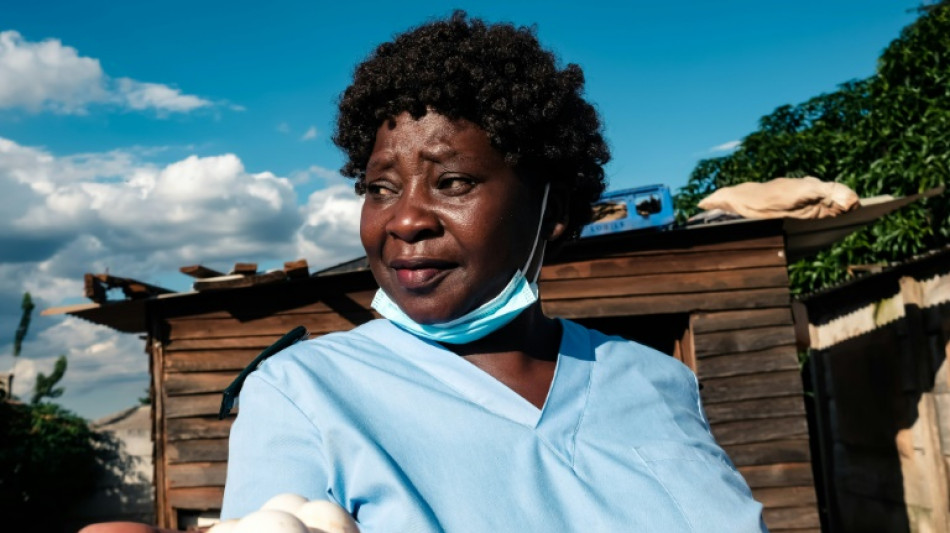
Virginia Mutsamwira says she treats four times the number of patients she should ideally handle at a township clinic in Harare, the capital of Zimbabwe.
"It's tiring -- the nurse-patient ratio is really bad," she says, throwing herself onto a brown sofa at her house in Cold Comfort township after a 12-hour shift.
"It's frustrating, because you can't offer quality care."
The 52-year-old senior nurse is skilled, experienced and educated. Yet her monthly salary of some $200 (192 euros) barely covers her basics.
To make ends meet for her family of eight, she runs a small grocery shop out of her home, where she also rears chickens and rabbits for sale.
After work, before she even takes off her blue uniform, she feeds the chickens.
She is joining the exodus of healthcare workers emigrating from Zimbabwe -- in her case, "to secure my retirement."
Official figures show that last year alone Zimbabwe lost nearly 1,800 nurses, mainly to Britain. That's more than 10 percent of all the nurses working in public hospitals.
Mutsamwira has already done her International English Language Test, required to get a visa to the United Kingdom, where salaries are around 10 times higher than in Zimbabwe.
The outflow of nursing staff is stripping the country of desperately-needed skills.
"We are always overwhelmed because many nurses are leaving," says Josephine Marare, 33, who works at one of the country's largest public hospitals, Sally Mugabe Central Hospital.
Under-equipped facilities only worsen morale. "Imagine working in a hospital where there are no bandages, no water, no basic drugs like painkillers," she says.
"I am just so frustrated. If I get money to get a visa, I will join the others who are leaving."
The migration has spurred demand for passports, with people queueing up before dawn to apply for travel documents in Harare.
- 'Won a lottery' -
Zimbabwe's healthcare facilities have been crumbling for more than a decade, tracking the downward spiral of the economy.
"The main driving factor is poor remuneration," said Simbarashe Tafirenyika, president of the Zimbabwe Urban and Rural Council Nurses Workers Union, explaining the nurses' exodus.
"They need to pay school fees, put food on the table. If anyone gets an opportunity, they are going."
It's so desperate that many highly qualified nurses opt for junior roles abroad because these pay better.
The Health Service Board, which grades and appoints government health workers, admits the mass exodus of nurses has had an effect.
Under a programme aimed at filling staffing gaps, retired nurses are being re-hired while training is being expanded.
"Losing experienced workers is always a challenge," spokesman Livingstone Mashange said.
The board's website opens with a picture of smiling nurses leaping joyfully and a bold "we are hiring" message.
Like other rich countries, Britain has a long tradition of recruiting staff from developing countries to meet the needs of its health service.
But shortages in the UK have shot up, driven by the Covid-19 pandemic and a dramatic drop in nurses recruited from eastern Europe as a result of Brexit.
According a report last June by the Health Foundation think-tank, Britain's National Health Service (NHS) faced a shortfall of 93,000 staff. Some 42 percent of them were nurses.
Jason Mutambara, a 45-year-old Zimbabwean father of four, migrated to Britain last year.
He says he has no regrets -- his monthly income rocketed to £2,700 ($3,375), enabling him to easily afford his children's school fees.
"It was like you've just won a lottery," he said. "You can't even think of coming back at the moment."
Mutambara's hope is that the Zimbabwean authorities fix the health system to stop the haemorrhage of skills.
"We were trained in Zimbabwe and we owe it to the people of Zimbabwe to continue working for them," he said. But for now, it appears Britain will be hiring for years to come.
M.Furrer--BTB