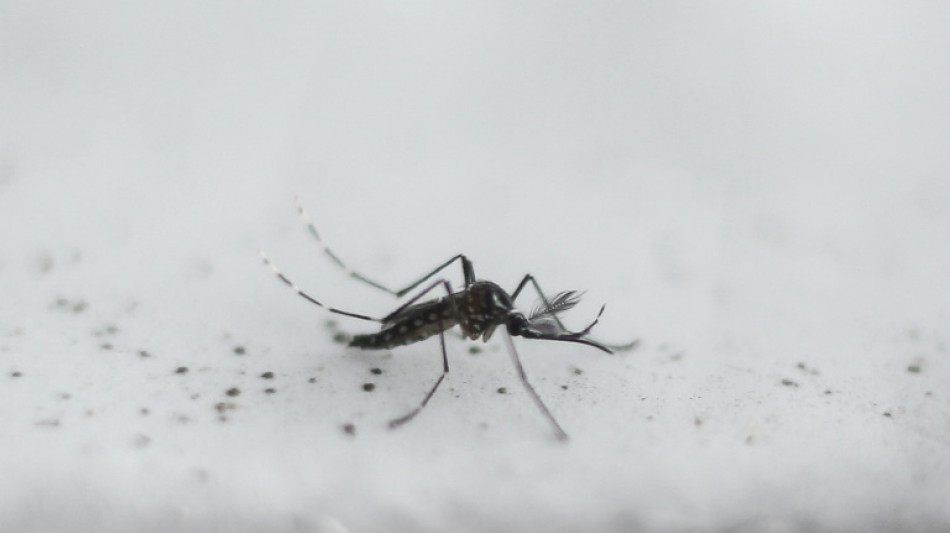
Djibouti experiments with GM mosquito against malaria / Photo: © AFP/File

 Yamal on target as Spain hold off Czech Republic

 Latvian exit polls suggest pro-European choice

 Lula, Bolsonaro wrap up campaigns ahead of knife-edge election

 Tuchel hails 'complete' England after Croatia demolition

 Fury to invite Trump to lead ring walk before Joshua showdown

 Fashion industry in 'precarious moment', says Vivienne Westwood supremo
 Seventh heaven for England in Nations League rout of Croatia

 Storms, flooding cause chaos on Greek holiday island of Crete

 #IAmJaneDoe: online support campaign in US university rape case

 Brazil shine on Selecao's first visit to India

 Zverev sets up Djokovic quarter-final at China Open, Rybakina out
 Happier at home, Bordeaux hammer Lyon in Top 14

 Lula, Bolsonaro in final push for votes ahead of knife-edge election

 Boisterous fashion week barnstorms 'sleepy' Nigerian capital

 UAE investigators say flydubai co-pilot was planning 'terrorist act'

 Rahul smacks century in India v Windies ODI

 Daryz seeks to join exclusive club of dual Arc winners

 Russia warns diplomats to leave Kyiv over new strikes threat

 Olympic champ Zheng rebukes rowdy home crowd at China Open

 World No.1 Sinner pulls out of Shanghai Masters to delay return

 Red Bull's Verstappen grabs pole position for Bahrain GP

 India beat Pakistan in blockbuster as golfer Kim wins 'crazy' gold

 India beat arch-rivals Pakistan to win Asian Games cricket gold

 Ethiopia's Tigray rebels abandon regional capital as govt advances: journalist

 Tom Kim powers to Games gold and exemption from military service

Tens of thousands of genetically modified mosquitos are being released every week in Djibouti as the tiny Horn of Africa state experiments with a new weapon against an unprecedented malaria surge.
East Africa faces a deadly new threat from the arrival of Anopheles stephensi, a mosquito native to Asia and the Middle East that thrives in urban areas and is immune to insecticides.
The World Health Organization (WHO) says the species is a key factor in an unprecedented spike in malaria cases in Djibouti and Ethiopia, and has been found in six other African countries so far.
In 2019, Abdoulilah Ahmed Abdi, health adviser to Djibouti's presidency, heard about a new invention being used primarily in Brazil against a dengue-carrying mosquito.
The so-called "Friendly" mosquito, created by British biotechnology firm Oxitec, is a genetically modified male that carries a protein ensuring its offspring will not survive.
Since only females bite, the idea is that GM males can be released in vast numbers without posing an additional risk to humans.
Djibouti launched the programme in May with the release of 40,000 GM mosquitos and on October 6, began weekly releases that will run for six months.
"We are trying to find with our partner Oxitec an innovative and sustainable solution that could have an impact on the whole region and the continent at large," said Abdi.
"We are very proud of it. It's an initiative for all Africa," he added.
Abdi said results were expected by mid-2025 and that Djibouti was also building a factory to produce the mosquito for shipment across Africa.
- Hopes and challenges -
Oxitec has released well over one billion GM mosquitos in Brazil and Florida in the United States, where it targets the dengue-carrying Aedes aegypti.
Its studies indicate it can reduce wild populations by 90 percent or more.
"There's nothing better at finding the biting disease-transmitting female mosquito than a male mosquito," Neil Morrison, Oxitec's chief strategy officer, told AFP.
He emphasised the Djibouti programme was still at a pilot stage.
"Early next year, we'll start to figure out how many mosquitoes we'll need to release to deliver suppression," he said.
GM mosquitos are controversial with some environmentalists.
A 2019 report led by GeneWatch UK said Oxitec's technology risked altering the evolution of mosquitos and the way diseases spread, in potentially dangerous ways.
It questioned Oxitec's claims of efficacy, saying it could inadvertently release many females alongside its sterile males, or simply push wild mosquitos into neighbouring areas.
Oxitec insists its GM mosquito is "completely harmless and non-toxic" and regulators cleared it for deployment in the US in 2022.
But if GM mosquitos must be continuously released to be effective, there is the question of cost -- a key factor in Africa, which accounts for around 95 percent of the 600,000 malaria deaths each year.
Oxitec refused tell AFP how much its mosquitos cost to governments and private buyers.
Outside experts are taking a wait-and-see approach.
"We are very supportive of innovation," said Dorothy Achu, WHO's head of tropical and vector-borne diseases in Africa.
She said WHO was working on a regulatory framework to measure the impact of GM methods.
"Initial results are very promising but we need things that are sustainable over time and we need impact on wide areas," said Achu.
S.Keller--BTB