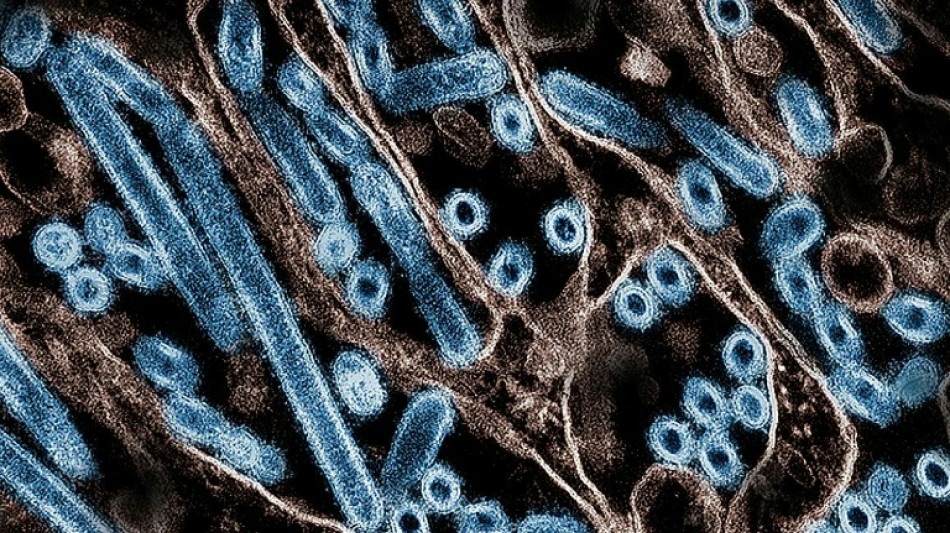
Bird flu mutated inside US patient, raising concern / Photo: © National Institute of Allergy and Infectious Diseases/AFP/File

 AI needs safety layers like nuclear plants: ex-OpenAI engineer

 MVP Judge will miss Yankees' MLB playoff series against Rays

 New lizard species discovered in Peru

 Fernandes hails Portugal's 'greatest symbol' Ronaldo, calls for unity

 Grandidier-Nkanang double takes Pau to Top 14 summit despite Vannes fightback

 Trainer Scott gets perfect Arc boost with top notch double

 Ex-PM says Putin cannot admit 'mistake' over Ukraine

 Houthis say Saudi Arabia launches dozens of strikes on Yemen capital

 Qatar and Abu Dhabi F1 Grand Prix to go ahead - F1 boss

 South Korea lift gloom with smash-and-grab Games football gold

 Ireland news conference before Israel game cut short amid tensions

 Protests over housing flare in Spain after relief measures rejected

 Zverev thrashes Shang to set up Djokovic quarter-final at China Open

 Turkey football ref chief jailed pending trial for graft

 North Korea says test of intermediate-range strategic missile included use of AI

 Rampant Sayers leads Hong Kong to third men's rugby gold in a row

 Ethiopia's Tigray rebels abandon regional capital as govt advances

 Bulgaria's Tsar Samuel returns 'home' after 1,000 years

 'Glad it's over': Kim powers to Games gold and military exemption

 After 11 World Cups, football finally comes home for one Indian fan

 Marc Marquez wins sprint at Japan MotoGP, Martin grabs pole

 Alcaraz fends off Arnaldi to reach Japan Open quarters

 Antonelli tops times in final practice at Bahrain GP

 Gauff digs deep to beat Osorio in China Open second round

 Fresh protests to hit Spain after housing measures defeated

The bird flu virus found in a severely ill patient hospitalized in the United States has mutated to become better adapted to human airways, though there is no evidence it has spread beyond the individual, authorities said.
Earlier this month, officials announced an elderly Louisiana patient was in "critical condition" with a severe H5N1 infection.
An analysis posted by the Centers for Disease Control and Prevention (CDC) on its website Thursday found that a small percentage of the virus detected in the patient's throat had genetic changes that may lead to "increased virus binding" to certain "cell receptors found in the upper respiratory tract of humans."
Importantly, these changes have not been found in birds, including in the backyard poultry flock thought to have infected the Louisiana patient initially.
Instead, the CDC stated that the mutations were "likely generated by replication of this virus in the patient with advanced disease," adding that no transmission of the mutated virus to other humans has been identified.
Experts contacted by AFP said it was too early to determine whether these changes would make the virus spread more easily or cause more severe disease in humans.
The particular mutation "is one step that is needed to make a more efficiently transmissible virus," said Angela Rasmussen, a virologist at the University of Saskatchewan in Canada. "But I do want to point out that it's not the only step."
She explained that while the mutation might mean the virus can more easily enter cells, this would need to be confirmed through further testing on animals. Moreover, similar mutations have been found in severely ill patients in the past without triggering wider spread among humans.
"It's good to know that we should be looking out for this," she said, "but it doesn't actually tell us, 'Oh, we're this much closer to a pandemic now.'"
Another expert, Thijs Kuiken of Erasmus University Medical Center in the Netherlands, agreed with Rasmussen.
"Efficient attachment to human upper respiratory tract cells is necessary, but not sufficient, for more efficient transmissibility between people," he said, "because the attachment process is but one of several steps in the virus replication cycle in a human cell."
Rasmussen expressed greater concern about the overall level of bird flu currently circulating rather than this specific case.
The CDC has reported 65 confirmed human cases of bird flu in the United States in 2024, with more likely going undetected among dairy and poultry workers.
This, Rasmussen explained, increases the chances of bird flu "reassortment" with seasonal flu, which could lead to "rapid evolutionary leaps in a short period of time," similar to the processes that caused the 1918 and 2009 pandemics.
O.Bulka--BTB