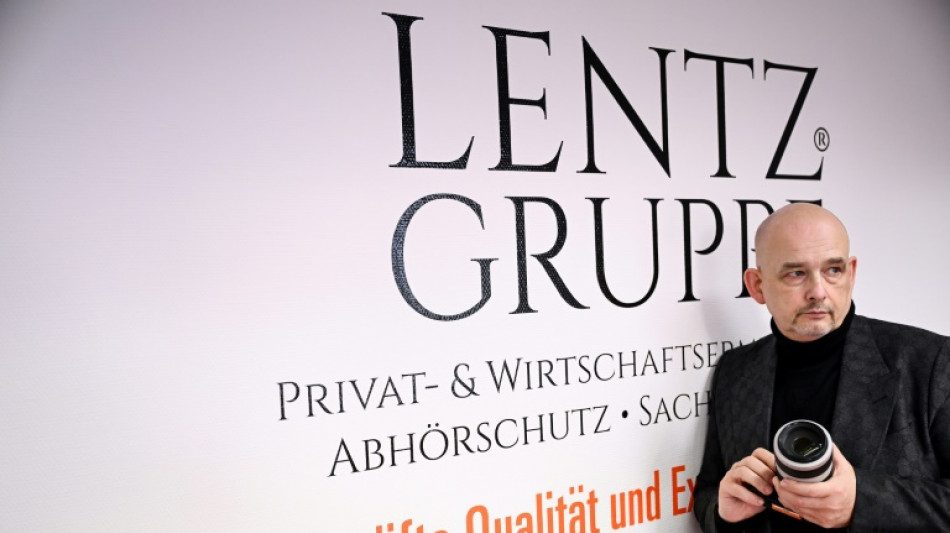
For German 'sick leave detective', business is booming / Photo: © AFP

 AI needs safety layers like nuclear plants: ex-OpenAI engineer

 MVP Judge will miss Yankees' MLB playoff series against Rays

 New lizard species discovered in Peru

 Fernandes hails Portugal's 'greatest symbol' Ronaldo, calls for unity

 Grandidier-Nkanang double takes Pau to Top 14 summit despite Vannes fightback
 Trainer Scott gets perfect Arc boost with top notch double

 Ex-PM says Putin cannot admit 'mistake' over Ukraine

 Houthis say Saudi Arabia launches dozens of strikes on Yemen capital

 Qatar and Abu Dhabi F1 Grand Prix to go ahead - F1 boss

 South Korea lift gloom with smash-and-grab Games football gold

 Ireland news conference before Israel game cut short amid tensions
 Protests over housing flare in Spain after relief measures rejected

 Zverev thrashes Shang to set up Djokovic quarter-final at China Open

 Turkey football ref chief jailed pending trial for graft
 North Korea says test of intermediate-range strategic missile included use of AI

 Rampant Sayers leads Hong Kong to third men's rugby gold in a row

 Ethiopia's Tigray rebels abandon regional capital as govt advances

 Bulgaria's Tsar Samuel returns 'home' after 1,000 years

 'Glad it's over': Kim powers to Games gold and military exemption

 After 11 World Cups, football finally comes home for one Indian fan
 Marc Marquez wins sprint at Japan MotoGP, Martin grabs pole
 Alcaraz fends off Arnaldi to reach Japan Open quarters

 Antonelli tops times in final practice at Bahrain GP
 Gauff digs deep to beat Osorio in China Open second round

 Fresh protests to hit Spain after housing measures defeated
Rising sick leave rates may be bad news for German companies at a time the economy is already ailing -- but for private eye Marcus Lentz, it has been a boon for his business.
He is seeing a record number of requests from firms for his agency to check up on employees suspected of calling in sick when they are actually fit to work.
"There are just more and more companies that don't want to put up with it anymore," he told AFP, adding his Lentz Group was receiving up to 1,200 such requests annually, around double the figure from a few years earlier.
"If someone has 30, 40 or sometimes up to 100 sick days in a year, then at some point they become economically unattractive for the employer," he said in an interview at his office in the gritty district around Frankfurt's main train station.
From auto titans to fertiliser producers, companies are ringing the alarm about the impact of high rates of sick leave on Europe's biggest economy.
While some say changes to reporting in sick have made it easier to fake illnesses, experts insist the reasons behind the rising numbers are more complex, ranging from increases in mental illnesses to more work pressure.
- 'Sick man of Europe' -
Many agree that the trend is weighing on Germany at a time the country's woes, from a manufacturing slowdown to weak demand for its exports, have led some to once again dub it "the sick man of Europe".
"The impact is significant and certainly affects economic activity," Claus Michelsen, chief economist at the German association of research-based pharmaceutical companies, told AFP.
The association calculated that higher rates of absenteeism at work due to illness shaved 0.8 percent off Germany's output in 2023 -- helping push the economy into a 0.3 percent contraction.
Workers in Germany on average took 15.1 days of sick leave last year, up from 11.1 days in 2021, according to federal statistics agency Destatis.
The TK, one of Germany's major statutory health insurers, reported the average number of sick days among workers it covers was 14.13 in the first nine months of the year -- a record high.
According to OECD data, Germans missed on average 6.8 percent of their working hours in 2023 due to illness -- worse than other EU countries such as France, Italy and Spain.
Some corporate leaders have been outspoken about the problem, with Mercedes-Benz chief executive Ola Kallenius lamenting that "absenteeism in Germany is sometimes twice as high as in other European countries".
Elon Musk's electric car giant Tesla went further, reportedly sending managers worried about high illness-related absences at its German factory to personally check up on employees on sick leave at their homes.
Critics say a system of allowing patients with mild symptoms to get sick notes from their doctor over the phone is providing employees who could work an easy way to take days off -- or fake illnesses entirely.
Some industry groups are calling for the system, first introduced during the Covid pandemic, to be abolished.
- 'Dangerous shortcuts' -
Detective Lentz said in many cases where people are pretending to be sick for long periods, they are doing work on the side.
He gave the example of a person who was helping out at his wife's business while officially off sick. Others, he said, have taken long-term sick leave to renovate their properties.
While it can be expensive to hire a detective, Lentz said firms will be looking to get rid of highly unproductive workers at a time of mounting economic woes.
"They say, anyone who is off sick so often is not making us any money -- out they go," he said.
Still, not everyone is convinced the high reported sick rates reflect the true picture.
Some say a new system whereby doctors automatically transmit sick notes to patients' insurance companies has led to more accurate reporting of sick leave, pushing up the figures.
Others meanwhile take a more nuanced view of the rising trend.
The Hans Boeckler Foundation's WSI institute, which is linked to German trade unions, said blaming workers for deciding to stay home too easily or for faking sickness were "dangerous shortcuts".
"They obscure the view of the really relevant causes," said Bettina Kohlrausch, WSI's scientific director, who pointed instead to more stressful working conditions, increasing respiratory ailments and fraying social protections.
K.Thomson--BTB