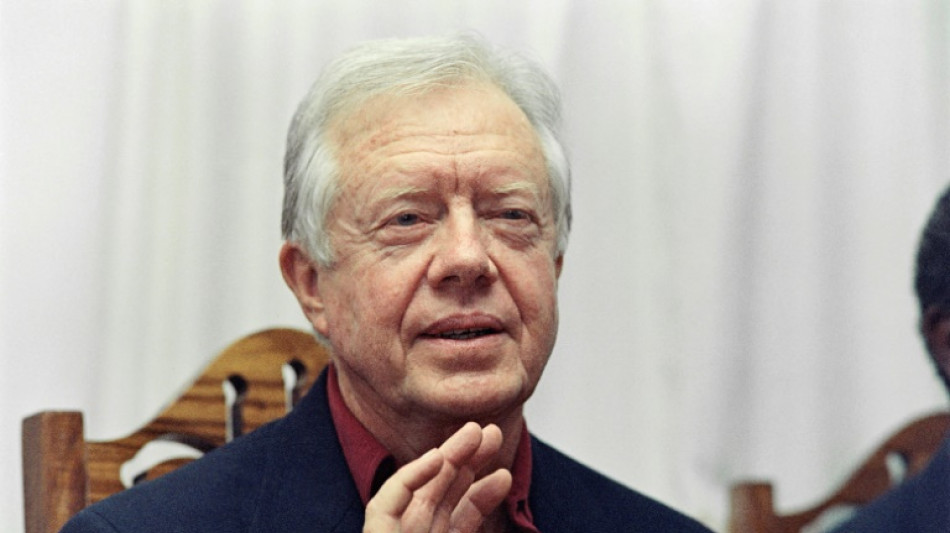
Key moments in the life of Jimmy Carter / Photo: © AFP/File

 AI needs safety layers like nuclear plants: ex-OpenAI engineer

 MVP Judge will miss Yankees' MLB playoff series against Rays

 New lizard species discovered in Peru

 Fernandes hails Portugal's 'greatest symbol' Ronaldo, calls for unity
 Grandidier-Nkanang double takes Pau to Top 14 summit despite Vannes fightback
 Trainer Scott gets perfect Arc boost with top notch double

 Ex-PM says Putin cannot admit 'mistake' over Ukraine

 Houthis say Saudi Arabia launches dozens of strikes on Yemen capital
 Qatar and Abu Dhabi F1 Grand Prix to go ahead - F1 boss
 South Korea lift gloom with smash-and-grab Games football gold

 Ireland news conference before Israel game cut short amid tensions
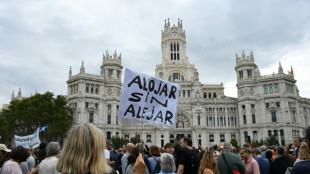 Protests over housing flare in Spain after relief measures rejected
 Zverev thrashes Shang to set up Djokovic quarter-final at China Open

 Turkey football ref chief jailed pending trial for graft

 North Korea says test of intermediate-range strategic missile included use of AI

 Rampant Sayers leads Hong Kong to third men's rugby gold in a row

 Ethiopia's Tigray rebels abandon regional capital as govt advances

 Bulgaria's Tsar Samuel returns 'home' after 1,000 years
 'Glad it's over': Kim powers to Games gold and military exemption

 After 11 World Cups, football finally comes home for one Indian fan
 Marc Marquez wins sprint at Japan MotoGP, Martin grabs pole
 Alcaraz fends off Arnaldi to reach Japan Open quarters
 Antonelli tops times in final practice at Bahrain GP
 Gauff digs deep to beat Osorio in China Open second round

 Fresh protests to hit Spain after housing measures defeated

Jimmy Carter's 1977-1981 presidency included successes like the Camp David peace accords, but also enough controversy for US voters to see him as weak -- and send him packing after only one term.
Carter's legacy however was largely built on his post-presidency, the longest in US history.
Here are a few key moments in the life of Carter, who died Sunday at the age of 100.
- The Panama Canal -
During his first year in office, Carter went back on a campaign promise and decided to hand back management of the Panama Canal -- which had been in US military control since its construction at the start of the 20th century.
"Fairness, and not force, should lie at the heart of our dealings with the nations of the world," he said at the signing of the canal treaties with Panamanian leader Omar Torrijos on September 7, 1977.
Carter was ridiculed for the move, which gave Panama control over the canal linking the Atlantic and Pacific Oceans at the end of 1999.
History, however, has looked upon the deal as a deft bit of diplomacy.
Giving Panama a meatier role in the canal's management in the run-up to the transfer allowed for stability, and broke with America's image as an overbearing imperialist power in Latin America.
Reacting to Carter's death on Sunday, President Jose Mulino said the former US leader helped Panama achieve "full sovereignty of our country."
- Morality in politics -
Upon his arrival in the Oval Office, Carter looked to distance himself from the realpolitik practiced by his predecessors -- a vestige of the Cold War -- and placed human rights at the heart of his agenda.
"Our principal goal is to help shape a world which is more responsive to the desire of people everywhere for economic well-being, social justice, political self-determination and basic human rights," he said in a 1978 speech at the US Naval Academy.
In concrete terms, Carter notably signed the International Covenant on Civil and Political Rights in 1977. It was eventually ratified by the United States in 1992 after being blocked for years by the Senate.
- Camp David Accords -
In September 1978, Carter invited Israeli premier Menachem Begin and Egyptian president Anwar Sadat to Camp David, the presidential retreat outside Washington.
After 13 days of secret negotiations under Carter's mediation, two accords were signed that ultimately led to a peace treaty the following year.
The diplomatic triumph was cited when Carter was awarded the Nobel Peace Prize.
- 'Crisis of confidence' -
In the summer of 1979, the economy rocked by inflation and his approval rating in free fall, Carter addressed the American people in a nationwide televised speech on July 15.
In that half-hour, he responded to his critics on his lack of leadership, instead laying the blame on a national "crisis of confidence."
"The erosion of our confidence in the future is threatening to destroy the social and the political fabric of America," he said.
The speech was poorly received and would come back to haunt him. Five cabinet members resigned that week.
- Iran hostage crisis -
The hostage crisis -- more than 50 Americans were held for 444 days at the US embassy in Tehran from November 1979 to January 1981 -- was the death knell for Carter's presidency.
A failed military rescue mission in April 1980 all but extinguished his chances of reelection later that year.
Operation Eagle Claw was thwarted by sandstorms and mechanical problems -- eventually, the mission was aborted. In the subsequent withdrawal, two American aircraft collided, killing eight servicemen.
In the following days, then secretary of state Cyrus Vance resigned, and the mission's failure symbolized Carter's inability to resolve the crisis.
The hostages were eventually freed on the same day that Republican Ronald Reagan took office, after thumping Carter at the polls in November 1980.
- The Carter Center -
Carter remained extremely active into his 90s despite his retirement from political life.
In 1982, he founded the Carter Center, which has focused on conflict resolution, promoting democracy and human rights, and fighting disease.
Carter -- often viewed as America's most successful former president -- traveled extensively, supervising elections from Haiti to East Timor, and tackling thorny global problems as a mediator.
- The Elders -
Carter was also a member of The Elders, a group of former world leaders founded by Nelson Mandela in 2007 to promote peace and human rights.
Fellow Nobel peace laureates South African Archbishop Desmond Tutu (who died in 2021), former Liberian president Ellen Sirleaf Johnson and the late UN secretary general Kofi Annan also belonged to the group.
L.Dubois--BTB