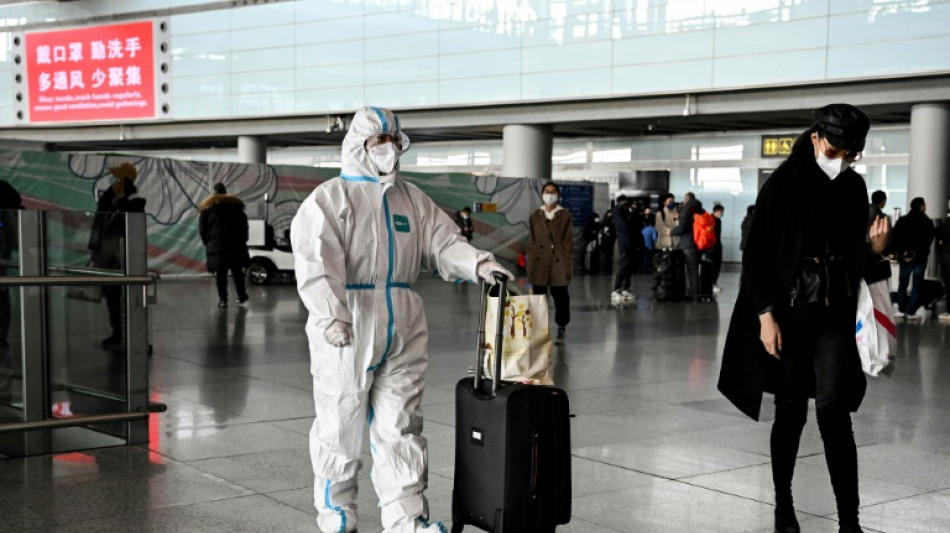
China says shared Covid information 'without holding anything back' / Photo: © AFP/File

 Prague’s Concert for the Future Kicks Off on Wenceslas Square

 Prince William and Princess of Wales to Announce Earthshot Prize Winners in Mumbai

 Indonesia Forest Fires: Health Crisis, Diplomatic Strains and the Search for Solutions

 BYD Dolphin G Leasing Deal: Plug-in Hybrid Supermini Available from £174 a Month

 JUEL Group Expands from Real Estate to Hospitality with Hyatt Centric Malta Opening

 French Economy Shrinks 0.1% as Consumer Confidence Slumps

 Wall Street Ends Turbulent Week Higher Despite Inflation and AI Jitters
Beijing insisted on Tuesday that it had shared information on Covid-19 "without holding anything back", after the World Health Organization implored China to offer more data and access to understand the disease's origins.
Covid-19, which first emerged in the central Chinese city of Wuhan in December 2020, went on to kill millions of people, shred economies and overwhelm health systems.
The WHO published a statement on Monday saying it was a "moral and scientific imperative" for China to share more information.
In response, China defended its transparency, saying it had made the "largest contribution to global origin tracing research".
"Five years ago... China immediately shared epidemic information and viral gene sequence with the WHO and the international community," foreign ministry spokeswoman Mao Ning said.
"Without holding anything back, we shared our prevention, control and treatment experience," she told reporters at a regular press briefing.
But over the course of the pandemic, the WHO repeatedly criticised Chinese authorities for their lack of transparency and cooperation.
A team of specialists led by the WHO and accompanied by Chinese colleagues conducted an investigation into the pandemic's origins in early 2021.
In a joint report, they favoured the hypothesis that the virus had been transmitted by an intermediary animal from a bat to a human, possibly at a market.
A team has not been able to return to China since, and WHO officials have repeatedly asked for additional data.
Mao said Tuesday that "more and more clues" pointed "to Covid-19's origins having a global scope".
China was "willing to continue working with various parties to promote global scientific origin tracing, and to make active efforts to prevent potential infectious diseases in the future", she said.
- Pandemic preparedness -
This month, WHO Director-General Tedros Adhanom Ghebreyesus said "the world would still face some of the same weaknesses and vulnerabilities that gave Covid-19 a foothold five years ago", if a new pandemic emerged today.
"But the world has also learnt many of the painful lessons the pandemic taught us, and has taken significant steps to strengthen its defences against future epidemics and pandemics," he said.
In December 2021, spooked by the devastation caused by Covid, countries decided to start drafting an accord on pandemic prevention, preparedness and response.
The WHO's 194 member states negotiating the treaty have agreed on most of what it should include, but are stuck on the practicalities.
A key fault line lies between Western nations with major pharmaceutical industry sectors and poorer countries wary of being sidelined when the next pandemic strikes.
While the outstanding issues are few, they include the heart of the agreement: the obligation to quickly share emerging pathogens, and then the pandemic-fighting benefits derived from them such as vaccines.
The deadline for the negotiations is May 2025.
L.Dubois--BTB



