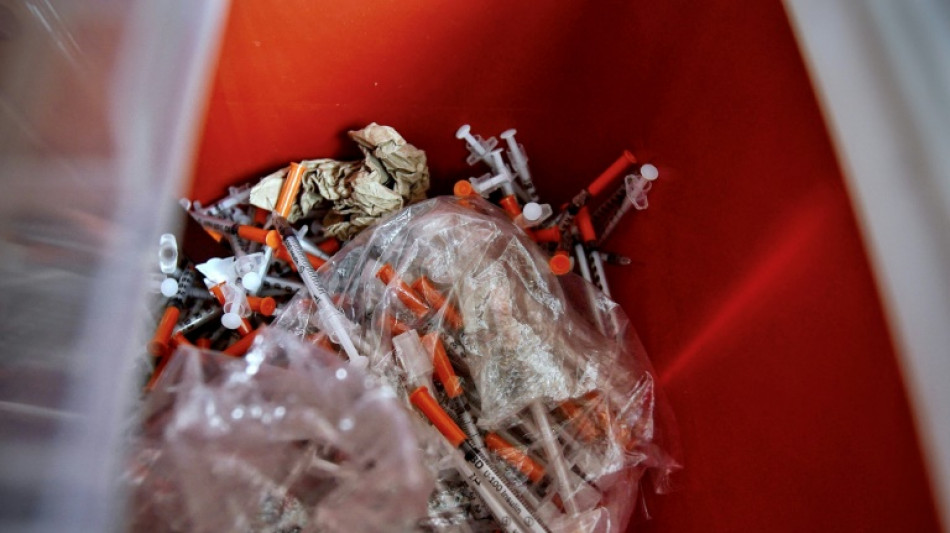
US fight against opioid overdoses becomes one of racial justice: researcher / Photo: © AFP Photo

 Lula, Bolsonaro in final push for votes ahead of knife-edge election

 Boisterous fashion week barnstorms 'sleepy' Nigerian capital

 UAE investigators say flydubai co-pilot was planning 'terrorist act'

 Rahul smacks century in India v Windies ODI

 Daryz seeks to join exclusive club of dual Arc winners

 Russia warns diplomats to leave Kyiv over new strikes threat

 Olympic champ Zheng rebukes rowdy home crowd at China Open

 World No.1 Sinner pulls out of Shanghai Masters to delay return

 Red Bull's Verstappen grabs pole position for Bahrain GP

 India beat Pakistan in blockbuster as golfer Kim wins 'crazy' gold

 India beat arch-rivals Pakistan to win Asian Games cricket gold

 Ethiopia's Tigray rebels abandon regional capital as govt advances: journalist

 Tom Kim powers to Games gold and exemption from military service

 Split loyalties for Indian football fans at Brazil friendly

 India-Pakistan blockbuster brings cricket fever to Japan baseball field

 Wong waiting on Rafa after winning Asian Games tennis gold

 With Russia next door and rising costs, Latvia goes to the polls

 Penalty hero rues empty seats as Games hosts Japan win football gold

 North Korea fires ballistic missile after Seoul's apology demand

 US regulator finds Boeing 737 MAX software bug 'not a safety concern'

 Ohtani 'managing' injuries as Dodgers launch MLB post-season

 Botched US execution leaves murderer unconscious on ventilator: lawyers

 Cornell rape case exposes sexual violence at US colleges

 France held by Italy in Zidane's homecoming after Olise stunner

 Ethiopian pro-government militia claims Tigray airport as regional tensions spike

In 2020, the death rate from drug overdose among Black people surpassed that of white people in the United States for the first time since 1999, according to a study published this year.
Its author, Joseph Friedman, a researcher at UCLA University in California, details for AFP the reasons for this recent shift.
- What were the different waves of opioid overdoses in the United States? -
The first wave was overdoses coming from prescription opioids that were essentially provided to the population through the healthcare system ... And then, as the US started to cut back heavily on prescription opioid access, a lot of people started using heroin.
That was associated with a large increase in overdose deaths because people are moving from a less dangerous to a more dangerous form of opioids ... And then the third wave is the shift to illicit fentanyl.
And here is where the US really kind of became an extreme global outlier in terms of overdose. Because illicit fentanyls are potentially several hundred times more potent than heroin by weight.
And the fourth wave is what we're seeing very recently, which is a huge increase in polysubstances, which means: basically people are using fentanyls but they're also mixing them with many different kinds of other substances. Some of this is intentional and much of this is unintentional.
- Why did you start studying racial inequalities in drug overdoses? -
There's been this narrative, a very powerful kind of cultural narrative in the US, historically, over the past like 10 or 15 years, that addiction and overdose was a quote unquote, white problem.
And this is something that I have written about critiquing.
It's true that during the first wave of the overdose crisis, white overdose death rates were higher than Black overdose deaths rates. In 2010, they were actually double, so approximately twice as high.
But that has really shifted. Basically after the first wave, we've seen overdose deaths rise faster among Black individuals than white individuals.
So basically, the only time where it was true that white communities were disproportionately affected was because of prescription opioids.
The roots of that are complex, but it's pretty clear that that relates to the deep-seated structural racism in the healthcare system, that actually really denies access to controlled substances to people of color.
- What is the situation today? -
Black communities are disproportionately affected by the shift of fentanyls. For the first time since the 1990s, the Black overdose death rate overtook the white overdose death rate in 2020.
The goals of overdose prevention now really align with the goals of racial justice movements.
There's really good evidence that fentanyl has made incarceration a very potent risk factor for overdose death. Immediately after people are released from prison, there's a huge spike in the risk of overdose death.
Combined with mass incarceration of Black communities, which we know is a big problem in the US, this is one of the key driving factors.
With the drug supply becoming so dangerous, it requires a lot of resources to stay safe. Access to health care, access to substance use treatments, access to harm reduction, housing, employment... all of these things give stability.
And so inequalities in these root conditions are, I think driving inequalities in overdose now.
People of every racial group use drugs. That's just a fact of life. Who dies from them is dictated by access to resources and cultural patterns, and there are deep-seated inequalities in terms of the resources that people need to stay safe.
- What do you think the answer should be? -
Basically the war on drugs, this police centric approach, has been an utter failure.
Our overdose death rates are something like three times higher than the second worst country, and they're over 20 times the average.
We have the worst drug overdose death rate in recorded history. There's never been anything even close to what we're experiencing right now.
We would need really, really profound restructuring of the way society spends money on drugs to actually make a difference here.
Harm reduction is an important solution, but it is not getting at the root issues here.
Which is access to treatments, and making the drug supply safer.
In Europe, in many places there's just heroin prescription programs. That's the kind of stability that helps people overcome substance use disorder.
J.Horn--BTB



