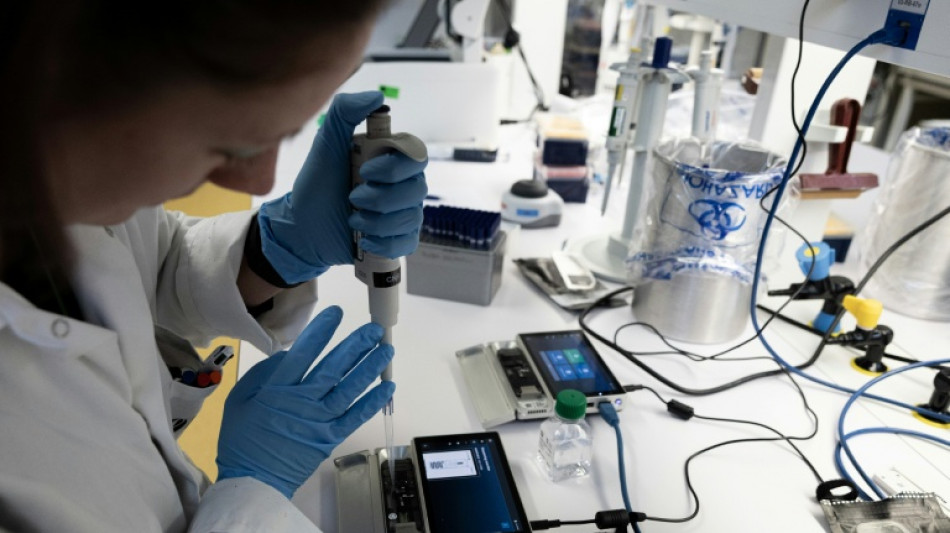
UK officials publish 'priority pathogen' watch list / Photo: © AFP

 Prague’s Concert for the Future Kicks Off on Wenceslas Square

 Prince William and Princess of Wales to Announce Earthshot Prize Winners in Mumbai

 Indonesia Forest Fires: Health Crisis, Diplomatic Strains and the Search for Solutions

 BYD Dolphin G Leasing Deal: Plug-in Hybrid Supermini Available from £174 a Month

 JUEL Group Expands from Real Estate to Hospitality with Hyatt Centric Malta Opening

 French Economy Shrinks 0.1% as Consumer Confidence Slumps

 Wall Street Ends Turbulent Week Higher Despite Inflation and AI Jitters
UK officials published a watch list of 24 "priority pathogen" families on Tuesday, hoping to boost readiness in case another public health crisis strikes.
The UK Health Security Agency's guide is designed to help researchers focus their efforts on certain viruses and bacteria that pose a threat to public health, as well as speed up the development of vaccines.
Pathogen families on the list include coronaviridae, which includes Covid-19, paramyxoviridae, which includes Nipah virus, and orthomyxoviridae, which includes bird flu. Ebola, norovirus and mpox are also listed.
The agency's chief scientific officer Isabel Oliver said it was "a vital guide for industry and academia, highlighting where scientific research can be targeted to boost UK preparedness against health threats."
"We hope this will help to speed up vaccine and diagnostics development where it is most needed, to ensure we are fully prepared in our fight against potentially deadly pathogens."
Five years since the start of the global Covid-19 pandemic, emotions still run raw across the UK with lingering accusations that the then government responded too slowly to the crisis.
According to the WHO, more than 232,000 people have died with Covid in the United Kingdom.
J.Fankhauser--BTB



