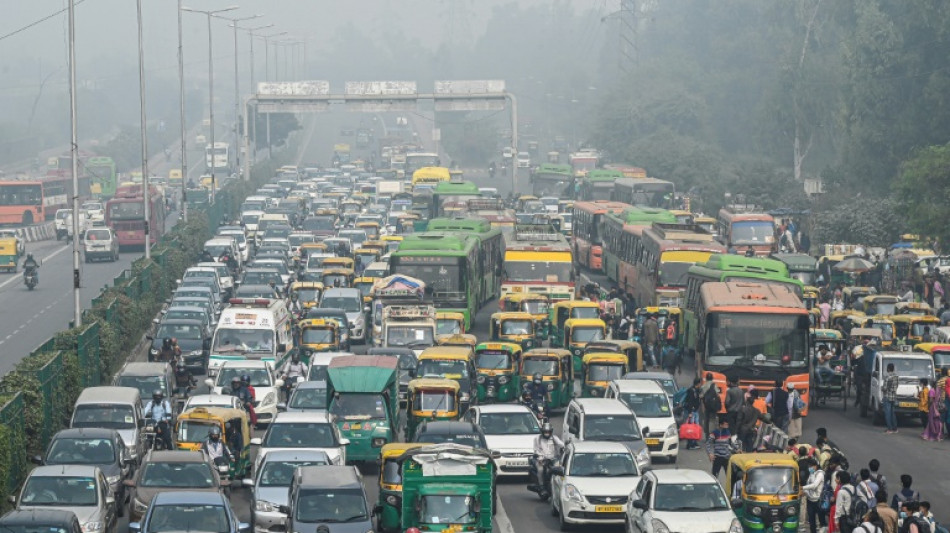
Polluted air cuts global life expectancy by two years / Photo: © AFP/File

 #IAmJaneDoe: online support campaign in US university rape case

 Brazil shine on Selecao's first visit to India

 Zverev sets up Djokovic quarter-final at China Open, Rybakina out
 Happier at home, Bordeaux hammer Lyon in Top 14

 Lula, Bolsonaro in final push for votes ahead of knife-edge election

 Boisterous fashion week barnstorms 'sleepy' Nigerian capital

 UAE investigators say flydubai co-pilot was planning 'terrorist act'

 Rahul smacks century in India v Windies ODI

 Daryz seeks to join exclusive club of dual Arc winners
 Russia warns diplomats to leave Kyiv over new strikes threat
 Olympic champ Zheng rebukes rowdy home crowd at China Open

 World No.1 Sinner pulls out of Shanghai Masters to delay return
 Red Bull's Verstappen grabs pole position for Bahrain GP

 India beat Pakistan in blockbuster as golfer Kim wins 'crazy' gold

 India beat arch-rivals Pakistan to win Asian Games cricket gold

 Ethiopia's Tigray rebels abandon regional capital as govt advances: journalist

 Tom Kim powers to Games gold and exemption from military service

 Split loyalties for Indian football fans at Brazil friendly

 India-Pakistan blockbuster brings cricket fever to Japan baseball field

 Wong waiting on Rafa after winning Asian Games tennis gold

 With Russia next door and rising costs, Latvia goes to the polls

 Penalty hero rues empty seats as Games hosts Japan win football gold

 North Korea fires ballistic missile after Seoul's apology demand

 US regulator finds Boeing 737 MAX software bug 'not a safety concern'

 Ohtani 'managing' injuries as Dodgers launch MLB post-season

Microscopic air pollution caused mostly by burning fossil fuels shortens lives worldwide by more than two years, researchers reported Tuesday.
Across South Asia, the average person would live five years longer if levels of fine particulate matter met World Health Organization standards, according to a report from the University of Chicago's Energy Policy Institute.
In the Indian states of Uttar Pradesh and Bihar, home to 300 million, crippling lung and heart disease caused by so-called PM2.5 pollution reduces life expectancy by eight years, and in the capital city of New Delhi by a decade.
PM2.5 pollution -- 2.5 microns across or less, roughly the diameter of a human hair -- penetrates deep into the lungs and enters the bloodstream.
In 2013, the United Nations classified it as a cancer-causing agent.
The WHO says PM2.5 density in the air should not top 15 microgrammes per cubic metre in any 24-hour period, or 5 mcg/m3 averaged across an entire year.
Faced with mounting evidence of damaging health impacts, the WHO tightened these standards last year, the first change since establishing air quality guidance in 2005.
"Clean air pays back in additional years of life for people across the world," lead research Crista Hasenkopf and colleagues said in the Air Quality Life Index report.
"Permanently reducing global air pollution to meet the WHO's guidelines would add 2.2 years onto average life expectancy."
- Major gains in China -
Almost all populated regions in the world exceed WHO guidelines, but nowhere more so that in Asia: by 15-fold in Bangladesh, 10-fold in India, and nine-fold in Nepal and Pakistan.
Central and West Africa, along with much of Southeast Asia and parts of central America, also face pollution levels -- and shortened lives -- well above the global average.
Surprisingly, PM2.5 pollution in 2020, the most recent data available, was virtually unchanged from the year before despite a sharp slow-down in the global economy and a corresponding drop in CO2 emissions due to Covid lockdowns.
"In South Asia, pollution actually rose during the first year of the pandemic," the authors noted.
One country that has seen major improvements is China.
PM2.5 pollution fell in the nation of 1.4 billion people by almost 40 percent between 2013 and 2020, adding two years to life expectancy.
But even with this progress, lives in China are on average cut short today by 2.6 years.
The worst-hit provinces include Henan and Hebei, in north-central China, and the coastal province of Shandong.
Compared to other causes of premature death, the impact of PM2.5 pollution is comparable to smoking tobacco, more than three times that of alcohol use, and six times that of HIV/AIDS, the report said.
F.Müller--BTB



