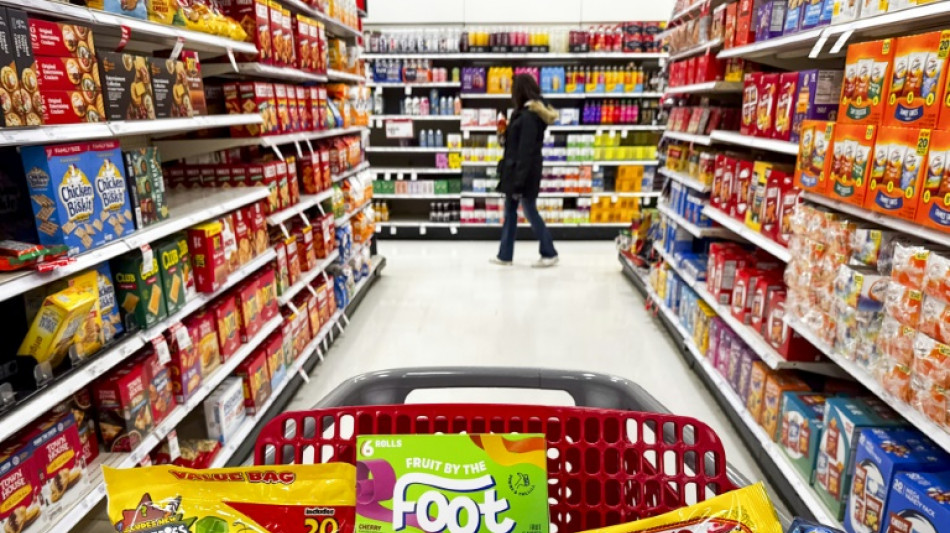
Trump's administration moves to ban artificial food dyes / Photo: © AFP/File

 Lula, Bolsonaro in final push for votes ahead of knife-edge election

 Boisterous fashion week barnstorms 'sleepy' Nigerian capital

 UAE investigators say flydubai co-pilot was planning 'terrorist act'

 Rahul smacks century in India v Windies ODI

 Daryz seeks to join exclusive club of dual Arc winners

 Russia warns diplomats to leave Kyiv over new strikes threat
 Olympic champ Zheng rebukes rowdy home crowd at China Open

 World No.1 Sinner pulls out of Shanghai Masters to delay return

 Red Bull's Verstappen grabs pole position for Bahrain GP

 India beat Pakistan in blockbuster as golfer Kim wins 'crazy' gold

 India beat arch-rivals Pakistan to win Asian Games cricket gold
 Ethiopia's Tigray rebels abandon regional capital as govt advances: journalist

 Tom Kim powers to Games gold and exemption from military service

 Split loyalties for Indian football fans at Brazil friendly

 India-Pakistan blockbuster brings cricket fever to Japan baseball field

 Wong waiting on Rafa after winning Asian Games tennis gold

 With Russia next door and rising costs, Latvia goes to the polls

 Penalty hero rues empty seats as Games hosts Japan win football gold

 North Korea fires ballistic missile after Seoul's apology demand

 US regulator finds Boeing 737 MAX software bug 'not a safety concern'

 Ohtani 'managing' injuries as Dodgers launch MLB post-season

 Botched US execution leaves murderer unconscious on ventilator: lawyers
 Cornell rape case exposes sexual violence at US colleges

 France held by Italy in Zidane's homecoming after Olise stunner

 Ethiopian pro-government militia claims Tigray airport as regional tensions spike
President Donald Trump's administration on Tuesday announced plans to ban synthetic dyes from the US food supply -— a move welcomed by health experts and marking a rare point of bipartisan agreement in an otherwise sharply divided political climate.
Health Secretary Robert F Kennedy Jr. has vowed to overhaul America's food system under the banner of his "Make America Healthy Again" agenda, and the push would phase out the eight approved artificial food dyes by the end of 2026.
It builds upon a prohibition on Red Dye 3 by the government of former president Joe Biden but accelerates the timeline and also asks the National Institutes of Health to carry out comprehensive research on how additives impact children's development.
"For the last 50 years, American children have increasingly been living in a toxic soup of synthetic chemicals," Food and Drug Administration commissioner Marty Makary said at a press conference surrounded by young families and MAHA supporters.
He cited studies linking synthetic dyes to conditions including attention deficit hyperactivity disorder (ADHD), diabetes, cancer, genomic disruption, gastrointestinal issues and more.
Of the eight synthetic dyes derived from petroleum, Yellow 5, Yellow 6 and Red 40 constitute the lion's share of those in use, Peter Lurie, president and executive director of the nonprofit Center for Science in the Public Interest, told AFP.
They are found in a range of products from beverages and candies to cereals, sauces and dairy products.
"None of them convey anything of any nutritional significance, and what they're really there for is to mislead -- to make food appear somehow redder, somehow bluer, somehow fruitier or more attractive than it is," he said. "And the purpose of all that is to drive up sales, it's not anything that benefits the American public."
- Bipartisan momentum -
Momentum has been building at the state level. In March, Republican-leaning West Virginia enacted a broad ban on synthetic dyes, following California's 2024 decision to restrict them in public schools.
While Red Dye No. 3 was previously targeted for phaseout in foods and drugs by 2027 and 2028 respectively due to cancer concerns, the remaining dyes have been linked to behavioral issues such as attention deficit disorder in children.
In Europe, these dyes aren't banned outright — but the requirement to carry warning labels has led many companies to switch to natural alternatives.
Kennedy's stance on synthetic dyes aligns him, unusually, with mainstream scientific consensus — a departure from his controversial history of promoting vaccine misinformation, downplaying the nation's worst measles outbreak in years, and suggesting bird flu should be allowed to spread naturally among poultry.
Industry opposition may still emerge. Food manufacturers have historically lobbied against tighter regulations, but Lurie believes resistance may be more muted this time.
"The question that industries are wrestling with now is whether or not to oppose this, and you know, the signs that I see are that they may just suck it up in the end," said Lurie.
He cited "tepid" statements made when Red 3 was banned and the limited response when Kennedy first warned he would be targeting dyes.
O.Krause--BTB