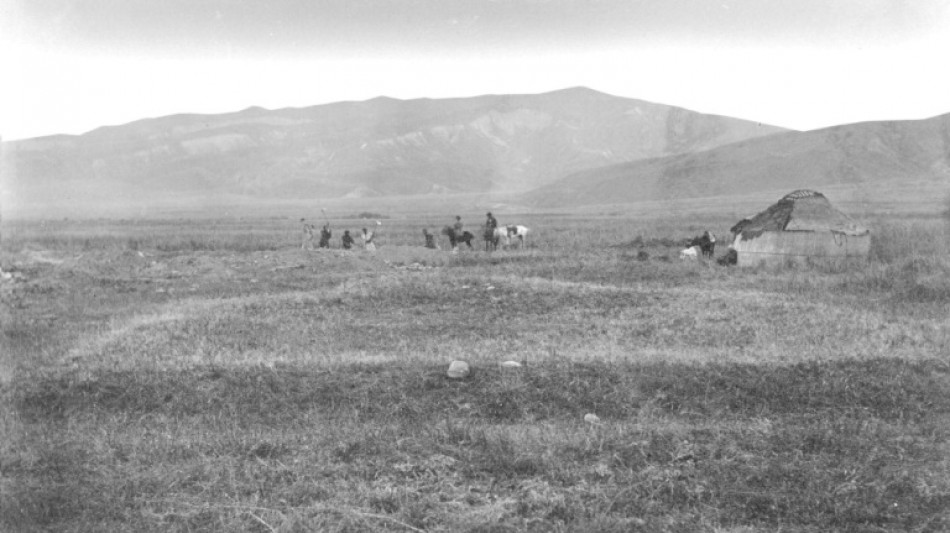
Black Death origin mystery solved... 675 years later / Photo: © HANDOUT/AFP/File

 #IAmJaneDoe: online support campaign in US university rape case

 Brazil shine on Selecao's first visit to India

 Zverev sets up Djokovic quarter-final at China Open, Rybakina out
 Happier at home, Bordeaux hammer Lyon in Top 14

 Lula, Bolsonaro in final push for votes ahead of knife-edge election

 Boisterous fashion week barnstorms 'sleepy' Nigerian capital

 UAE investigators say flydubai co-pilot was planning 'terrorist act'

 Rahul smacks century in India v Windies ODI

 Daryz seeks to join exclusive club of dual Arc winners

 Russia warns diplomats to leave Kyiv over new strikes threat

 Olympic champ Zheng rebukes rowdy home crowd at China Open

 World No.1 Sinner pulls out of Shanghai Masters to delay return
 Red Bull's Verstappen grabs pole position for Bahrain GP

 India beat Pakistan in blockbuster as golfer Kim wins 'crazy' gold

 India beat arch-rivals Pakistan to win Asian Games cricket gold

 Ethiopia's Tigray rebels abandon regional capital as govt advances: journalist

 Tom Kim powers to Games gold and exemption from military service

 Split loyalties for Indian football fans at Brazil friendly

 India-Pakistan blockbuster brings cricket fever to Japan baseball field

 Wong waiting on Rafa after winning Asian Games tennis gold

 With Russia next door and rising costs, Latvia goes to the polls

 Penalty hero rues empty seats as Games hosts Japan win football gold

 North Korea fires ballistic missile after Seoul's apology demand

 US regulator finds Boeing 737 MAX software bug 'not a safety concern'

 Ohtani 'managing' injuries as Dodgers launch MLB post-season

A deadly pandemic with mysterious origins: it might sound like a modern headline, but scientists have spent centuries debating the source of the Black Death that devastated the medieval world.
Not anymore, according to researchers who say they have pinpointed the source of the plague to a region of Kyrgyzstan, after analysing DNA from remains at an ancient burial site.
"We managed to actually put to rest all those centuries-old controversies about the origins of the Black Death," said Philip Slavin, a historian and part of the team whose work was published Wednesday in the journal Nature.
The Black Death was the initial wave of a nearly 500-year pandemic. In just eight years, from 1346 to 1353, it killed up to 60 percent of the population of Europe, the Middle East and Africa, according to estimates.
Slavin, an associate professor at the University of Stirling in Scotland who has "always been fascinated with the Black Death", found an intriguing clue in an 1890 work describing an ancient burial site in what is now northern Kyrgyzstan.
It reported a spike in burials in 1338-39 and that several tombstones described people having "died of pestilence".
"When you have one or two years with excess mortality it means that something funny was going on there," Slavin told reporters.
"But it wasn't just any year -- 1338 and 1339 was just seven or eight years before the Black Death."
It was a lead, but nothing more without determining what killed the people at the site.
For that, Slavin teamed up with specialists who examine ancient DNA.
They extracted DNA from the teeth of seven people buried at the site, explained Maria Spyrou, a researcher at the University of Tuebingen and author of the study.
Because teeth contain many blood vessels, they give researchers "high chances of detecting blood-borne pathogens that may have caused the deaths of the individuals," Spyrou told AFP.
- 'Big Bang' event -
Once extracted and sequenced, the DNA was compared against a database of thousands of microbial genomes.
"One of the hits that we were able to get... was a hit for Yersinia pestis," more commonly known as plague, said Spyrou.
The DNA also displayed "characteristic damage patterns," she added, showing that "what we were dealing with was an infection that the ancient individual carried at the time of their death."
The start of the Black Death has been linked to a so-called "Big Bang" event, when existing strains of the plague, which is carried by fleas on rodents, suddenly diversified.
Scientists thought it might have happened as early as the 10th century but had not been able to pinpoint a date.
The research team painstakingly reconstructed the Y. pestis genome from their samples and found the strain at the burial site pre-dated the diversification.
And rodents living in the region now were also found to be carrying the same ancient strain, helping the team conclude the "Big Bang" must have happened somewhere in the area in a short window before the Black Death.
The research has some unavoidable limitations, including a small sample size, according to Michael Knapp, an associate professor at New Zealand's University of Otago who was not involved in the study.
"Data from far more individuals, times and regions... would really help clarify what the data presented here really means," said Knapp.
But he acknowledged it could be difficult to find additional samples, and praised the research as nonetheless "really valuable".
Sally Wasef, a paleogeneticist at Queensland University of Technology, said the work offered hope for untangling other ancient scientific mysteries.
"The study has shown how robust microbial ancient DNA recovery could help reveal evidence to solve long-lasting debates," she told AFP.
W.Lapointe--BTB