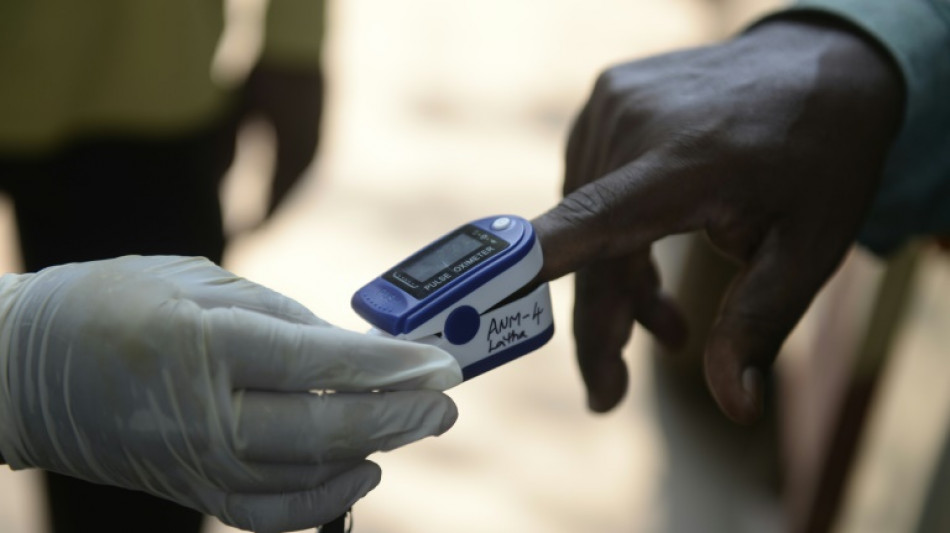
Dark-skinned patients get less ICU oxygen due to flawed device: study / Photo: © AFP/File

 Prague’s Concert for the Future Kicks Off on Wenceslas Square

 Prince William and Princess of Wales to Announce Earthshot Prize Winners in Mumbai

 Indonesia Forest Fires: Health Crisis, Diplomatic Strains and the Search for Solutions

 BYD Dolphin G Leasing Deal: Plug-in Hybrid Supermini Available from £174 a Month

 JUEL Group Expands from Real Estate to Hospitality with Hyatt Centric Malta Opening

 French Economy Shrinks 0.1% as Consumer Confidence Slumps

 Wall Street Ends Turbulent Week Higher Despite Inflation and AI Jitters
Racial minorities receive less oxygen in the intensive care unit than white patients because of a flaw in a medical device found in hospitals across the world, a US study said Monday.
The pulse oximeter, first developed in the 1970s, clips to a patient's finger and uses red and infrared light absorption to assess hemoglobin. But it is known to generate falsely elevated readings in people with darker skin.
In new research published in JAMA Internal Medicine, Eric Raphael Gottlieb and colleagues looked back at records of 3,069 patients at the Beth Israel Deaconess Medical Center in Boston who spent at least 12 hours in the hospital's ICU.
They compared oxygen saturation estimates on the pulse ox devices to more accurate direct readings taken of hemoglobin oxygen saturation.
After controlling for other variables, they found that Black, Asian and Hispanic patients were given 0.2 to 0.4 liters per minute less oxygen than their white counterparts.
"Our findings present a unique and compelling opportunity to improve equity through device reengineering and by reevaluating how data are interpreted," the team wrote.
Another recent study on the same topic showed that measurement biases in oxygen saturation levels was associated with a time delay in eligibility for Covid-19 treatment for Black and Hispanic patients.
An accompanying editor's note said devices exist that perform more equitably, but have never been widely distributed.
"Health care systems, including academic centers, are large-scale purchasers of pulse oximeters," the editorial said. "If they make a commitment to buy only devices that function across skin tones, manufacturers would respond."
C.Meier--BTB



