'Severe' pain: a New Yorker's experience of monkeypox / Photo: © AFP

 AI needs safety layers like nuclear plants: ex-OpenAI engineer

 MVP Judge will miss Yankees' MLB playoff series against Rays

 New lizard species discovered in Peru

 Fernandes hails Portugal's 'greatest symbol' Ronaldo, calls for unity

 Grandidier-Nkanang double takes Pau to Top 14 summit despite Vannes fightback

 Trainer Scott gets perfect Arc boost with top notch double

 Ex-PM says Putin cannot admit 'mistake' over Ukraine

 Houthis say Saudi Arabia launches dozens of strikes on Yemen capital

 Qatar and Abu Dhabi F1 Grand Prix to go ahead - F1 boss

 South Korea lift gloom with smash-and-grab Games football gold
 Ireland news conference before Israel game cut short amid tensions
 Protests over housing flare in Spain after relief measures rejected

 Zverev thrashes Shang to set up Djokovic quarter-final at China Open

 Turkey football ref chief jailed pending trial for graft

 North Korea says test of intermediate-range strategic missile included use of AI

 Rampant Sayers leads Hong Kong to third men's rugby gold in a row

 Ethiopia's Tigray rebels abandon regional capital as govt advances

 Bulgaria's Tsar Samuel returns 'home' after 1,000 years

 'Glad it's over': Kim powers to Games gold and military exemption

 After 11 World Cups, football finally comes home for one Indian fan
 Marc Marquez wins sprint at Japan MotoGP, Martin grabs pole
 Alcaraz fends off Arnaldi to reach Japan Open quarters
 Antonelli tops times in final practice at Bahrain GP

 Gauff digs deep to beat Osorio in China Open second round

 Fresh protests to hit Spain after housing measures defeated

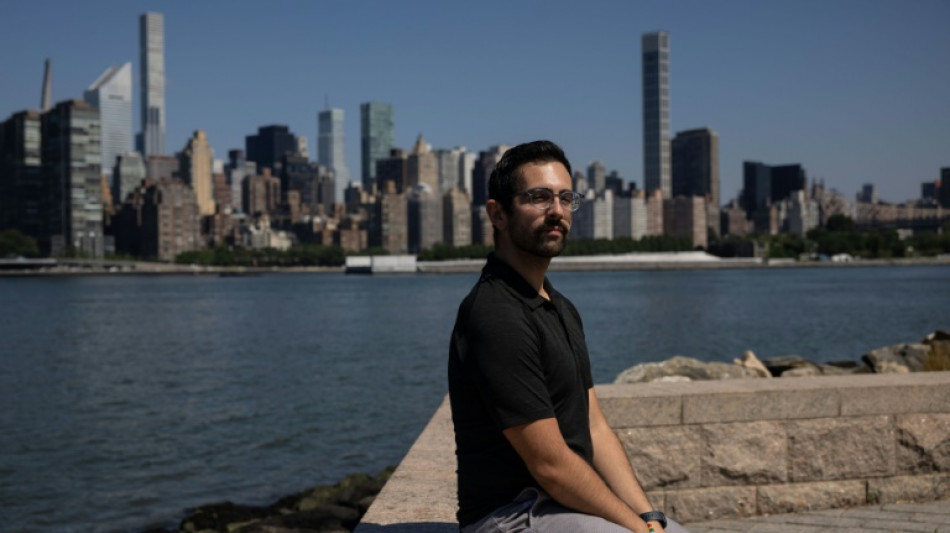
"It was the worst pain that I have experienced in my life," says 26-year-old New Yorker Kyle Planck, recalling his recent monkeypox infection.
Although anyone can catch monkeypox, Planck first took note of the virus in spring when authorities said many of the first cases in Europe and America were in men who have sex with men.
"I was a little bit worried that it would eventually affect us here in the United States, especially being a member of the LGBTQ+ community," he remembers.
At the end of June, the PhD candidate in pharmacology says he started to feel very sick.
A fever, swollen lymph nodes and a negative Covid-19 test made him think it could be monkeypox.
A doctor told him to wait and see how his symptoms evolved, but after four days of being feverish he developed spots that left him in no doubt.
"They had started on my arms and my hands and over the course of a day they spread all over my body.
"I had about 30 lesions develop at that point," he says at his apartment in the borough of Queens.
Planck was able to get tested on July 5 and the following day started treatment with TPOXX, or Tecovirimat, an antiviral drug originally used against human smallpox but authorized in a trial against monkeypox.
Planck concedes that his proximity to the medical community made it easier for him to enroll in a study.
"I know that is not the reality for most people in New York, which is really unfortunate," he says.
Monkeypox usually clears up on its own but can be extremely painful.
Planck was in intense pain for a week, especially from the lesions on his mucus membranes, before the drugs started to relieve his symptoms.
"The pain was so severe for me that I basically was taking warm baths six or seven times a day, just because that was the only thing that would make me feel better," he says.
Planck found the experience "exhausting" and adding to his stress was a fear of contaminating his roommate, even though transmission occurs by close contact.
He believes his case was "relatively mild" because he was able to receive treatment and that "so many people are going through worse."
Planck feels that US health authorities were too slow to react to the first outbreak of cases and says that preventative messaging has been too weak.
- Vaccine doses -
"I think the government was kind of like, 'let's wait and see what happens, let's wait and see if this becomes a problem,' and that really doesn't take into account how infectious diseases work," he says.
Planck has written multiple letters to elected officials asking them to increase access to the antiviral drug.
"We have millions of doses of the TPOXX treatment available. And months into this outbreak, we're still not really able to mobilize those resources," he says.
The United States initially had 100 million doses of the ACAM2000 vaccine. It is designed to treat human smallpox but can cause significant side effects and is not recommended for immunocompromised people.
Only a thousand doses of the newer and safer Jynneos vaccine were available as cases first started multiplying, largely because nearly 800,000 doses were blocked in Denmark pending approval by the Food and Drug Administration.
Availability is increasing, however.
New York City -- which has 711 confirmed cases, the highest concentrated number in the country -- has received 21,500 doses and is awaiting a supply of 25,000 more.
Appointments have gone in minutes and long queues have formed outside clinics in recent days.
"I don't want anyone to have to go through what I went through," concludes Planck.
G.Schulte--BTB



