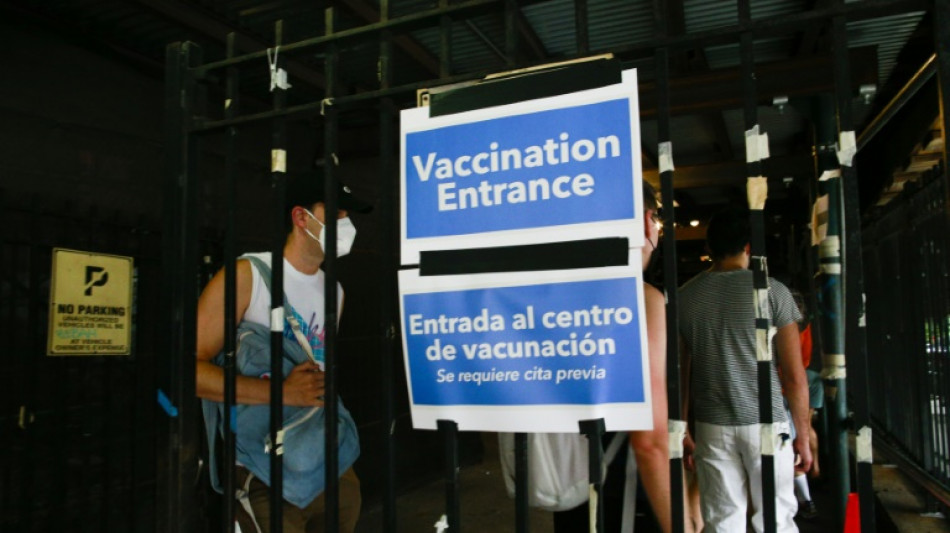
US declares monkeypox a public health emergency / Photo: © AFP/File

 Prague’s Concert for the Future Kicks Off on Wenceslas Square

 Prince William and Princess of Wales to Announce Earthshot Prize Winners in Mumbai

 Indonesia Forest Fires: Health Crisis, Diplomatic Strains and the Search for Solutions

 BYD Dolphin G Leasing Deal: Plug-in Hybrid Supermini Available from £174 a Month

 JUEL Group Expands from Real Estate to Hospitality with Hyatt Centric Malta Opening

 French Economy Shrinks 0.1% as Consumer Confidence Slumps

 Wall Street Ends Turbulent Week Higher Despite Inflation and AI Jitters
The United States on Thursday declared monkeypox a public health emergency, a move that should free up new funds, assist in data gathering and allow the deployment of additional personnel in the fight against the disease.
"We're prepared to take our response to the next level in addressing this virus, and we urge every American to take monkeypox seriously and to take responsibility to help us tackle this virus," Health and Human Services secretary Xavier Becerra said in a call.
The declaration, which is initially effective for 90 days but can be renewed, came as nationwide cases topped 6,600 on Thursday, around a quarter of them from New York state.
Experts believe the real number could be much higher in the current outbreak since the symptoms can be subtle, including single lesions.
The US has so far delivered some 600,000 JYNNEOS vaccines -- originally developed against monkeypox's related virus, smallpox -- but this number figure is still far short of the approximately 1.6 million people considered at highest risk and who need the vaccine most.
Some 99 percent of US cases have so far been among men who have sex with men, the Health and Human Services department said last week, and this is the population authorities are targeting in the national vaccination strategy.
In contrast to previous outbreaks in Africa, the virus is now predominantly spread through sexual activity -- but the Centers for Disease Control and Prevention says other routes are also possible, including sharing bedding, clothing, and prolonged face-to-face contact.
The US declaration comes after the World Health Organization also designated the outbreak an emergency last month -- something it reserves for diseases of highest concern.
Also Thursday, US Food and Drug Administration commissioner Robert Califf said his agency was mulling a move that would allow clinicians to administer five doses of vaccine based on one dose of existing vials.
The vaccine is currently administered subcutaneously, but the new approach would involve administering it intradermally, at a more shallow angle.
This "means basically sticking the needle within the skin and creating a little pocket there into which the vaccine goes, so this is really nothing highly unusual," said Califf.
M.Furrer--BTB



