'Synthetic embryo' breakthrough but growing human organs far off / Photo: © AFP

 AI needs safety layers like nuclear plants: ex-OpenAI engineer

 MVP Judge will miss Yankees' MLB playoff series against Rays

 New lizard species discovered in Peru

 Fernandes hails Portugal's 'greatest symbol' Ronaldo, calls for unity

 Grandidier-Nkanang double takes Pau to Top 14 summit despite Vannes fightback

 Trainer Scott gets perfect Arc boost with top notch double

 Ex-PM says Putin cannot admit 'mistake' over Ukraine

 Houthis say Saudi Arabia launches dozens of strikes on Yemen capital

 Qatar and Abu Dhabi F1 Grand Prix to go ahead - F1 boss

 South Korea lift gloom with smash-and-grab Games football gold

 Ireland news conference before Israel game cut short amid tensions

 Protests over housing flare in Spain after relief measures rejected

 Zverev thrashes Shang to set up Djokovic quarter-final at China Open

 Turkey football ref chief jailed pending trial for graft

 North Korea says test of intermediate-range strategic missile included use of AI

 Rampant Sayers leads Hong Kong to third men's rugby gold in a row

 Ethiopia's Tigray rebels abandon regional capital as govt advances

 Bulgaria's Tsar Samuel returns 'home' after 1,000 years

 'Glad it's over': Kim powers to Games gold and military exemption

 After 11 World Cups, football finally comes home for one Indian fan

 Marc Marquez wins sprint at Japan MotoGP, Martin grabs pole

 Alcaraz fends off Arnaldi to reach Japan Open quarters

 Antonelli tops times in final practice at Bahrain GP

 Gauff digs deep to beat Osorio in China Open second round

 Fresh protests to hit Spain after housing measures defeated

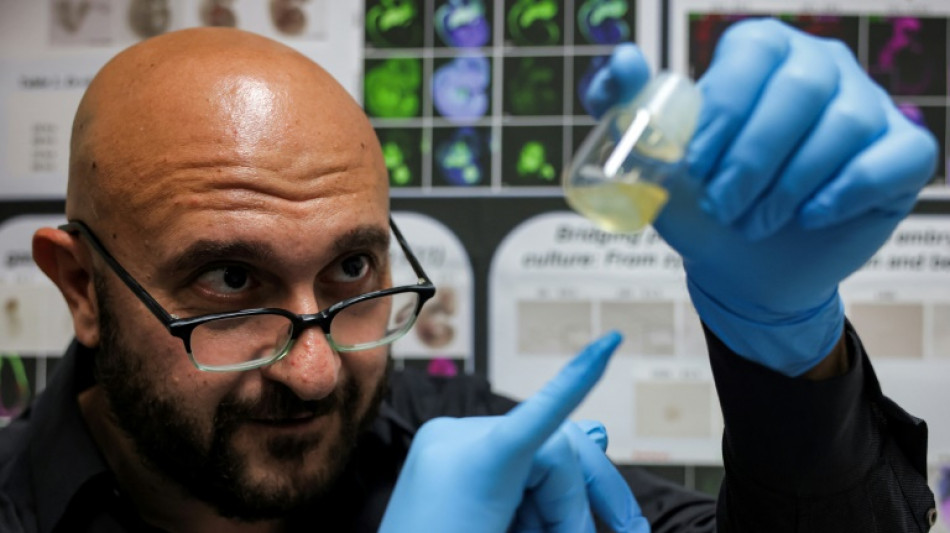
Stem cell scientists say they have created "synthetic embryos" without using sperm, eggs or fertilisation for the first time, but the prospect of using such a technique to grow human organs for transplantation remains distant.
The breakthrough was hailed as a major step forward, though some experts said the result could not fully be considered to be embryos and warned of future ethical considerations.
In research published in the journal Cell this week, scientists at the Weizmann Institute of Science in Israel described mouse stem cells self-assembling into embryo-like structures in the lab.
The research built upon 2018 research that had a bundle of mouse stem cells self-organised into something resembling the beginnings of an embryo -- but with far fewer cells.
The Weizmann team led by Palestinian stem cell scientist Jacob Hanna went much further.
They started by collecting cells from the skin of mice, then made them artificially return to the state of stem cells.
The stem cells were then placed in a special incubator, which continuously moved to mimic a mother's womb.
The vast majority of the cells failed to form anything.
But 50 -- 0.5 percent of the 10,000 total -- collected themselves into spheres, then embryo-like structures, the researchers said.
After eight days -- around a third of the 20-day mouse gestation period -- there were early signs of a brain and a beating heart, they added.
They were described as 95 percent similar to normal mouse embryos.
"The embryo is the best organ-making machine and the best 3D bioprinter -- we tried to emulate what it does," Hanna said in a Weizmann statement.
- 'Not embryos' -
While they were the most advanced synthetic embryo-like structures ever grown, some scientists not involved in the research warned against calling them "embryos".
"These are not embryos," French stem cell scientist Laurent David told AFP.
"Until proven otherwise, they do not result in a viable individual capable of reproducing," he added.
He preferred to call them embryoids, the name for a group of cells that resemble an embryo, emphasising that they showed only the very beginnings of organs.
However, David welcomed the "very convincing" research, which he said could allow further experiments to understand exactly how organs form.
Hanna said the team's "next challenge is to understand how stem cells know what to do -- how they self-assemble into organs and find their way to their assigned spots inside an embryo".
- Ethical implications -
If human organs could one day be grown in a lab, it could provide life-saving transplants to thousands of people every year without the need for donors.
There has been progress in this new field -- several years ago researchers managed to develop an artificial intestine in the lab that could be implanted into a mouse.
For humans, however, such organ implants remain science fiction.
Still, Hanna has founded a company, Renewal Bio, that aims to find a way to use the technology for therapeutic purposes.
Researchers not involved in the study said it was very early to consider using such a technique for humans.
Alfonso Martinez Arias of Spain's Pompeu Fabra University said the breakthrough "opens the door to similar studies with human cells, though there are many regulatory hoops to get through first and, from the point of view of the experiments, human systems lag behind mouse systems".
And aiming to get similar results from human cells will likely open an ethical can of worms.
"Although the prospect of synthetic human embryos is still distant, it will be crucial to engage in wider discussions about the legal and ethical implications of such research," James Briscoe of Britain's Francis Crick Institute said.
P.Anderson--BTB