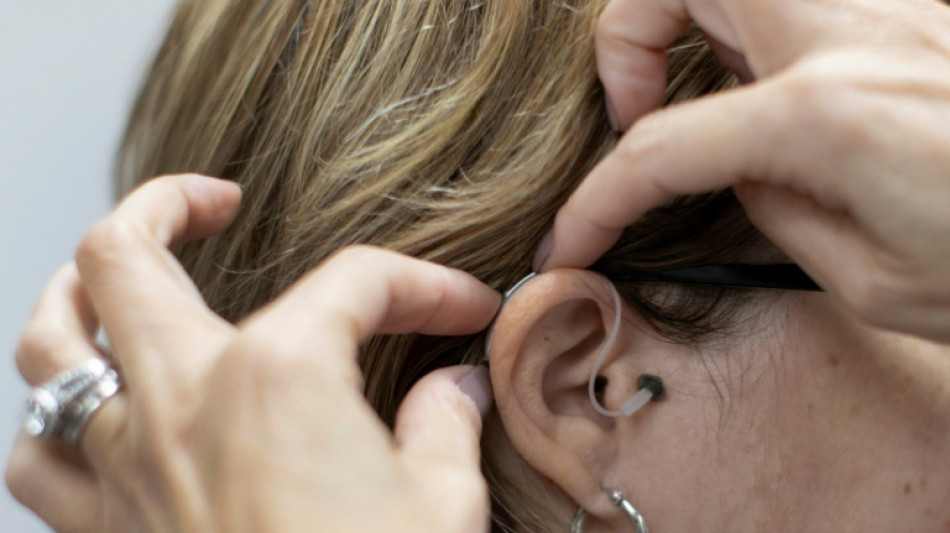
US makes hearing aids over-the-counter to curb costs / Photo: © GETTY IMAGES NORTH AMERICA/AFP

 Prague’s Concert for the Future Kicks Off on Wenceslas Square

 Prince William and Princess of Wales to Announce Earthshot Prize Winners in Mumbai

 Indonesia Forest Fires: Health Crisis, Diplomatic Strains and the Search for Solutions

 BYD Dolphin G Leasing Deal: Plug-in Hybrid Supermini Available from £174 a Month

 JUEL Group Expands from Real Estate to Hospitality with Hyatt Centric Malta Opening

 French Economy Shrinks 0.1% as Consumer Confidence Slumps

 Wall Street Ends Turbulent Week Higher Despite Inflation and AI Jitters
Over-the-counter hearing aids will for the first time be available to tens of millions of Americans, officials said Tuesday, in an effort to cut prices from $5,000 a pair.
"For many Americans who suffer from hearing loss, safe and effective and high quality hearing aids have been unaffordable," health secretary Xavier Becerra told reporters in a briefing.
The action, which should take effect in October, would reduce the cost of a pair of hearing aids by an estimated $2,800 per pair, by removing the requirement to see a doctor or audiologist, added Brian Deese, White House Director of the National Economic Council.
At present, a pair of hearing aids costs in the region of $5,000 per pair in the United States -- far more than other advanced countries such as Britain, where the devices are free.
Children, as well as people with severe hearing loss, would still require a prescription.
President Joe Biden, who had called for the move in an executive order issued last year, said in a statement the rule "makes good on my commitment to lower costs for American families... giving people more choices to improve their health and wellbeing."
One in eight people in the United States -- around 30 million people -- aged 12 years or older has hearing loss in both ears, based on standard hearing examinations, according to the Food and Drug Administration.
The new rule applies to hearing aids that work through air conduction, bringing amplified sound into the ear canal where it moves through the eardrum and the middle ear to reach the inner ear, where the processed signal is sent to the brain.
People with more severe hearing loss may require bone conduction hearing aids that bypass the outer and middle ear.
T.Bondarenko--BTB



