
WHO urges caution after dog catches monkeypox / Photo: © AFP

 AI needs safety layers like nuclear plants: ex-OpenAI engineer

 MVP Judge will miss Yankees' MLB playoff series against Rays

 New lizard species discovered in Peru

 Fernandes hails Portugal's 'greatest symbol' Ronaldo, calls for unity

 Grandidier-Nkanang double takes Pau to Top 14 summit despite Vannes fightback

 Trainer Scott gets perfect Arc boost with top notch double

 Ex-PM says Putin cannot admit 'mistake' over Ukraine

 Houthis say Saudi Arabia launches dozens of strikes on Yemen capital

 Qatar and Abu Dhabi F1 Grand Prix to go ahead - F1 boss

 South Korea lift gloom with smash-and-grab Games football gold
 Ireland news conference before Israel game cut short amid tensions
 Protests over housing flare in Spain after relief measures rejected

 Zverev thrashes Shang to set up Djokovic quarter-final at China Open

 Turkey football ref chief jailed pending trial for graft
 North Korea says test of intermediate-range strategic missile included use of AI

 Rampant Sayers leads Hong Kong to third men's rugby gold in a row

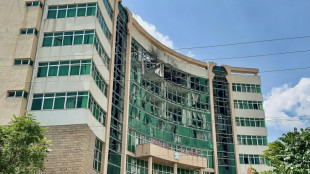 Ethiopia's Tigray rebels abandon regional capital as govt advances

 Bulgaria's Tsar Samuel returns 'home' after 1,000 years

 'Glad it's over': Kim powers to Games gold and military exemption

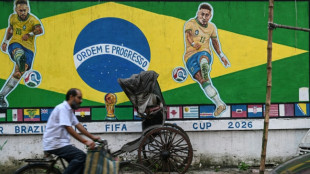 After 11 World Cups, football finally comes home for one Indian fan
 Marc Marquez wins sprint at Japan MotoGP, Martin grabs pole

 Alcaraz fends off Arnaldi to reach Japan Open quarters
 Antonelli tops times in final practice at Bahrain GP

 Gauff digs deep to beat Osorio in China Open second round

 Fresh protests to hit Spain after housing measures defeated

The World Health Organization called Wednesday for people infected with monkeypox to avoid exposing animals to the virus following a first reported case of human-to-dog transmission.
A first case of human-to-dog transmission of monkeypox -- between two men and their Italian greyhound living together in Paris -- was reported last week in the medical journal The Lancet.
"This is the first case reported of human-to-animal transmission... and we believe it is the first instance of a canine being infected," Rosamund Lewis, the WHO's technical lead for monkeypox, told reporters.
Experts had been aware of the theoretical risk that such a jump could happen, she said, adding that public health agencies had already been advising those suffering from the disease to "isolate from their pets".
She also said "waste management is critical" to lowering the risk of contaminating rodents and other animals outside the household.
- Species barrier -
When viruses jump the species barrier it often sparks concern that they could mutate dangerously.
Lewis stressed that so far there were no reports that was happening with monkeypox.
But she acknowledged that "as soon as the virus moves into a different setting in a different population, there is obviously a possibility that it will develop differently and mutate differently".
The main concern revolves around animals outside of the household.
"The more dangerous situation... is where a virus can move into a small mammal population with high density of animals," WHO emergencies director Michael Ryan told reporters.
"It is through the process of one animal infecting the next and the next and the next that you see rapid evolution of the virus."
He stressed though that there was little cause for concern around household pets.
"I don't expect the virus to evolve any more quickly in one single dog than in one single human," he said, adding that while "we need to remain vigilant... pets are not a risk."
Monkeypox was originally identified in monkeys kept for research in Denmark in 1958, though it is found most frequently in rodents.
The disease was first discovered in humans in 1970, with the spread since then mainly limited to certain West and Central African countries.
But in May, cases of the disease, which causes fever, muscular aches and large boil-like skin lesions, began spreading rapidly around the world, mainly among men who have sex with men.
Worldwide, more than 35,000 cases have been confirmed since the start of the year in 92 countries, and 12 people have died, according to the WHO, which has designated the outbreak a global health emergency.
- 'Not a silver bullet' -
With global case numbers jumping by 20 percent in the past week alone, the UN health agency is urging all countries to do more to rein in the spread, including ensuring at-risk populations have access to services and information about the dangers and how to protect themselves.
There is also a vaccine, originally developed for smallpox, but it is in short supply.
Lewis also stressed that there was still little data on the effectiveness of the vaccine in protecting against monkeypox in the current outbreak.
While no randomised control trials had been conducted yet, she said there were reports of breakthrough cases following vaccination, indicating "the vaccine is not 100 percent".
Pointing to limited studies in the 1980s suggesting that the smallpox vaccines used at the time might offer 85-percent protection against monkeypox, she said the breakthrough cases were "not really a surprise".
"But it reminds us that the vaccine is not a silver bullet," she said.
O.Lorenz--BTB



