The Ebola virus: profile of a dreaded killer / Photo: © AFP

 Yamal on target as Spain hold off Czech Republic

 Latvian exit polls suggest pro-European choice
 Lula, Bolsonaro wrap up campaigns ahead of knife-edge election
 Tuchel hails 'complete' England after Croatia demolition

 Fury to invite Trump to lead ring walk before Joshua showdown

 Fashion industry in 'precarious moment', says Vivienne Westwood supremo
 Seventh heaven for England in Nations League rout of Croatia

 Storms, flooding cause chaos on Greek holiday island of Crete

 #IAmJaneDoe: online support campaign in US university rape case

 Brazil shine on Selecao's first visit to India

 Zverev sets up Djokovic quarter-final at China Open, Rybakina out
 Happier at home, Bordeaux hammer Lyon in Top 14

 Lula, Bolsonaro in final push for votes ahead of knife-edge election

 Boisterous fashion week barnstorms 'sleepy' Nigerian capital
 UAE investigators say flydubai co-pilot was planning 'terrorist act'
 Rahul smacks century in India v Windies ODI

 Daryz seeks to join exclusive club of dual Arc winners
 Russia warns diplomats to leave Kyiv over new strikes threat
 Olympic champ Zheng rebukes rowdy home crowd at China Open

 World No.1 Sinner pulls out of Shanghai Masters to delay return
 Red Bull's Verstappen grabs pole position for Bahrain GP
 India beat Pakistan in blockbuster as golfer Kim wins 'crazy' gold

 India beat arch-rivals Pakistan to win Asian Games cricket gold
 Ethiopia's Tigray rebels abandon regional capital as govt advances: journalist

 Tom Kim powers to Games gold and exemption from military service

The highly contagious Ebola virus has claimed more than 15,000 lives since it was first identified in central Africa in 1976.
On Tuesday, Uganda announced its first Ebola fatality since 2019 in an outbreak in the central district of Mubende.
Here is a factfile on one of the world's most deadliest diseases:
- Origins -
Ebola is a viral haemorrhagic fever that was first discovered in the Democratic Republic of Congo (DR Congo).
Five of the virus species are known to cause disease in humans -- Zaire, Sudan, Bundibugyo, Reston and Tai Forest.
The first three have resulted in serious outbreaks in Africa.
The 24-year-old man whose death was announced Tuesday in Uganda tested positive for the Sudan strain.
- Transmission -
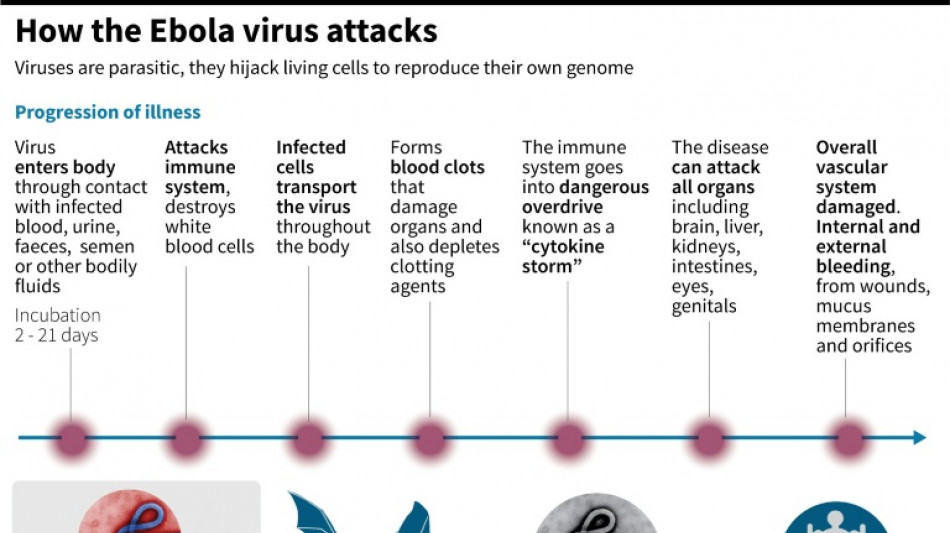
The virus' natural reservoir animal is suspected to be a species of fruit bat, which does not itself fall ill but can pass the disease on to primates, including humans. Humans become exposed to the virus if they kill or butcher infected bats for food.
Among humans, the virus is passed on by contact with the blood, body fluids, secretions or organs of an infected or recently deceased person.
Those infected do not become contagious until symptoms appear. They become more and more contagious until just after their death, which poses great risks during funerals.
Death rates are high, at around 50 percent on average of those infected, and up to 90 percent for some epidemics, World Health Organization (WHO) data show.
- Symptoms -
Following an incubation period of between two and 21 days, Ebola develops into a high fever, weakness, intense muscle and joint pain, headaches and a sore throat.
The initial symptoms are often followed by vomiting and diarrhoea, skin eruptions, kidney and liver failure, and sometimes internal and external bleeding.
- Vaccines and treatment -
Merck's Ervebo vaccine, the first Ebola jab approved by the US Food and Drug Administration (FDA) in December 2019, has been shown to be highly effective in protecting people from the Zaire strain.
US group Johnson & Johnson has also reported promising results against the Zaire strain of its two-dose Zabdeno vaccine, which has been authorised for use in the European Union.
In terms of treatment, the WHO in August recommended two life-saving medicines, Inmazeb and Ebanga, which were successfully trialled during Ebola outbreaks.
- Worst outbreaks -
The worst-ever outbreak began in December 2013 in southern Guinea before spreading to two neighbouring West African countries, Liberia and Sierra Leone.
More than 11,300 people were killed, according to WHO estimates.
The second-deadliest took place between 2018 and 2020 in DR Congo's conflict-plagued North Kivu province and killed 2,299 people according to the WHO.
DR Congo has experienced 14 Ebola outbreaks since the 1970s.
The first person infected outside Africa was a Spanish nurse who caught the disease in 2014 after cleaning the hospital room of a Spanish missionary who was repatriated from West Africa with the virus. The missionary died but the nurse survived.
L.Dubois--BTB