In Canada's Arctic, Inuit traditions help combat youth depression / Photo: © AFP

 Lula, Bolsonaro wrap up campaigns ahead of Brazil's knife-edge vote

 Toulouse edge Castres in Top 14 derby

 Murakami homer propels White Sox to MLB playoff win over Guardians

 Israel targets top Hamas leader in deadly Gaza strike on anniversary

 Houthis say struck oil facility near Riyadh, as Saudis hit Sanaa

 AI needs safety layers like nuclear plants: ex-OpenAI engineer

 MVP Judge will miss Yankees' MLB playoff series against Rays

 New lizard species discovered in Peru

 Fernandes hails Portugal's 'greatest symbol' Ronaldo, calls for unity

 Grandidier-Nkanang double takes Pau to Top 14 summit despite Vannes fightback
 Trainer Scott gets perfect Arc boost with top notch double

 Ex-PM says Putin cannot admit 'mistake' over Ukraine

 Houthis say Saudi Arabia launches dozens of strikes on Yemen capital

 Qatar and Abu Dhabi F1 Grand Prix to go ahead - F1 boss

 South Korea lift gloom with smash-and-grab Games football gold

 Ireland news conference before Israel game cut short amid tensions

 Protests over housing flare in Spain after relief measures rejected

 Zverev thrashes Shang to set up Djokovic quarter-final at China Open

 Turkey football ref chief jailed pending trial for graft

 North Korea says test of intermediate-range strategic missile included use of AI

 Rampant Sayers leads Hong Kong to third men's rugby gold in a row

 Ethiopia's Tigray rebels abandon regional capital as govt advances

 Bulgaria's Tsar Samuel returns 'home' after 1,000 years

 'Glad it's over': Kim powers to Games gold and military exemption

 After 11 World Cups, football finally comes home for one Indian fan

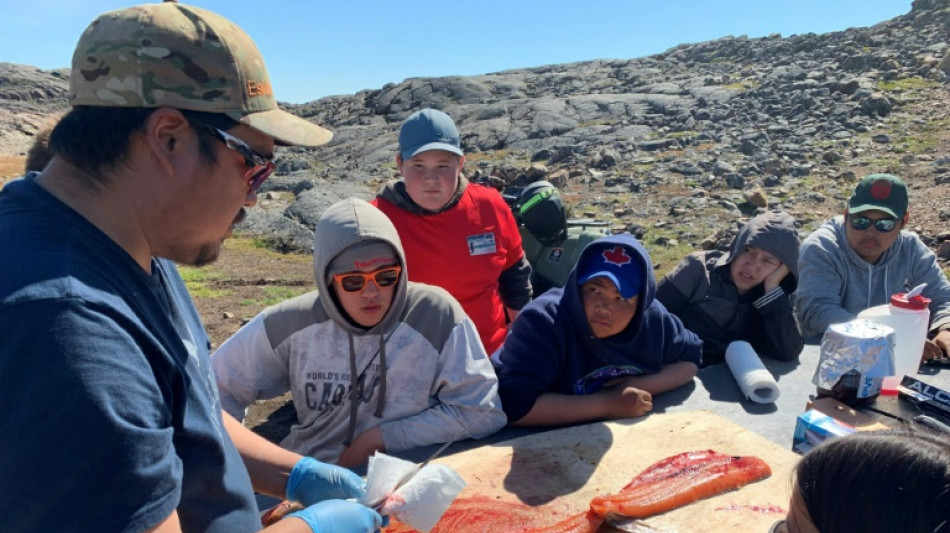
Filleting a fish, lighting a fire or building an igloo: In Canada's Arctic, Inuit youth are being encouraged to connect with their culture in an attempt to prevent severe depression and save lives.
A dozen teenagers and young adults gather around instructor Alex Flaherty. They don't want to miss any of the traditional hunter's precise gestures as he carves a fish or lights a fire.
"Our culture has changed so much in the last 50 years when people used to live in igloos... the change is happening so fast, (and) we are losing our culture," he tells AFP.
Flaherty blames the societal shifts for a series of social ills such as violent crime, substance abuse and a high rate of suicide.
Hoping to help remedy these problems, he's taken hundreds of teenagers hiking, camping and hunting in the vast tundra in the past three years.
In addition to keeping alive Inuit culture, his government-funded Polar Outfitting program also aims to bolster young people's mental health and teach them to adapt to a changing climate -- in a region that is warming much faster than elsewhere.
Flaherty says he takes mostly youth aged 12 to 20 years old, "because that's when their lifestyle starts changing (and) when they need help."
In the summer, they hike across the rocky, windswept lands near the bay city of Iqaluit that is home to some 7,000 residents -- and is accessible only by plane most months.
They also learn to make fishing nets to catch Arctic char and to navigate and survive in the pristine but unforgiving environment.
In the dead of winter, when sunlight is reduced to just a few hours per day, they will go out on the ice to fish, and build igloos.
- 'Not just about fishing' -
At 22, Annie Kootoo is the oldest in the current class. She gushes with joy after spending 10 days in the wilderness.
"I did a lot of activities that I don't usually do, and it's been very helpful for my mental health," she says.
Chris Laisa, a 14-year-old echoes the sentiment. "I feel great," he says after a lesson.
"It was fun because I learned how to fillet a fish, how to prepare it."
Flaherty, standing nearby, adds that it's "not just about fishing. It's about clearing your mind, being outdoors and sharing with others."
In the Nunavut territory of northern Canada, where the average age is 28, young people are deeply affected by the isolation and intergenerational traumas caused by past colonial policies.
Like many Indigenous peoples in Canada, the Inuit are haunted by memories of being forced into residential schools where they were stripped of their language and culture, and abused by teachers and headmasters.
Here the suicide rate is much higher than the rest of the country -- 76.6 per 100,000 inhabitants in 2020 compared to 10.1, according to Statistics Canada.
Camilla Sehti, the Nunavut government's head of mental health and addictions services, goes through a long list of what's contributed to the crisis: "It's just so many factors."
Healing, she says, "starts with reconnecting people to their culture."
"I think colonization had a huge impact on this territory and the ability for people to feel connected to self," she explains, describing new mental health initiatives that emphasize "family, culture and community."
After losing her best friend two years ago, Minnie Akeeagok started posting warnings on social media about depression and suicide.
"Everybody in Nunavut knows someone who has committed suicide or faced mental health issues. I personally know more than five," the 18-year-old told AFP.
"We need more resources, more accessibility within the mental health field in Nunavut," she says, noting that in the far off communities of this Arctic territory the situation is even more dire.
N.Fournier--BTB