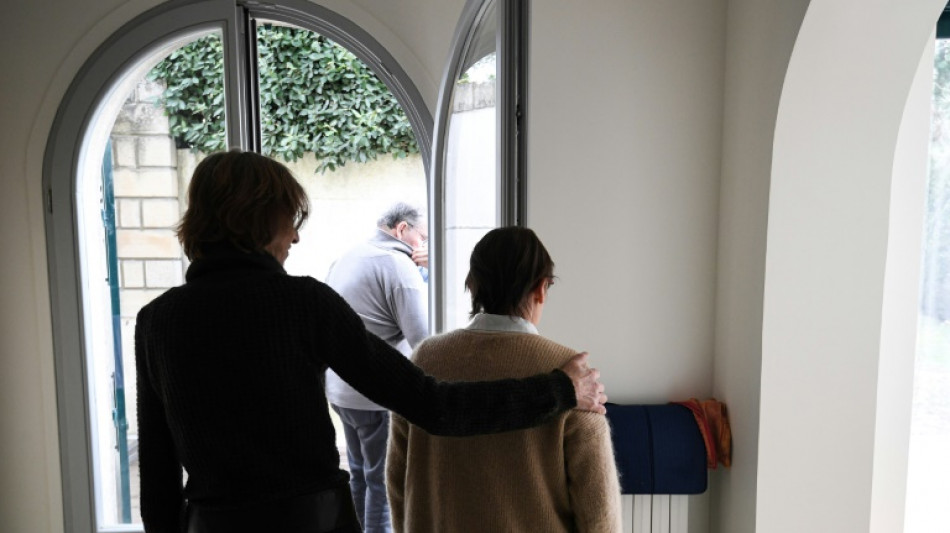
Experts encouraged by Alzheimer drug preliminary data / Photo: © AFP/File

 Lula, Bolsonaro wrap up campaigns ahead of Brazil's knife-edge vote

 Toulouse edge Castres in Top 14 derby

 Murakami homer propels White Sox to MLB playoff win over Guardians

 Israel targets top Hamas leader in deadly Gaza strike on anniversary

 Houthis say struck oil facility near Riyadh, as Saudis hit Sanaa

 AI needs safety layers like nuclear plants: ex-OpenAI engineer

 MVP Judge will miss Yankees' MLB playoff series against Rays

 New lizard species discovered in Peru

 Fernandes hails Portugal's 'greatest symbol' Ronaldo, calls for unity

 Grandidier-Nkanang double takes Pau to Top 14 summit despite Vannes fightback

 Trainer Scott gets perfect Arc boost with top notch double

 Ex-PM says Putin cannot admit 'mistake' over Ukraine

 Houthis say Saudi Arabia launches dozens of strikes on Yemen capital

 Qatar and Abu Dhabi F1 Grand Prix to go ahead - F1 boss

 South Korea lift gloom with smash-and-grab Games football gold

 Ireland news conference before Israel game cut short amid tensions

 Protests over housing flare in Spain after relief measures rejected

 Zverev thrashes Shang to set up Djokovic quarter-final at China Open

 Turkey football ref chief jailed pending trial for graft

 North Korea says test of intermediate-range strategic missile included use of AI

 Rampant Sayers leads Hong Kong to third men's rugby gold in a row

 Ethiopia's Tigray rebels abandon regional capital as govt advances

 Bulgaria's Tsar Samuel returns 'home' after 1,000 years

 'Glad it's over': Kim powers to Games gold and military exemption

 After 11 World Cups, football finally comes home for one Indian fan

Experts on Wednesday said they were encouraged after preliminary data for a new Alzheimer's drug showed it slowed cognitive decline, the first medicine to accomplish this goal.
The treatment, called lecanemab, was tested in a clinical trial of nearly 1,800 people, and slowed cognitive decline by 27 percent across an 18-month period, according to early results announced by makers Biogen and Eisai.
"This is the first drug that's been shown to not only remove the build-up of a protein called amyloid in the brain, but to have a small but statistically significant impact on cognitive decline in people with early-stage disease," said Susan Kohlhaas of Alzheimer's UK.
But experts cautioned their comments were tempered by the preliminary nature of the results, which were announced by press release ahead of publication in a peer-reviewed journal, as the companies look to bring the treatment to market as early as January 2023 in the United States.
Biogen previously brought another Alzheimer's drug to market called Aduhelm, but there was significant controversy over the evidence it worked, and its approval led to three high-level resignations in the US Food and Drug Administration.
According to a statement by Biogen and Eisai, in addition to slowing cognitive decline, the new treatment also slowed build-up in the brain of the protein amyloid, which forms sticky plaques and kills brain cells.
Side effects included higher rates of swelling and bleeding in the brain in the group that received the treatment compared to the group that received a placebo.
Both treatment and placebo groups had people of similar characteristics, including a broad range of underlying conditions. A quarter were either Hispanic or African American.
Michel Vounatsos, CEO of Biogen, said the announcement "gives patients and their families hope that lecanemab, if approved, can potentially slow the progression of Alzheimer's disease."
Masud Husain, a professor of neurology at the University of Oxford, said in a statement: "While the summary of the results certainly seems very encouraging, we have to be cautious until we are allowed to review the data fully.
"It is also important to bear in mind that the trial results apply only to people with mild Alzheimer's disease, not everyone with the condition, and that there were important side effects of the drug, including bleeds in the brain."
F.Müller--BTB