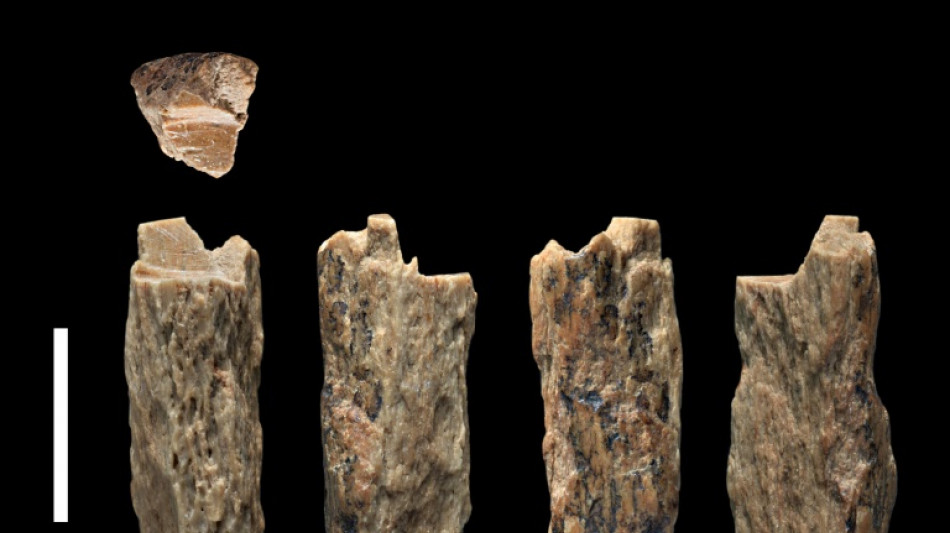
The mysterious Denisovans / Photo: © University of Oxford/Max Planck Institute/AFP/File

 Lula, Bolsonaro wrap up campaigns ahead of Brazil's knife-edge vote

 Toulouse edge Castres in Top 14 derby

 Murakami homer propels White Sox to MLB playoff win over Guardians

 Israel targets top Hamas leader in deadly Gaza strike on anniversary

 Houthis say struck oil facility near Riyadh, as Saudis hit Sanaa

 AI needs safety layers like nuclear plants: ex-OpenAI engineer

 MVP Judge will miss Yankees' MLB playoff series against Rays

 New lizard species discovered in Peru

 Fernandes hails Portugal's 'greatest symbol' Ronaldo, calls for unity

 Grandidier-Nkanang double takes Pau to Top 14 summit despite Vannes fightback

 Trainer Scott gets perfect Arc boost with top notch double

 Ex-PM says Putin cannot admit 'mistake' over Ukraine

 Houthis say Saudi Arabia launches dozens of strikes on Yemen capital

 Qatar and Abu Dhabi F1 Grand Prix to go ahead - F1 boss

 South Korea lift gloom with smash-and-grab Games football gold

 Ireland news conference before Israel game cut short amid tensions

 Protests over housing flare in Spain after relief measures rejected

 Zverev thrashes Shang to set up Djokovic quarter-final at China Open

 Turkey football ref chief jailed pending trial for graft

 North Korea says test of intermediate-range strategic missile included use of AI

 Rampant Sayers leads Hong Kong to third men's rugby gold in a row

 Ethiopia's Tigray rebels abandon regional capital as govt advances

 Bulgaria's Tsar Samuel returns 'home' after 1,000 years

 'Glad it's over': Kim powers to Games gold and military exemption

 After 11 World Cups, football finally comes home for one Indian fan

Little is known of the mysterious Denisovans. These distant relatives of the Neanderthals roamed eastern and southern Eurasia but left little trace of their time on Earth.
"Hominin Denisova" was discovered by Swedish paleogeneticist Svante Paabo, the winner of this year's Nobel prize in medicine.
In 2012, Paabo and his team sequenced the DNA of a remarkably well-preserved fragment of bone, 40,000 years old, found four years earlier in the Denisova cave in southern Siberia.
The result was astounding -- they had come across an entirely novel hominin, distinct from Neanderthals and even more from Homo sapiens, aka modern humans.
The Denisovans shared a common ancestor with the Neanderthals until their populations diverged 380,000 to 470,000 years ago.
This was much later than the split between modern humans and Neanderthals/Denisovans, which occurred between 550,000 and 760,000 years ago.
In the same cave, paleontologists later discovered the fossil of a young girl who was part Neanderthal, part Denisovan, proving that these two archaic species interbred.
But while we know the Neanderthals disappeared around 40,000 years ago, we have little idea as to when our other closest evolutionary relative went extinct.
We don't know what the Denisovans looked like either as they left only rare fossilised traces of their time on Earth other than the fragments found in Siberia and a jawbone discovered on the Tibetan Plateau in 2019.
The work of Paabo and his team at the Max Planck Institute in Leipzig have nonetheless shed some light on our mysterious ancestor.
By comparing DNA sequences, they found a "gene flow" between both Denisovan and Neanderthals, and between Denisovans and modern humans.
In other words, before they went extinct, Denisovans also interbred with our species.
Up to six percent of Denisovan DNA is still found in present-day humans in Asia-Pacific and southeast Asia -- Australian Aborigines, Melanesians and the Negritos of the Philippines -- suggesting our far-distant relative roamed over a vast swathe of east and south Eurasia.
Neanderthals, by contrast, lived in western Eurasia.
Scientists believe the ancient ancestors of today's Melanesians interbred with Denisovans from southeast Asia, far from the frozen mountains of Siberia and Tibet.
Proof that the Denisovans had spread as far as the warm tropics of Asia was lacking until a missing link -- a child's tooth at least 130,000 years old -- was discovered in a cave in Laos in 2018.
One of the biggest remaining mysteries is why modern humans were so successful in their expansion and why the Denisovans and Neanderthals went extinct, after having adapted to a Eurasian environment for several hundred thousand years.
C.Meier--BTB