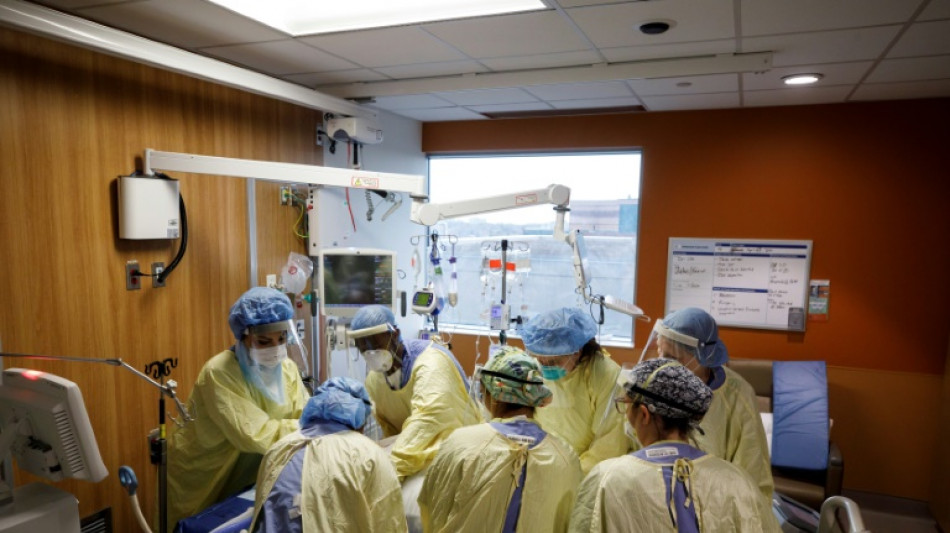
Nursing shortage forces emergency room closures across Canada / Photo: © AFP/File

 Lula, Bolsonaro wrap up campaigns ahead of Brazil's knife-edge vote

 Toulouse edge Castres in Top 14 derby

 Murakami homer propels White Sox to MLB playoff win over Guardians

 Israel targets top Hamas leader in deadly Gaza strike on anniversary

 Houthis say struck oil facility near Riyadh, as Saudis hit Sanaa

 AI needs safety layers like nuclear plants: ex-OpenAI engineer

 MVP Judge will miss Yankees' MLB playoff series against Rays

 New lizard species discovered in Peru

 Fernandes hails Portugal's 'greatest symbol' Ronaldo, calls for unity

 Grandidier-Nkanang double takes Pau to Top 14 summit despite Vannes fightback

 Trainer Scott gets perfect Arc boost with top notch double

 Ex-PM says Putin cannot admit 'mistake' over Ukraine

 Houthis say Saudi Arabia launches dozens of strikes on Yemen capital

 Qatar and Abu Dhabi F1 Grand Prix to go ahead - F1 boss

 South Korea lift gloom with smash-and-grab Games football gold

 Ireland news conference before Israel game cut short amid tensions

 Protests over housing flare in Spain after relief measures rejected

 Zverev thrashes Shang to set up Djokovic quarter-final at China Open

 Turkey football ref chief jailed pending trial for graft

 North Korea says test of intermediate-range strategic missile included use of AI

 Rampant Sayers leads Hong Kong to third men's rugby gold in a row

 Ethiopia's Tigray rebels abandon regional capital as govt advances

 Bulgaria's Tsar Samuel returns 'home' after 1,000 years

 'Glad it's over': Kim powers to Games gold and military exemption

 After 11 World Cups, football finally comes home for one Indian fan

An acute nursing shortage is clogging or even closing hospital emergency rooms across Canada, pushing an already stressed national health system to the brink with potentially severe consequences for patient care.
Burnout from the Covid-19 pandemic, abuse from patients and salary discontent have seen nursing staff quitting their jobs in droves, and experts say the situation is only likely to worsen.
The impact on emergency care is such that Ottawa police recently had to take a shooting victim to hospital in their squad car, rather than wait for an ambulance, and an elderly woman who fell and broke her hip was forced to wait six hours for help from paramedics based 100 kilometers (62 miles) away.
Over the summer and into the fall, staffing shortages meant dozens of emergency rooms were forced to close -- sometimes for a night or a weekend, sometimes longer.
Wait times to see an ER doctor have soared to 12, 16, 20 hours -- or more.
"They're numb, deflated and feeling hopeless," said Cathryn Hoy, president of the Ontario Nurses' Association. Herself a nurse for 20 years, she described the situation as "critical."
Amelie Inard, 32, was taken to an ER in Montreal this week, in extreme pain and peeing blood.
The place was packed, and an overwrought nurse told her to describe her condition "in one sentence, really quickly, because of how busy they were," Inard said.
She eventually left in frustration, without seeing a doctor.
Hospital workloads are rising, Hoy said, along with patients' exasperation over extended wait times, leading to a spiking of violence against nurses.
Several nurses told AFP they had been punched, scratched or spat on, and had trays, dishes and feces thrown at them.
- 'Crazy conditions' -
In the capital Ottawa, ambulances were unavailable on more than 1,000 occasions from January to July, as paramedics were stuck waiting to unload patients at crowded ERs.
A hospital in Peterborough, east of Toronto, in the past week was forced to treat patients on gurneys in the parking lot because its ER was full, said Hoy.
In Manitoba, doctor Merril Pauls said there had been "multiple times throughout the summer when we had to shut down beds in the emergency room" at Winnipeg's Health Sciences Centre because of the nursing shortage.
On one recent Sunday, he said, "We had too many people coming in and had no place to put them. We literally were double-bunking critical patients in a resuscitation bay.
"Our nurses are really working in crazy conditions."
It's a "really significant phenomenon going on across the country," the doctor added, and it's "getting worse."
- High turnover -
A recent survey by the Canadian Union of Public Employees, the country's largest labor union, found that 87 percent of nurses have considered leaving their job "because of the thankless and grueling working conditions."
"Even new graduates are quitting," Hoy said.
Federal health minister Jean-Yves Duclos has vowed to make it easier for foreign credentials to be recognized. That could help 11,000 internationally trained doctors and nurses get jobs in their field in Canada.
But that won't be nearly enough, with 34,400 nursing positions now vacant, according to government data.
Compounding the problem, many Canadians -- like Inard -- don't have a family doctor and turn to emergency rooms for care.
"It's just so difficult to find a family doctor," she said.
And a frequent shortage of regular hospital beds often means long waits to transfer patients out of ERs to wards.
Ontario passed a bill at the end of September permitting transfers of patients awaiting long-term care to facilities up to 150 kilometers away.
Provincial Health Minister Sylvia Jones said it would "ease pressures on crowded emergency departments."
But critics say it could force frail, elderly people into care homes far from their loved ones.
For now, almost everyone needing treatment is eventually seen. But delays can pose long-term consequences for patients' health.
"If a stroke patient doesn't get access to a clot-busting medicine fast, brain cells will die and the patient will end up being more disabled than they would have been," Pauls said.
Serious infections can be deadly if not treated in time. So, too, can cancers and other diseases, he added.
Pauls recalled routinely telling discharged patients "to come back if things get worse."
"But now they laugh at us. They say: 'You're crazy. There's no way I'm going to go through this again.'"
N.Fournier--BTB



