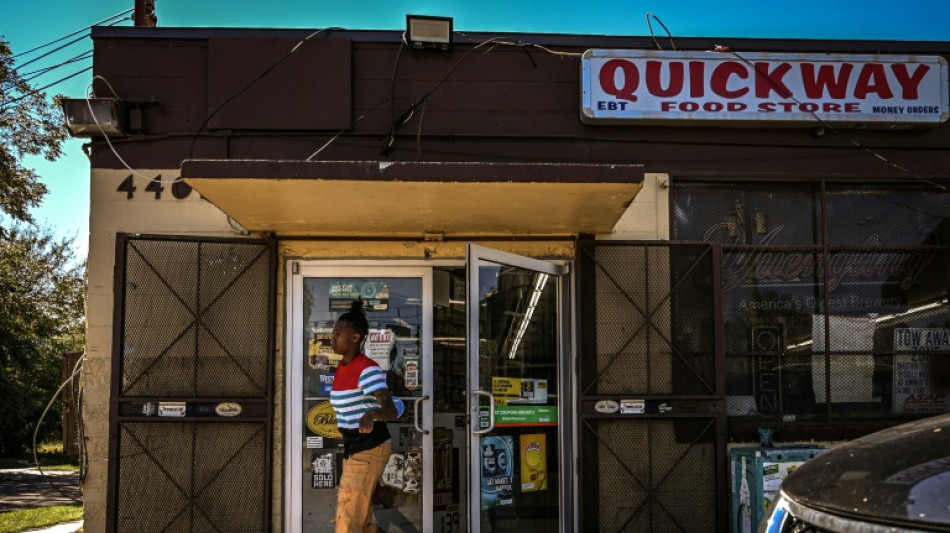
In a Florida 'food desert,' a gnawing sense of being left behind / Photo: © AFP/File

 Lula, Bolsonaro wrap up campaigns ahead of Brazil's knife-edge vote

 Toulouse edge Castres in Top 14 derby

 Murakami homer propels White Sox to MLB playoff win over Guardians

 Israel targets top Hamas leader in deadly Gaza strike on anniversary
 Houthis say struck oil facility near Riyadh, as Saudis hit Sanaa

 AI needs safety layers like nuclear plants: ex-OpenAI engineer

 MVP Judge will miss Yankees' MLB playoff series against Rays

 New lizard species discovered in Peru

 Fernandes hails Portugal's 'greatest symbol' Ronaldo, calls for unity
 Grandidier-Nkanang double takes Pau to Top 14 summit despite Vannes fightback
 Trainer Scott gets perfect Arc boost with top notch double

 Ex-PM says Putin cannot admit 'mistake' over Ukraine

 Houthis say Saudi Arabia launches dozens of strikes on Yemen capital

 Qatar and Abu Dhabi F1 Grand Prix to go ahead - F1 boss
 South Korea lift gloom with smash-and-grab Games football gold

 Ireland news conference before Israel game cut short amid tensions

 Protests over housing flare in Spain after relief measures rejected

 Zverev thrashes Shang to set up Djokovic quarter-final at China Open

 Turkey football ref chief jailed pending trial for graft
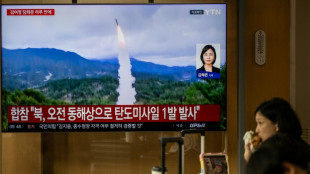 North Korea says test of intermediate-range strategic missile included use of AI

 Rampant Sayers leads Hong Kong to third men's rugby gold in a row

 Ethiopia's Tigray rebels abandon regional capital as govt advances

 Bulgaria's Tsar Samuel returns 'home' after 1,000 years

 'Glad it's over': Kim powers to Games gold and military exemption

 After 11 World Cups, football finally comes home for one Indian fan
Sitting outside her modest home in Jacksonville, Florida, on a street lined with nondescript buildings in faded shades of blue, a weary Brenda Jenkins expresses a simple wish: to be able to buy fresh fruit and produce in her own neighborhood.
It sounds simple enough. But for people like her, one of the 39 million Americans living in "food deserts" -- most of them low-income urban dwellers, and predominantly people of color -- fresh food is practically inaccessible.
In a country with often poor mass transit and persistent pockets of poverty, getting to grocery stores that sell fresh food can be daunting.
"It's very tiring," said the 26-year-old Jenkins, a mother of three.
The phrase "food desert" is misleading. The problem is not so much that fresh food is unavailable, as that it can be hard to get to, in a country where the car is king -- but also expensive.
There are no supermarkets in Jenkins' nearly all-Black neighborhood in the large city of Jacksonville on Florida's northern Atlantic coast.
Service stations, fast food restaurants and mom-and-pop groceries provide the only nearby food options.
Their shelves bulge with candy, chips, soda and cookies. But the only fresh products are likely to be a few wan-looking apples or bruised bananas near the cash register.
Yet the poorest residents have no other option. The city's mass transit system is skeletal. And the nearest supermarket is nearly an hour's walk away.
Jenkins has a car, and she often takes neighbors with her when she goes shopping.
But "what if I decided to move or what if I had something to do?" she asked. "How can they get groceries?"
And when her car breaks down -- a not-infrequent occurrence -- she has had no choice but to buy "processed foods" from a corner grocery -- "and it's just not healthy, especially with children."
With US midterm elections just weeks away -- and the prospect of major change in the Congress -- Jenkins complained that she has seen no candidates in her neighborhood, and received no campaign leaflets.
She thinks politicians ignore her area "because we're considered low-income."
If the authorities really cared, she said, "something would have been done" to address the food desert problem.
- 'A human right' -
The once-prosperous neighborhood has progressively fallen on hard times over the decades, making it less and less profitable for the big supermarket chains.
When the last one closed, "people lost access to healthy food," said Mika Hardison-Carr, a Black woman who manages a collective garden called White Harvest Farms.
Over time, local residents simply got used to living in a food desert and getting by on "processed food, canned food (and) noodles," said Hardison-Carr, holding a freshly picked kumquat.
"It is absolutely hard to change people's way of life," she said.
So the challenge now, Hardison-Carr added, is not just to give people access to fresh foods but to teach them to again make those foods a part of their daily diet.
Limited food options and poor eating habits are "contributing to all of these health issues that's causing us to die earlier, to be sicker, to be fatter," she said.
And she is adamant about this: "Access to fresh, healthy food should be a human right."
Her urban farm, created by the Clara White Mission with the help of public funds, provides free produce to the volunteers who help with the garden, and a low-price option to others in the neighborhood, who can pay with the federal food stamps that so many rely on.
On this autumn day, with Florida's normally stifling heat beginning to turn balmy, people are at work in the garden, a rare patch of green in the neighborhood's gritty urban landscape.
To attract buyers, the farm's crops include vegetables -- like collard greens -- that are essential to Southern and African-American cooking.
"They've already been in here asking us when the greens are ready," 43-year-old volunteer Nicole Boone noted with a laugh, adding, "we just seeded them!"
She has been with the program since it began last year.
Nearby, Sarah Salvatore, another garden manager, is planting flowers to attract insects that will help avoid the need for pesticides.
"Food deserts are very easy to eliminate," she said, hunched over her plants.
"We have to elect people that are putting their energy towards solving these issues," Salvatore said, "because they're solvable -- they're just underfunded."
M.Ouellet--BTB



