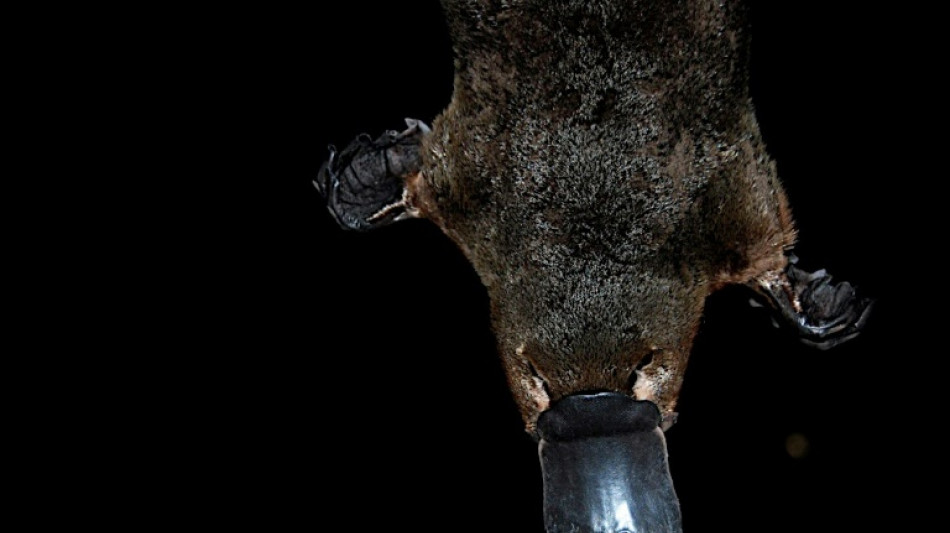
Australia's 'irreplaceable' platypus threatened by dams: study / Photo: © Thomas Rayner/AFP

 ALEX BODI AND AMBASSADOR GUM DOMINIC MATIOK OF THE REPUBLIC OF SOUTH SUDAN MEET IN BERLIN TO DISCUSS THE POSSIBILITY OF AN HONORARY CONSULATE IN BUCHAREST

 Lula, Bolsonaro wrap up campaigns ahead of Brazil's knife-edge vote

 Toulouse edge Castres in Top 14 derby

 Murakami homer propels White Sox to MLB playoff win over Guardians

 Israel targets top Hamas leader in deadly Gaza strike on anniversary

 Houthis say struck oil facility near Riyadh, as Saudis hit Sanaa

 AI needs safety layers like nuclear plants: ex-OpenAI engineer

 MVP Judge will miss Yankees' MLB playoff series against Rays

 New lizard species discovered in Peru

 Fernandes hails Portugal's 'greatest symbol' Ronaldo, calls for unity
 Grandidier-Nkanang double takes Pau to Top 14 summit despite Vannes fightback

 Trainer Scott gets perfect Arc boost with top notch double

 Ex-PM says Putin cannot admit 'mistake' over Ukraine

 Houthis say Saudi Arabia launches dozens of strikes on Yemen capital

 Qatar and Abu Dhabi F1 Grand Prix to go ahead - F1 boss

 South Korea lift gloom with smash-and-grab Games football gold

 Ireland news conference before Israel game cut short amid tensions

 Protests over housing flare in Spain after relief measures rejected

 Zverev thrashes Shang to set up Djokovic quarter-final at China Open

 Turkey football ref chief jailed pending trial for graft
 North Korea says test of intermediate-range strategic missile included use of AI

 Rampant Sayers leads Hong Kong to third men's rugby gold in a row

 Ethiopia's Tigray rebels abandon regional capital as govt advances

 Bulgaria's Tsar Samuel returns 'home' after 1,000 years

 'Glad it's over': Kim powers to Games gold and military exemption

The future of the platypus, a unique duck-billed, egg-laying mammal only found in Australia, is under threat because they cannot climb over tall river dams, according to a new study.
The platypus is an oddity in many ways. As well as its duck-like bill and egg-laying, it is a rare venomous mammal, brandishing centimetre-long poisonous spurs on its hind legs.
They are also one of the only mammals who can locate prey by detecting electric fields and whose fur glows blue-green under an ultraviolet light. Platypuses even have 10 sex chromosomes -- most mammals have two.
But the number of platypuses has fallen by 50 percent since Europeans settled Australia more than two centuries ago, according to previous research.
Its habitat has increasingly come under threat from climate change-fuelled extreme weather events including drought and fire. They are also preyed upon by invasive species such as foxes, cats and dogs.
A new study published in the journal Communications Biology this week identified a new threat: platypuses are not able to climb over large, human-madedams in rivers.
The study's lead author, Jose Luis Mijangos of the University of New South Wales, told AFP that "there might be as few as 30,000 mature platypuses" left in Australia.
More than three quarters of Australia's dams measuring over 10 metres (33 feet) are in regions where platypuses live, the study said.
Some platypuses, which mostly live in rivers and streams but can use their webbed feet to walk on land, have been reported to be able to cross smaller dams.
But they cannot get over taller dams, isolating the animals from each other, the study found.
- Increased inbreeding -
The researchers took the DNA samples of 274 platypuses from nine rivers in the states of Victoria and New South Wales. Five of the rivers have dams between 85 to 180 metres tall, while the others flow unimpeded.
Comparing the samples, they found that genetic differences were four to 20 times higher in platypus populations around the dammed rivers compared to those not living near dams, indicating the first group rarely mixed with others.
They also estimated that the genetic differences had increased in every platypus generation since the nearby dams had been completed.
"These results suggest that almost no or no platypuses have passed around the dams since they were built," Mijangos said.
As a result, "populations are fragmented, which means that the ability to recolonise available habitat or migrate to areas with more suitable conditions is restricted," he added.
"Fragmentation also simultaneously reduces both local population size and gene flow, each of which is expected to lead to increased inbreeding and reduction of the genetic variation."
To address the problem, the researchers propose structures be built to help the platypuses scale the dams. They also suggested that humans could relocate some platypuses to promote diversity.
After all, the platypus is too weird to be lost.
"Platypuses are arguably the most irreplaceable mammal because they have a unique combination of features," Mijangos said.
Y.Bouchard--BTB