
-
 How young is too young as child prodigies win big at Asian Games
-
Swiss vote on what it means to be neutral

-
 UK Labour party meets buoyed by Burnham but eager for concrete plans
-
Pope to meet with victims of clerical sex abuse during France trip

-
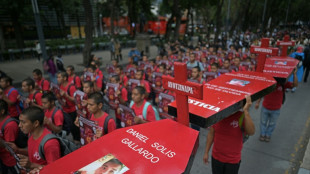 Thousands protest ahead of Mexican president's report on missing students
-
Iran stands firm on Hormuz plan after US rejection

-
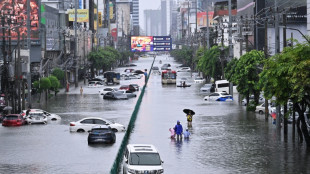 Bangkok floods force thousands into shelters
-
Madrid protest camp grows after eviction outrage

-
 AI startup urges optimism from Europe despite safety fears
-
Italy winemakers hail bumper harvest but cut output
-
 'Godlike, invincible': Japan hails 11-year-old Games history-maker
-
Kyiv shoppers feel the pinch from Russian strikes

-
 Nepal's hydropower ambitions face climate reality check
-
Japanese anime actor fights TikTok over AI voice cloning

-
 Power cuts, rubble: millions come home to find Sudan's capital unlivable
-
Curtain falls on the romance of India's single-screen cinemas

-
 Internationals keep Presidents Cup lead with late fightbacks
-
Smells like teen spirit as US thrash Peru 4-1

-
 Tuchel to 'keep pushing' England to reach Spain's level
-
Cavy chaos: Hundreds attend New Zealand's biggest guinea pig show

-
 Alcaraz saves match points to keep Europe ahead in Laver Cup
-
Venezuela releases more political prisoners after opposition talks

-
 Spain success driven by hunger to improve, says De La Fuente
-
England's best 'for a long time' despite Spain defeat, says Kane

-
 Lyon collapse at Stade Francais to suffer first Top 14 loss
-
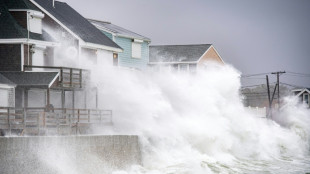
Powerful storm pummels northeast US with rain, high winds
-
 Oyarzabal and Spain sink England again as Modric shines for Croatia
-
Filmmaker Mike Leigh wins top prize at Spain festival with 'last film'

-
 Housing protesters camp in central Madrid after mass demonstration
-
Spain beat England in Nations League to extend unbeaten run

-
 Louise Trotter expands her palette at Bottega Veneta
-
Ireland squad vote to play Israel tie despite Gaza unease

-
 Pope prays at Lourdes after huge Paris mass
-
Gutsy Vollering wins cycling road race world title

-
 USA trims International lead after Presidents Cup four-balls
-
Vollering wins cycling road race world title

-
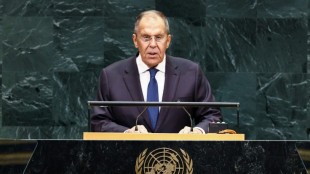 Russia accuses Europe of blocking Ukraine talks, as strikes drag on
-
Man City's meteoric rise clouded by dark shadow

-
 'He said hello': Families pray with pope on Paris avenue
-
Mbappe out for two weeks or more with knee injury say Real

-
 Pope celebrates giant Paris mass, flies to Lourdes
-
Lyon collapse away to Stade and suffer first Top 14 loss

-
 Thousands march in Madrid over eviction of 87-year-old woman
-
Russia accuses Europe of seeking to thwart Ukraine talks

-
 England women back to winning ways with last-gasp defeat of New Zealand
-
Man City chairman defiant over reported Premier League charges

-
 Trump rejects Iran proposal for deal to reopen Hormuz
-
Germany ready to 'walk through fire' for Klopp, says Tah

-
 England's Cox says injured Buttler leaves 'big shoes to fill'
-
At least 16 killed in Russian and Ukrainian strikes
Nature guardians: Why Indigenous people are vital for saving biodiversity
For countless generations prior to European colonization, Canada's Indigenous people relied on caribou both as a source of subsistence and as an integral part of their cultural practices.
Hunting and butchering the animal in frigid temperatures was long seen as a rite of passage, and members of the First Nations were the first to detect their serious decline.
"Fundamentally we are people of caribou," Valerie Courtois, director of Canada's Indigenous Leadership Initiative and a member of the Innu nation, told AFP.
"Caribou is what has really enabled us to survive, and to be who we are."
Today the species, which is known as reindeer outside North America, is endangered across much of Canada as a result of widespread habitat destruction from logging, roadbuilding, construction of transmission lines and more.
But an innovative pilot program led by Indigenous people might show a path to wider recovery.
As delegates from across the world meet in COP15 in Montreal this week to hammer out a new deal for nature, the case highlights the value of Indigenous stewardship in protecting ecosystems that benefit all humanity.
As detailed in a March 2022 paper in "Ecological Applications," the Klinse-Za subpopulation of caribou in British Columbia were once so plentiful they were described as "bugs on the landscape" but by 2013 had dwindled to just 38 animals.
That year, the First Nations of West Moberly and Saulteau devised a plan that saw them first cull wolves to reduce caribou predation, then added a maternal pen-fenced enclosures for females to birth and raise calves.
Their efforts saw the number of caribou of the herd triple in the area from 38 to 114.
With the threat of localized extinction averted, the two nations signed an agreement in 2020 with the governments of British Columbia and Canada to secure 7,900 square kilometers (3,050 square miles) of land for caribou, hoping to eventually revive their traditional hunt.
"When you protect caribou, a lot of animals come along for the ride," Ronnie Drever, a conservation scientist with nonprofit Nature United, told AFP.
"Good caribou conservation is also climate action," he added, because the old-growth forests and peatlands they live on are invaluable carbon sinks.
- Science catching up -
Globally, Indigenous people own or use a quarter of the world's land, but safeguard 80 percent of remaining biodiversity -- testament to centuries of sustainable practices that modern science is only just starting to understand.
A paper published this October in Current Biology looked at tropical forests across Asia, Africa, and the Americas, finding those located on protected Indigenous lands were the "healthiest, highest functioning, most diverse, and most ecologically resilient."
A 2019 paper in Environmental Science & Policy analyzed more than 15,000 areas in Canada, Brazil and Australia.
It found that the total number of birds, mammals, amphibians and reptiles were highest on lands managed or co-managed by Indigenous communities.
Protected areas like parks and wildlife reserves had the second highest levels of biodiversity, followed by areas that were not protected.
"This suggests that it's the land-management practices of many Indigenous communities that are keeping species numbers high," said lead author Richard Schuster, in a statement.
- Partnership crucial -
Jennifer Tauli Corpuz, of the Kankana-ey Igorot people of the Philippines, who is a lawyer and biodiversity expert with the International Indigenous Forum on Biodiversity, stressed that collaborative efforts were crucial.
"Conservation does not have a good history with Indigenous peoples, it's resulted in displacement," she told AFP.
National parks established on Euro-American notions that the land was once pristine "wilderness" typically prohibited Indigenous peoples from exercising their customary land uses, and forcibly displaced many from their ancestral homes.
Instead, she says, the rights of Indigenous groups need to be woven into the fabric of the new global biodiversity deal -- including a cornerstone pledge to protect 30 percent of land and water by 2030.
Indigenous groups say they should have greater autonomy to take the lead as managers of protected areas, arguing their successful record demonstrates they can pursue economic activity sustainably.
"The current biodiversity crisis is often depicted as a struggle to preserve untouched habitats," said a study published last year in the Proceedings of the National Academy of Sciences, which found that areas untouched by people were almost as rare 12,000 years ago as they are today.
"Current biodiversity losses are caused not by human conversion or degradation of untouched ecosystems, but rather by the appropriation, colonization, and intensification of use in lands inhabited and used by prior societies," it concluded.
M.Furrer--BTB


