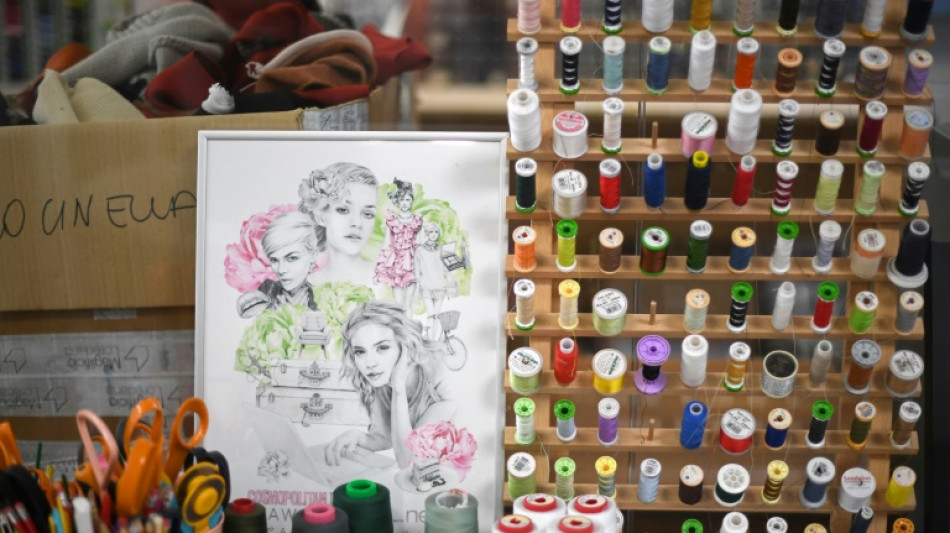
Fast-fashion fallout: young people in UK spurred into sewing / Photo: ©

 TikTok agrees to teen limits in US settlement following Meta

 Venezuela's oil cradle pins hopes on US energy deals
 US, China buy time with trade truce as pressure builds

 'Leo, Leo': Young Catholics give pope rockstar welcome in France

 Lula bans sports betting days ahead of Brazil's election

 Guatemala ensures survival of vulnerable 'fossil' fish

 Mancini finds positives in Italy loss, accepts fans' jeers

 Alcaraz helps Europe into Laver Cup lead

 Six missing after building collapses in historic Athens district

 Mbappe scores but suffers knee injury as Zidane gets debut France win

 Mancini's Italy return spoiled by Belgium defeat

 Rodri confident in Man City innocence despite reported charges
 Jay-Z rape accuser says she made 'false accusations'

 Senegal draw first match under Vieira and Nigeria survive scare

 Trump, Xi end summit long on pomp, but short on progress

 Russia not preparing for conflict with Europe, Putin says

 Trump's photo of Xi greeting carries signs of AI

 Six missing after building blast in historic Athens district

 Millions in US northeast brace for powerful storm

 Assefa seeks 'better than my best' at Berlin marathon
 US court refuses to overturn Pentagon ban on Anthropic

 Verstappen and Norris blame slow cars as Mercedes tops qualifying

 Crowds cheer pope in Paris after AI 'paradise of machines' warning

 Teen swimmer makes Games history as Thai, Chinese sprinters win gold

 Man City found guilty of 114 Premier League charges - reports

From jogging outfits to summer dresses, Lea Baecker has stitched together most of her wardrobe herself from inside her London flat, part of a burgeoning number of young amateur seamstresses.
Like many others in the growing horde of sew-it-yourself enthusiasts, she has grown increasingly disillusioned with the retail clothing industry, viewing it as too destructive.
"My main motivation was not having to buy ready-to-wear clothes anymore because I didn't want to support fast fashion," Baecker, 29, told AFP, referring to clothes made and sold cheaply to be thrown away after minimal use.
The doctoral student in neuroscience only started sewing in 2018, beginning with small bags before moving on to clothes.
Four years on, she estimates about 80 percent of clothes in her wardrobe are homemade, from pyjamas to long fleece coats, as well as jeans made with denim scraps scalped from relatives.
Baecker now buys new clothes "very rarely", she added, wearing one of her self-made long, hand-sewn dresses.
- 'Scale' -
The fashion and textile industry is the third most polluting sector globally after food and construction, accounting for up to 5 percent of greenhouse gas emissions, according to a 2021 report by the World Economic Forum.
Low-cost fashion retailers are regularly criticised for their waste and pollution, as well as the pay conditions imposed on their workers.
Tara Viggo knows fast fashion only too well, having worked in the industry for 15 years as a pattern maker.
"I realised the scale that the fashion industry was working at and it was a bit terrifying," she told AFP.
In 2017, Viggo decided to start creating her own patterns -- the blueprint drawings on paper before garments are made.
She started out small, selling only around one set of patterns per year, a far cry from the four a day that she would sometimes churn out in the ready-to-wear industry.
Viggo conceded independent operators like her were only tiny competitors to the big brands, but insisted they still could have a meaningful impact.
"The more of us that do (it), the better," she said.
"It's like a trigger... People start to look at where their consumption" is, she added noting it also made you aware of the true costs involved.
"Once you know how to sew your own clothes, you can't fathom that a shirt should be £3 ($4.10, 3.60 euros) anymore."
- 'More young people' -
Viggo's "Zadie" jumpsuit is now a top seller on "The Fold Line", an online platform selling independently produced sewing patterns, according to its co-founder Rachel Walker.
Since its launch in 2015, the website has grown from about 20 designers to more than 150 today.
Rosie Scott and Hannah Silvani, who run a London workshop selling fabrics from fashion designers' unsold stock, have also seen the resurgence in sewing's popularity, particularly among young people.
"The clients have changed," said Scott.
"More young people have shown interest in sewing -- young people who are really interested in making their own clothes and making them sustainably."
Women make up more than 90 percent of the clientele, she also noted.
Customers can choose from some 700 designer fabrics, sold from £8 a metre for cotton voile -- a sheer, lightweight cotton fabric -- to £110 for the same length of lace.
Orders soared during the pandemic and are still going strong despite the lifting of restrictions, Scott said.
- Instagram key -
The sector's explosive growth would not have been possible without Instagram, where the sewing community has made a pastime once seen as unfashionable much more trendy.
The photo-sharing platform "is really important", Baecker said, allowing sewists to post images of their designs and engage with each other.
This is what prompted her to join the social network, where she now regularly shares her latest works.
"I found each pattern has a specific hashtag that you can look up and then you can see a lot of different people wearing the same pattern and you can imagine how it can look on yourself," she explained.
For example, Viggo's #Zadiejumpsuit -- which comes in velvet or cotton, with or without sleeves -- has been tagged in almost 11,000 posts.
Meanwhile, the hashtag #handmadewardrobe features in more than 900,000 posts.
With Baecker sharing so many of her creations, she has also inspired friends to join the growing sewing revolution.
"That is my proudest achievement... getting my friends into sewing as well," she said.
N.Fournier--BTB