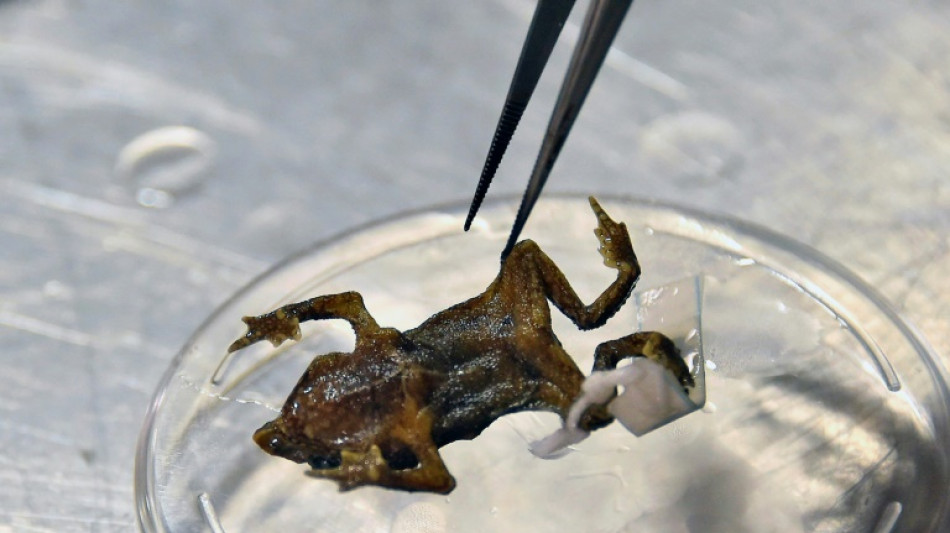
Ecuadoran toad breaks its silence after 100 years / Photo: ©

 Man City chairman defiant over reported Premier League charges

 Germany ready to 'walk through fire' for Klopp, says Tah

 At least 16 killed in Russian and Ukrainian strikes

 Powerful storm pummels US Northeast

 Bangkok declares disaster after homes flooded, roads submerged by heavy rain

 Norris calls for errant Colapinto to be banned for causing Baku crash

 Russell finds himself again and prepares to heap pressure on Antonelli

 South Korea hold nerve to win Asian Games basketball gold

 Russell holds off Verstappen to claim imperious victory in Baku

 Russell holds off Verstappen to win Azerbaijan Grand Prix

 India's Kohli says 2027 ODI World Cup will be his last

 Huge crowds cheer Pope Leo along Champs-Elysees ahead of Paris mass

 Putellas wants to bring 'winning culture and mentality' to London City

 Rare Italian opera returns to Moscow after nearly 120-year hiatus

 Pope to celebrate giant Paris mass after 'peace' appeal

 Homes flooded, roads submerged: Bangkok declares disaster over heavy rains

 Ahead of Paris mass, pope urges life together in 'dignity and peace'

 Austria 'ghetto' language classes leave children to repeat school

 S.African women runners arm themselves after string of killings

 'I felt embarrassed': Japan eSports whizz-kid, 11, wins Games gold

 Indonesia fires threatens critically-endangered orangutan: IUCN

 Bangkok declares flood disaster across city

 'World records not enough': North Korea weightlifters target Olympic gold rush

 Iran proposes Hormuz plan, Trump reportedly refuses

 El Nino rewrites the menu in the world's top restaurants

Ecuadoran biologist Jorge Brito was trekking through the forest when he heard what he thought was the chirp of a cricket.
What he found changed a century of scientific belief.
"At first I thought it was some sort of cricket out there vocalizing, but then I paid attention," said Brito, from Ecuador's national biodiversity institute.
It was, in fact, a type of brown toad with rough skin called Rhinella festae that has a prominent nose and had been considered mute since it was first discovered 100 year ago.
"While it did not inflate its vocal sack, you could see a small flicker" on its chin, said Brito.
He caught it and took it to a laboratory to study with his colleague Diego Batallas.
"The first time I heard it, I said: Wow, that's not the sound of a toad, it's like a little bird," Batalla told AFP.
The toad, which measures between 45 and 68 centimeters in length, lives in the mountainous Ecuadoran regions of Cutucu and Condor, extending over the border into the Amazonian region of Peru.
The discovery was first reported in February in Neotropical Biodiversity magazine, where Brito and Batallas described the sound made by the toad.
"It is the first time this unique song of the Rhinella festae has been recorded and it's surprising because it shouldn't sing," Batallas told AFP.
The toad does not have the vocal sack that allows most amphibians to amplify their calls so that they can be heard up to one kilometer away.
"The fact that this species can sing (without the vocal sack) makes it unique," added Batallas, who used to sing in a choir.
Batallas said that the faint sound emitted by the Rhinella festae demonstrates that some species of amphibians could have evolved in such a way -- perhaps as an anti-predator measure -- as to "not need their song to be heard very far away."
In the case of the Rhinella festae, it emits a sound as a greeting, whereas other species of toad croak as part of a mating ritual or as a warning.
"It's a very subtle sound and very difficult to hear in nature."
Ecuador has registered 658 different species of amphibians, of which 623 are toads or frogs and almost 60 percent of those are at risk or in danger of disappearing.
Only Brazil and Colombia have more species of amphibians than Ecuador.
M.Odermatt--BTB