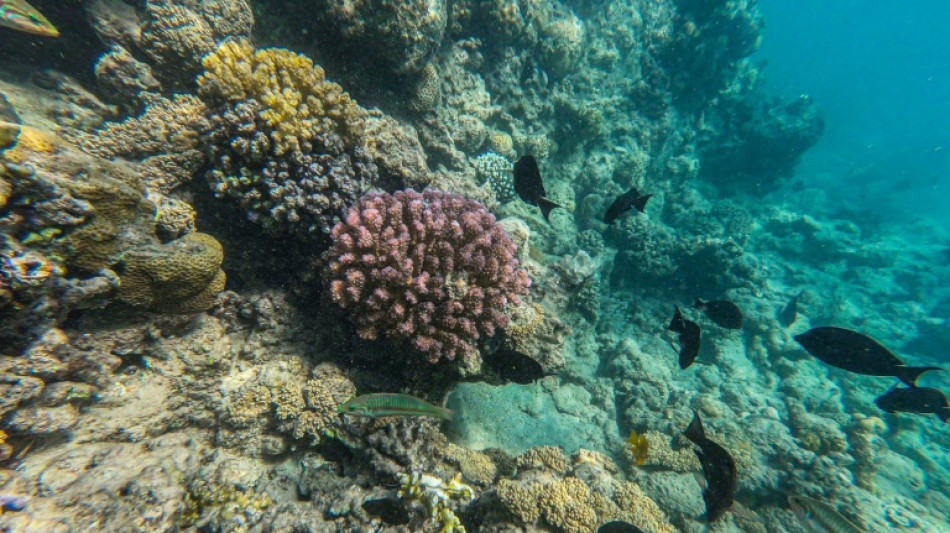
Marine heatwaves last longer in deeper water: study / Photo: © AFP

 Messi and Alcaraz love it, now padel takes step closer to Olympics

 Tolls mount in Thailand, Myanmar floods

 Why India's opposition wants top poll official out

 PU Prime Strengthens UAE Momentum with Strong Showing at Forex Expo Dubai 2026

 Eight dead in Thailand floods since mid-September

 Oil prices spike after Trump rejects Iran truce offer

 Taylor Swift sets new record at MTV VMAs
 Seoul seeks apology after Ukraine reveals transfer of North Korean POWs

 Messi on target again but Miami downed by Columbus

 In Washington's political cauldron, a fight over foie gras

 Flavio Bolsonaro: political heir in his father's shadow

 Ravens grab last-second win in Rio as Commanders stop Seahawks

 USA rallies to capture 11th consecutive Presidents Cup

 Phillies clinch, Astros wrap up division on final day of MLB season

 Commanders hand champion Seahawks their first loss

 Dupont scores twice to send Toulouse top of Top 14

 Ireland beat Israel but no handshakes due to war in Gaza

 Tense standoff over flashpoint N.Ireland parade lasts into night

 Stunned McNulty wins 'miracle' road race world title

 Re-released 'Avengers: Endgame' snaps-up N. America box office lead

 American McNulty wins shock road race world title

 Serbia's President Aleksandar Vucic announces resignation

 Tuchel urges Bellingham to play with 'rage'

 Russian strikes on Ukraine kill 8

 Bavuma, Miller hit centuries as South Africa clinch series

Marine heatwaves may last longer and be more intense in deeper water, potentially threatening sensitive species as climate change makes the extreme events more frequent, researchers said on Monday.
Oceans have absorbed 90 percent of the excess heat produced by the carbon pollution from human activity since the dawn of the industrial age.
Marine heatwaves -- episodes of abnormally high water temperatures -- have become more frequent and intense.
These can have a particularly severe impact on species that cannot migrate to escape intolerably warm waters, like corals in the Great Barrier Reef and kelp forests off southern Australia and the northeastern Pacific.
In a new study published in the journal Nature Climate Change, researchers looked at impacts of temperature spikes in deeper waters, which lead author Eliza Fragkopoulou said was "the first attempt to look into marine heatwaves below the surface".
"Marine heatwaves and their effects have been studied mostly at the ocean surface and we did not know much about their characteristics in the deep ocean," she told AFP.
Using on-site observations and modelling, researchers examined global marine heatwaves from 1993 to 2019, including data up to 2,000 metres (6,562 feet) below the surface.
They found the intensity was highest at 50 to 200 metres below the surface, occasionally up to 19 percent stronger than the surface heatwave.
The duration also increased with depth, with warming persisting up to two years after temperatures returned to normal on the surface, the study said.
The scientists looked at a proxy measure of thermal stress known as cumulative intensity and mapped that against distribution of biodiversity at the edge of their maximum heat limits to see areas where marine creatures are potentially more vulnerable to changes.
These high stress conditions overlapped in up to 22 percent of the global oceans, they found.
Regional variability of marine heatwaves makes measuring biodiversity exposure complex, and their duration varied by location due to different oceanic conditions.
In general, Fragkopoulou, of the Centre of Marine Sciences at Portugal's University of Algarve, said the impact on biodiversity was likely greatest from the surface to a depth of 250 metres.
The largest portions of the oceans categorised as highly exposed were found in the North Atlantic and Indian oceans, at depths between 1,000 and 2,000 metres.
- Better monitoring 'urgent' -
A separate study published last month in the journal Nature suggested that some marine creatures can withstand the heat better than others, with a finding that ocean fish can endure marine heatwaves with no major impact on their numbers.
Fragkopoulou told AFP that more research was needed on heatwaves in the deeper oceans to unpick the potential impacts on tourism and fisheries.
"Considering that marine heatwave impacts on deep-sea biodiversity are still largely unknown, there is an urgent need for more and better monitoring of the global ocean to understand their effects," she told AFP.
M.Ouellet--BTB