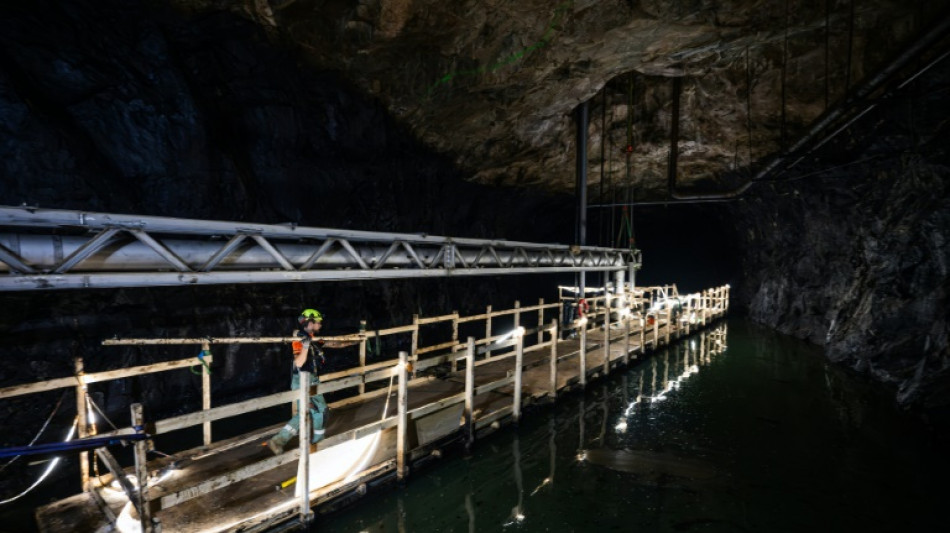
Remaking an old Swedish oil depot into a giant underground 'thermos' / Photo: © AFP/File

 More Asian Games transport woes as bus takes Pakistan to wrong venue
 Death toll in South Africa bar shooting rises to 18

 Aide to Venezuelan opposition leader returns from exile

 Messi and Alcaraz love it, now padel takes step closer to Olympics

 Tolls mount in Thailand, Myanmar floods

 Why India's opposition wants top poll official out

 PU Prime Strengthens UAE Momentum with Strong Showing at Forex Expo Dubai 2026

 Eight dead in Thailand floods since mid-September

 Oil prices spike after Trump rejects Iran truce offer

 Taylor Swift sets new record at MTV VMAs
 Seoul seeks apology after Ukraine reveals transfer of North Korean POWs

 Messi on target again but Miami downed by Columbus

 In Washington's political cauldron, a fight over foie gras

 Flavio Bolsonaro: political heir in his father's shadow

 Ravens grab last-second win in Rio as Commanders stop Seahawks

 USA rallies to capture 11th consecutive Presidents Cup

 Phillies clinch, Astros wrap up division on final day of MLB season

 Commanders hand champion Seahawks their first loss

 Dupont scores twice to send Toulouse top of Top 14

 Ireland beat Israel but no handshakes due to war in Gaza

 Tense standoff over flashpoint N.Ireland parade lasts into night

 Stunned McNulty wins 'miracle' road race world title

 Re-released 'Avengers: Endgame' snaps-up N. America box office lead

 American McNulty wins shock road race world title

 Serbia's President Aleksandar Vucic announces resignation

Work lights strung up along railings illuminate a dank cavern where workers are preparing to transform a former oil depot into a hot water "thermos" to heat a Swedish town.
Originally dug out in the early 1970s, the three caverns with a combined volume of 300,000 cubic metres served as an oil storage until the site was abandoned in 1985.
"We are now converting it into a giant thermos to store hot water in," explained project manager Rickard Svensson at power and district heating company Malarenergi in the city of Vasteras.
The site will "store energy, which we sometimes have an excess of, and ... use that at times when there is a shortage," he said.
The caverns are close to Malarenergi's combined heat and power plant, which supplies electricity and especially heat via district heating, to Vasteras' 130,000 or so inhabitants.
Hundreds of metres of pipes are being installed along with massive heat exchangers, so excess heat can heat up the water stored within and then be used to transport heat out when needed.
In another area, workers are fitting hundreds of steel bars to make a thick reinforced concrete wall which will serve as a plug for the cavern.
Once the remodelling is completed, the entire cave system will be flooded and sealed for good.
The site had previously been emptied of oil but never properly decontaminated.
"It was an excellent fit to re-use the oil storage and thereby take advantage of an existing resource," Lisa Granstrom, strategy manager at Malarenergi, told AFP.
While the plant is already able to store heat in tanks above ground, they are nowhere near the size of the new installation.
The volume is roughly the equivalent of 6,000 backyard pools and can provide approximately 13 gigawatt hours (GWh), according to Malarenergi.
- New energy landscape -
Being able to store excess heat for future use means the utility can reduce the need to bring reserve plants, some of which rely on fossil fuels, online during cold snaps.
"It will even mean that during some days we'll be able to stop production and just rely on this cave, just using the heat from here," vice president Magnus Eriksson said.
In a climate where temperatures can range from minus 20 degrees Celsius (minus 4 Fahrenheit) in winter to plus 30 degrees (86 F) in summer, the "thermos" would be able to provide heat for "up to a week" on cold days and "around two weeks" in summer.
While the idea of converting such caverns is not novel, Malarenergi believes theirs is likely the largest of its kind.
Finnish utility Helen finished a similar project in 2021 on the island of Mustikkamaa near Helsinki with a capacity to store 11.5 GWh of energy.
Another, much larger project by Vantaa Energy is also planned for construction north of Helsinki, where the planned facility of 1,000,000 cubic metres will be able store 90 GWh of thermal energy using superheated water, according to the company.
Being able to store energy is a recurring challenge as countries seek to maximise the use of the energy that is produced.
"For both electricity and heat in the new energy landscape, storing energy is crucial to adjust to peaks in production and demand," Filip Johnsson, a professor of energy systems at the Chalmers University of Technology in Gothenburg, told AFP.
In the case of heating, producers can avoid having to start up redundancy plants during cold snaps -- which may rely on sources of energy such as oil or coal.
Meanwhile, there a different problem with wind power.
"When it's very windy, you get a lot of wind power that you can't use. But when it's not so windy there will be a shortage," Johnsson said.
He added that to make better use of wind power, excess energy can be stored in batteries or as hydrogen produced from electricity.
S.Keller--BTB