To find out how wildlife is doing, scientists try listening / Photo: © AFP/File

 More Asian Games transport woes as bus takes Pakistan to wrong venue
 Death toll in South Africa bar shooting rises to 18
 Aide to Venezuelan opposition leader returns from exile

 Messi and Alcaraz love it, now padel takes step closer to Olympics

 Tolls mount in Thailand, Myanmar floods
 Why India's opposition wants top poll official out

 PU Prime Strengthens UAE Momentum with Strong Showing at Forex Expo Dubai 2026

 Eight dead in Thailand floods since mid-September

 Oil prices spike after Trump rejects Iran truce offer

 Taylor Swift sets new record at MTV VMAs
 Seoul seeks apology after Ukraine reveals transfer of North Korean POWs

 Messi on target again but Miami downed by Columbus

 In Washington's political cauldron, a fight over foie gras

 Flavio Bolsonaro: political heir in his father's shadow

 Ravens grab last-second win in Rio as Commanders stop Seahawks

 USA rallies to capture 11th consecutive Presidents Cup

 Phillies clinch, Astros wrap up division on final day of MLB season

 Commanders hand champion Seahawks their first loss

 Dupont scores twice to send Toulouse top of Top 14

 Ireland beat Israel but no handshakes due to war in Gaza

 Tense standoff over flashpoint N.Ireland parade lasts into night

 Stunned McNulty wins 'miracle' road race world title

 Re-released 'Avengers: Endgame' snaps-up N. America box office lead

 American McNulty wins shock road race world title

 Serbia's President Aleksandar Vucic announces resignation

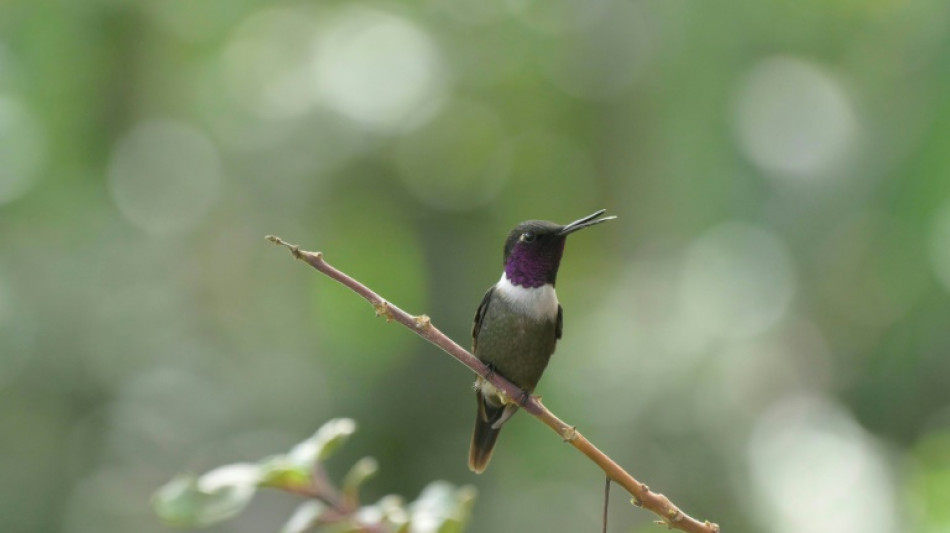
A reedy pipe and a high-pitched trill duet against the backdrop of a low-pitched insect drone. Their symphony is the sound of a forest, and is monitored by scientists to gauge biodiversity.
The recording from the forest in Ecuador is part of new research looking at how artificial intelligence could track animal life in recovering habitats.
When scientists want to measure reforestation, they can survey large tracts of land with tools like satellite and lidar.
But determining how fast and abundantly wildlife is returning to an area presents a more difficult challenge -- sometimes requiring an expert to sift through sound recordings and pick out animal calls.
Jorg Muller, a professor and field ornithologist at University of Wurzburg Biocenter, wondered if there was a different way.
"I saw the gap that we need, particularly in the tropics, better methods to quantify the huge diversity... to improve conversation actions," he told AFP.
He turned to bioacoustics, which uses sound to learn more about animal life and habitats.
It is a long-standing research tool, but more recently is being paired with computer learning to process large amounts of data more quickly.
Muller and his team recorded audio at sites in Ecuador's Choco region ranging from recently abandoned cacao plantations and pastures, to agricultural land recovering from use, to old-growth forests.
They first had experts listen to the recordings and pick out birds, mammals and amphibians.
Then, they carried out an acoustic index analysis, which gives a measure of biodiversity based on broad metrics from a soundscape, like volume and frequency of noises.
Finally, they ran two weeks of recordings through an AI-assisted computer programme trained to distinguish 75 bird calls.
- More recordings needed -
The programme was able to pick out the calls on which it was trained in a consistent way, but could it correctly identify the relative biodiversity of each location?
To check this, the team used two baselines: one from the experts who listened to the audio recordings, and a second based on insect samples from each location, which offer a proxy for biodiversity.
While the library of available sounds to train the AI model meant it could only identify a quarter of the bird calls the experts could, it was still able to correctly gauge biodiversity levels in each location, the study said.
"Our results show that soundscape analysis is a powerful tool to monitor the recovery of faunal communities in hyperdiverse tropical forest," said the research published Tuesday in the journal Nature Communications.
"Soundscape diversity can be quantified in a cost-effective and robust way across the full gradient from active agriculture, to recovering and old-growth forests," it added.
There are still shortcomings, including a paucity of animal sounds on which to train AI models.
And the approach can only capture species that announce their presence.
"Of course (there is) no information on plants or silent animals. However, birds and amphibians are very sensitive to ecological integrity, they are a very good surrogate," Muller told AFP.
He believes the tool could become increasingly useful given the current push for "biodiversity credits" -- a way of monetising the protection of animals in their natural habitat.
"Being able to directly quantify biodiversity, rather than relying on proxies such as growing trees, encourages and allows external assessment of conservation actions, and promotes transparency," the study said.
F.Pavlenko--BTB