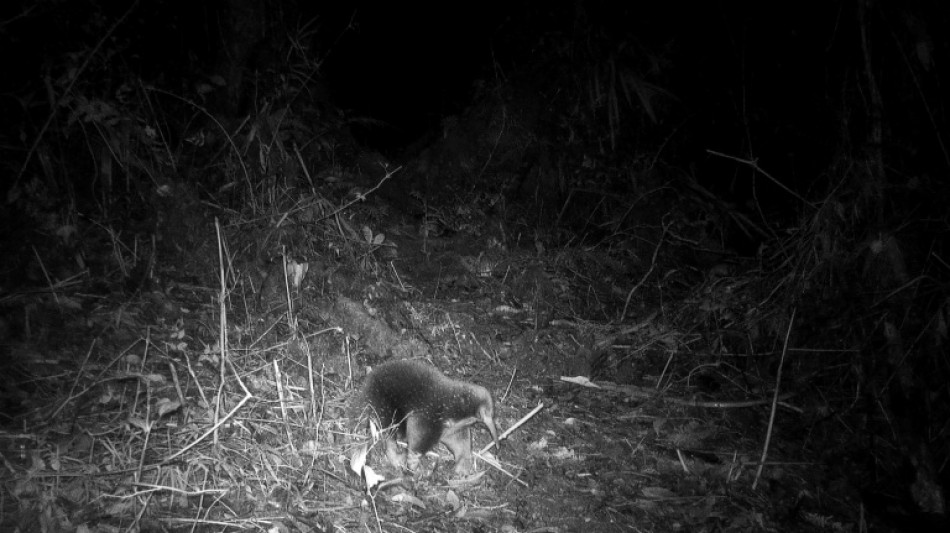
Elusive Attenborough echidna rediscovered in Indonesia / Photo: © EXPEDITION CYCLOPS/AFP

 Pope urges Europe to help combat 'deceit and lies' in international ties

 Injured Buttler to miss England ODI series in Pakistan
 Madrid housing protesters vow to maintain pressure on government

 In kayaks or waist-deep in floodwater, shoppers return to Bangkok markets

 UK police probes Iran link to air base bomb scare: media

 Eala blasts into Asian Games quarters in just 55 minutes

 Taiwan gender-row boxer Lin Yu-ting guarantees Asian Games medal

 Comedian on trial for allegedly insulting Erdogan in standup show

 More Asian Games transport woes as bus takes Pakistan to wrong venue

 Death toll in South Africa bar shooting rises to 18

 Aide to Venezuelan opposition leader returns from exile

 Messi and Alcaraz love it, now padel takes step closer to Olympics

 Tolls mount in Thailand, Myanmar floods

 Why India's opposition wants top poll official out

 PU Prime Strengthens UAE Momentum with Strong Showing at Forex Expo Dubai 2026

 Eight dead in Thailand floods since mid-September

 Oil prices spike after Trump rejects Iran truce offer

 Taylor Swift sets new record at MTV VMAs
 Seoul seeks apology after Ukraine reveals transfer of North Korean POWs

 Messi on target again but Miami downed by Columbus

 In Washington's political cauldron, a fight over foie gras

 Flavio Bolsonaro: political heir in his father's shadow

 Ravens grab last-second win in Rio as Commanders stop Seahawks

 Scheffler makes sportsmanship stand over tee screamer

 Anthropic CEO Amodei to dine with Trump at White House

An elusive echidna feared extinct after disappearing for six decades has been rediscovered in a remote part of Indonesia, on an expedition that also found a new kind of tree-dwelling shrimp.
The Zaglossus attenboroughi, a kind of long-beaked echidna named for famed British naturalist David Attenborough, had last been seen in 1961.
Echidnas are nocturnal and shy, making them difficult to find at the best of times, and the Attenborough long-beaked echidna has never been recorded outside the extremely remote Cyclops Mountains of Indonesia's Papua region.
They are the last vestiges of an ancient animal line, explained James Kempton, a biologist from the University of Oxford who led the expedition.
"The reason it appears so unlike other mammals is because it is a member of the monotremes –- an egg-laying group that separated from the rest of the mammal tree-of-life about 200 million years ago."
It took a team of scientists and experts from Britain and Indonesia four weeks and 80 camera traps to find the echidna, and it was only on the last day, and the final memory card of the trip, that the creature made an appearance.
Just a few seconds of black and white footage shows the slightly ungainly creature ambling through the undergrowth, apparently unaware of the excitement its very existence is likely to elicit.
"The discovery is the result of a lot of hard work and over three-and-a-half years of planning," said Kempton.
The team relied heavily on guidance from the local community, who helped them navigate difficult terrain and granted them access to areas regarded as sacred.
In addition to the rediscovered echidna, the team found a kind of honeyeater bird not recorded since 2008, and a slew of underground species that are new to science.
Blind spiders, blind harvestman and a whip scorpion were all recorded in a previously unexplored cave system that was revealed only when a team member fell through a moss-covered entrance.
Among the more unusual findings was a new kind of tree-dwelling shrimp.
"We were quite shocked to discover this shrimp in the heart of the forest," said Leonidas-Romanos Davranoglou, the team's lead entomologist, theorising that the region's heavy rainfall creates an environment humid enough for the shrimps to live on land.
The discoveries came despite perilous conditions, with Davranoglou breaking his arm on the trip and another researcher enduring a leech attached to his eye for a day and half before it was removed at a hospital.
For all the hardships, Kempton described the landscape as "magical," and the team hopes their findings will highlight the desperate need for conservation of the region and Indonesia's remaining forests elsewhere.
"Tropical rainforests are among the most important and most threatened terrestrial ecosystems," said Davranoglou.
S.Keller--BTB


