Endangered sea turtles get second life at Tunisian centre / Photo: © AFP

 Pope urges Europe to help combat 'deceit and lies' in international ties

 Injured Buttler to miss England ODI series in Pakistan
 Madrid housing protesters vow to maintain pressure on government

 In kayaks or waist-deep in floodwater, shoppers return to Bangkok markets

 UK police probes Iran link to air base bomb scare: media

 Eala blasts into Asian Games quarters in just 55 minutes
 Taiwan gender-row boxer Lin Yu-ting guarantees Asian Games medal
 Comedian on trial for allegedly insulting Erdogan in standup show

 More Asian Games transport woes as bus takes Pakistan to wrong venue
 Death toll in South Africa bar shooting rises to 18
 Aide to Venezuelan opposition leader returns from exile

 Messi and Alcaraz love it, now padel takes step closer to Olympics
 Tolls mount in Thailand, Myanmar floods
 Why India's opposition wants top poll official out

 PU Prime Strengthens UAE Momentum with Strong Showing at Forex Expo Dubai 2026

 Eight dead in Thailand floods since mid-September

 Oil prices spike after Trump rejects Iran truce offer

 Taylor Swift sets new record at MTV VMAs
 Seoul seeks apology after Ukraine reveals transfer of North Korean POWs

 Messi on target again but Miami downed by Columbus

 In Washington's political cauldron, a fight over foie gras

 Flavio Bolsonaro: political heir in his father's shadow
 Ravens grab last-second win in Rio as Commanders stop Seahawks
 Scheffler makes sportsmanship stand over tee screamer

 Anthropic CEO Amodei to dine with Trump at White House

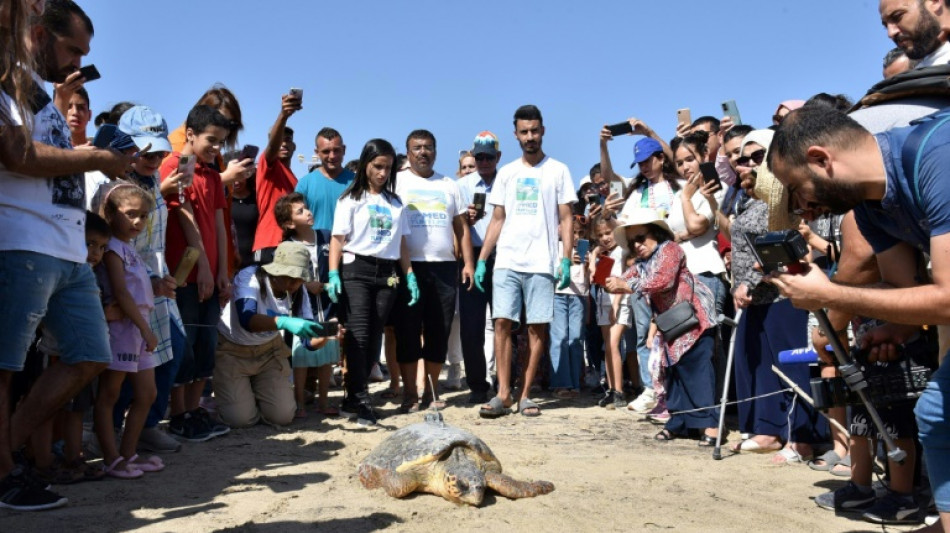
A crowd has gathered to see off Rose, a loggerhead sea turtle, who labours across the Tunisian sand to rejoin the waters of the Mediterranean.
For the last month, Rose has been recovering at the First Aid Sea Turtle Center in the coastal city of Sfax after she was ensnared in a fishing net.
The facility, one of two in North Africa, is run by the EU-funded Life Med Turtles project, which looks after endangered species, such as the loggerhead, and aims to improve marine life protection by gathering data on their behaviour.
Since the centre opened in 2021, nearly 80 turtles have been treated and returned to their natural environment, said its chief Imed Jribi.
The project also aims to educate the local population in places like Sfax, which relies on fishing.
"Before, we were ignorant," said 29-year-old local fisherman Hamadi Dahech, who brought Rose into the centre after trapping her accidentally.
"People ate them, used them for witchcraft, or as medicine and many other things. Today, thanks to (the centre) raising awareness among fishermen, she has a better chance of survival at sea," Dahech said at Rose's release.
- Do not eat -
"We use the turtles that arrive here for scientific research, for their protection as well as raising awareness," Jribi said.
To highlight the natural wonders in the waters off Tunisia, the centre opens to the general public on weekends.
Malak Morali, a 30-year-old local who brought her two children to watch Rose's release, said her son loves the ocean-going creatures.
"Every time he hears that there are turtles, he wants to come to take photos and learn new things," she said.
Morali said that it was only thanks to the centre that she learnt "that the meat is not edible".
"We usually say that cooking it is good, but it is the opposite."
The consumption of sea turtle meat is dangerous due to the high levels of pollution in the waters they inhabit.
Toxins, such as mercury, build up in their liver and kidneys, posing a significant threat to human health.
Besides the deadly metals, the turtles often eat floating waste.
The creatures can "confuse plastic bags with jellyfish", said Hamed Mallat, a marine biologist.
A 2015 study by the University of Queensland in Australia found that the majority of the world's sea turtle population was consuming plastic.
- Trapped in nets -
Every year, around 10,000 loggerheads are caught by trawlers and in fishing nets in the waters off Tunisia, a potential death sentence for the turtles.
Life Med Turtles estimates that around 70 percent of sea turtle deaths in the Mediterranean alone are caused by gillnets, a sort of large net suspended vertically in the water.
Some, however, make it through alive and at the centre in Sfax, it is often the fishermen themselves who bring in the injured turtles.
As an acknowledgement of their help, the rescued animals are frequently named after the fishermen themselves.
One of them, a frail baby turtle called Ayoub, was fed by caretakers with a syringe.
As well as fishing, global warming poses an acute threat to the turtles by altering their sex ratio.
According to the US National Ocean Service, if a turtle's egg incubates below 27.7 Celsius (81.9 degrees Fahrenheit), the hatchling will be male.
But above 31 degrees Celsius the baby turtle will be female, putting the turtles at greater risk of extinction as fewer males are born.
The rescue centre in Sfax nonetheless has hope and is continuing its work to prevent the death of the species.
Before releasing Rose, Jribi and Mallat attached a location tracker to her shell.
They aim to analyse where Rose is most active, which could reveal more about her species' migration and behaviour.
"She is the one who will protect the ecosystem at sea," said Rose's rescuer Dahech.
L.Janezki--BTB


