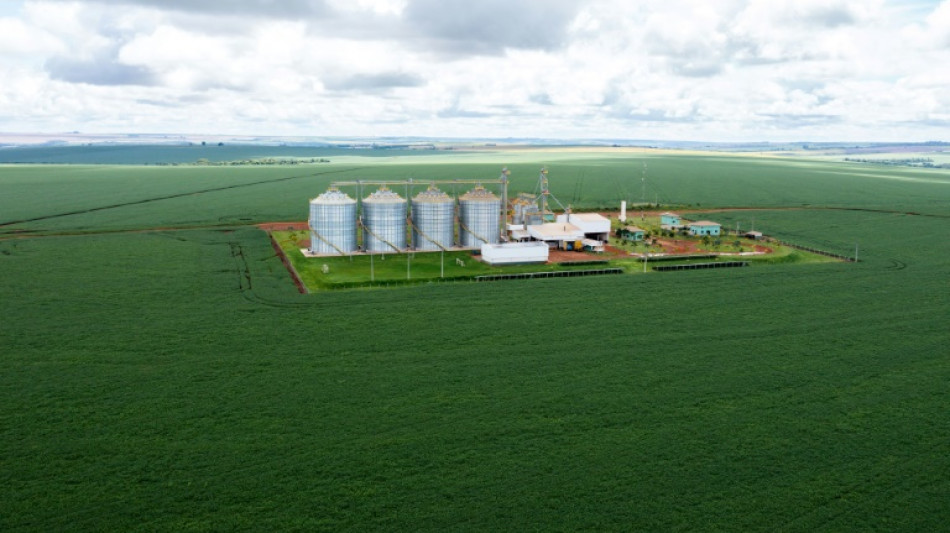
'Harvesting data': Latin American AI startups transform farming / Photo: © AFP/File

 8.3 mn refugees at risk due to 'severe' funding cuts: UN

 Stocks drop and oil rises as Hormuz hopes fade

 OpenAI cancels release of newest model due to safety concerns

 AI bosses head to White House as safety pressure builds

 Batista sacked as Costa Rica coach after six months

 Flooding, power cuts and evacuations as Hurricane Polo slams Mexico

 Dodgers eye three-peat, Red Sox face Yankees as MLB playoffs begin

 Certification of Boeing 737 MAX delayed by software bug

 Celine Dion wows Paris Fashion Week with surprise gig

 AMD buys firm founded by AI 'godmother' Fei-Fei Li

 Italy rebound in Turkey as France win late in Belgium

 Pope says concerns about AI 'should be taken seriously'

 Hurricanes to hoist title banner as NHL season begins

 Justice Alito steps aside from major US climate case

 Willis happy with England exile after retains Top 14 player award

 Spain housing protests keep heat on government as PM seeks new law

 Wissa spoils Zimbabwe homecoming as DR Congo win AFCON qualifier

 UK police release on bail five men held over airbase incident

 Ex-All Black Plummer 'sure' New Zealand will find Super Rugby solution

 Shein sees 1% revenue growth in first half of 2026
 Netherlands regrets Israel retaliation in settlements row

 Moscow seizes Russian assets of German food retailer Metro

 Bulgarian spirits inflamed by new rakia rules

 Documentary turns camera on architect Peter Zumthor

 UK police say releasing on bail five men held over airbase incident

For centuries, farmers used almanacs to try to understand and predict weather patterns.
Now, a new crop of Latin American startups is helping do that with artificial intelligence, promising a farming revolution in agricultural giants like Brazil, the world's biggest exporter of soybeans, corn and beef.
Aline Oliveira Pezente, a 39-year-old entrepreneur from the Brazilian state of Minas Gerais, was working at agriculture company Louis Dreyfus Commodities when she noticed a problem in how the farming industry operates in Brazil.
Producers need huge amounts of credit up-front to buy inputs like seed and fertilizer, she says. But lenders are wary given how difficult it is to size up the myriad risks, from the natural -- droughts, floods, crop disease, erosion -- to the financial -- bankruptcy, price crashes and more.
In 2018, Aline and her husband Fabricio launched a startup called Traive that collects massive amounts of agriculture-related data, then analyzes it with AI, breaking down the capital risk for lenders and giving farmers easier access to credit.
"Lenders used to each use their own (risk analysis) model. Imagine like a giant Excel file," Aline told AFP. "But it's very hard for humans, even those who are super knowledgeable of statistics and mathematics, to create equations that capture the nuances of all the variables.
"They were taking three months to do something that we can do in five minutes with way better accuracy," said Aline, who has a master's degree specializing in AI and data analysis from Massachusetts Institute of Technology.
- AI for agriculture -
Seven years on, Traive's clients include agro-industry giants like Syngenta, fintech firms and Latin America's second-biggest bank, Banco do Brasil. More than 70,000 producers use its platform, which has facilitated nearly $1 billion in financial operations, it says.
Aline presented her work this week at the Rio de Janeiro edition of Web Summit, the massive tech gathering dubbed "Davos for Geeks."
Speaking alongside her on a panel called "Harvesting Data: The Next Agricultural Revolution," fellow entrepreneur Alejandro Mieses explained how AI has the potential to reshape farming.
Worldwide, farmers are increasingly turning to AI to boost yields and returns, with applications like self-driving tractors, drones that track crop health and smart cameras that recognize weeds for herbicide treatment.
Mieses's Puerto Rico-based startup, TerraFirma, developed an AI model that uses satellite images to forecast environmental risks like natural disasters, crop disease and erosion.
"We insist on the physics of it, because we believe that is the base point. Understanding how water moves, how wind moves, how different solar exposures operate throughout your farmland," he said at Web Summit, of which AFP is a media partner this year.
The hard part, the panelists said: AI models have to be trained on massive amounts of data.
Although farmers tend to be data-obsessed -- painstakingly tracking environmental conditions, inputs and productivity -- gathering and processing that information around the world is complex.
"It's quite resource-intensive. You need servers, you need an immense repository of data," said Mieses, 39.
"It's the same old story of garbage in, garbage out."
- Climate question -
The agriculture industry faces criticism in countries like Brazil, whose rise as an agricultural powerhouse has also seen a surge of environmental destruction in key regions like the Amazon rainforest, a vital resource against climate change.
Innovation optimists argue that, with the world's population expected to reach nearly 10 billion people by 2050, technologies like AI are humanity's best hope for surviving without destroying the planet.
Mariana Vasconcelos is the 32-year-old chief executive of Brazilian startup Agrosmart, which uses AI to help farmers manage climate risks and produce more sustainably.
"The UN Food and Agriculture Organization says we need to increase food production to feed a growing population. At the same time, we have to produce with less: less land, less deforestation, less carbon footprint. How can we do that without technology?" she said.
"Agriculture is often seen as opposed to nature. But I think technology is showing that actually it can regenerate, restore the environment, work together with nature... Agriculture is headed for a more sustainable model."
J.Horn--BTB