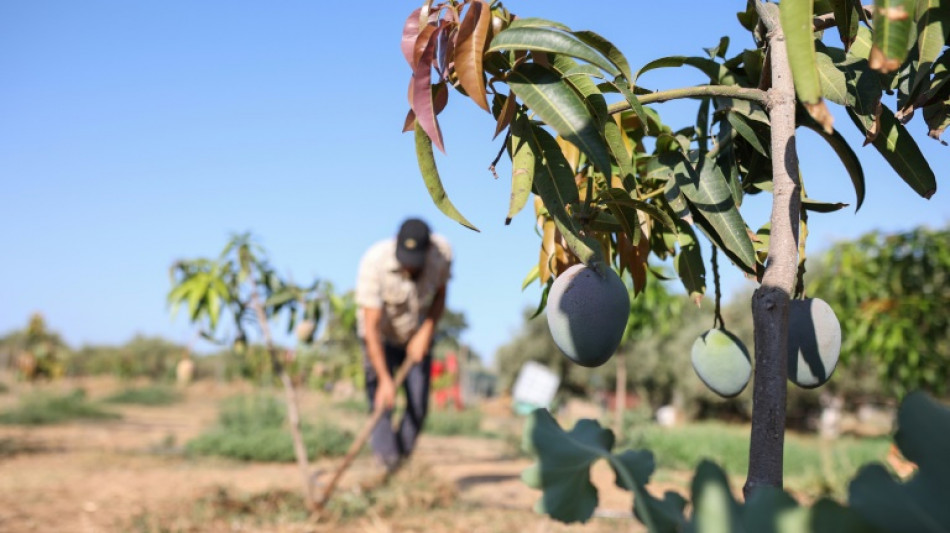
Greeks try tropical crops in climate change experiment / Photo: © AFP

 Trump admin finalizes reversal of US fuel economy standards

 US says no China arms sale plans after envoy cites Trump offer

 Dozens kidnapped in two weekend attacks in northern Nigeria

 Next stop the world: Pathirage wins Asian Games javelin gold

 Aster Launches Perpetual Grid Trading 2.0 with Up to 140,000 $ASTER Liquidity Mining Campaign

 Seoul says North Korean mines 'highly suspected' as cause of DMZ blast

 Russia pummels Kyiv in latest deadly daytime attack

 Wartime Ukraine works to keep its railways on track

 Boy among 3 dead in migrant Channel crossing accident: French authorities

 SGFX Creates a Standout Brand Experience at Forex Expo Dubai 2026

 Pope urges Europe to help combat 'deceit and lies' in international ties

 Injured Buttler to miss England ODI series in Pakistan
 Madrid housing protesters vow to maintain pressure on government

 In kayaks or waist-deep in floodwater, shoppers return to Bangkok markets

 UK police probes Iran link to air base bomb scare: media

 Eala blasts into Asian Games quarters in just 55 minutes

 Taiwan gender-row boxer Lin Yu-ting guarantees Asian Games medal

 Comedian on trial for allegedly insulting Erdogan in standup show

 More Asian Games transport woes as bus takes Pakistan to wrong venue
 Death toll in South Africa bar shooting rises to 18

 Aide to Venezuelan opposition leader returns from exile

 Messi and Alcaraz love it, now padel takes step closer to Olympics

 Tolls mount in Thailand, Myanmar floods

 Why India's opposition wants top poll official out

 PU Prime Strengthens UAE Momentum with Strong Showing at Forex Expo Dubai 2026

Stirring the leaves of a shrub on his farm in Kyparissia, western Greece, Panos Adamopoulos spied the first soon-to-be-ripe mangoes -- his share of a state experiment against climate change.
"Right there!" he exclaimed.
For decades, this fertile land on the shores of the Ionian Sea has been mainly known for olives, in addition to watermelon and other crops.
But even this part of Greece that sees more rain than other parts of the country is grappling with the effects of drought.
After the warmest winter on record, Greece also experienced the hottest June and July since reliable data collection began in 1960.
"There is no winter," Adamopoulos, 38, told AFP, adding that his property has not received a drop of rain since March.
"No water, no cultivation," said the farmer, whose trees seem to grow right into the Ionian Sea.
Most of Adamopoulos' income currently comes from iceberg lettuce.
But with increasingly arid seasons in sight, he may soon have to give up on some of his lucrative, yet water-intensive crops, such as watermelon.
Adamopoulos is among a small number of Greek growers turning to tropical fruits -- mangoes, avocados, lychees, cherimoya and macadamia nuts -- which he says are "more resistant" to the increasingly intense heat in the Mediterranean region.
For now, he only grows a few dozen mango and avocado trees on his 80-hectare (198-acre) estate.
The exotic fruits are adapting so well to their new surroundings that Adamopoulos now plans to plant a further 300 trees. He he said he had already received orders for his first harvests, due later this month.
The initiative is part of a study by Greek state agriculture institute Demeter to determine whether tropical fruits could help address the country's looming drought problem.
- Not a miracle solution -
Study supervisor Teresa Tzatzani says the point is to "find new ways to face this climate change, and make it work in our favour".
"It is hotter all year round now, and this is good for these crops," she said.
Although avocado already grows on the island of Crete, scientists were unsure whether the tree would adapt to conditions on the Greek mainland.
And while mango trees need very little rainfall, the last two winters have been unusually dry, Tzatzani noted.
This type of innovation is essential to save the sector from future climate disasters, said Antonis Paraskevopoulos, head of agriculture for the local region of Triphylia.
But for now, tropical fruits are not a miracle solution.
The programme currently has only a dozen farmers and around 10 hectares under cultivation.
And while it is not intended to replace staple local products such as olives or oranges, it can act as a complement, said Tzatzani, who plans to extend the experiment to other Greek regions.
Neighbouring countries are experiencing similar problems. In Italy, Sicilian farmers have started producing mangoes, bananas and papayas.
The Intergovernmental Panel on Climate Change (IPCC) estimates that the Mediterranean basin, one of the "hotspots" of climate change, will experience more frequent heat waves and droughts.
- A 'bad year'? -
Theodoros Dimitrakakis, another Greek farmer taking part in the initiative, estimates that it will take years for tropical fruit production to become profitable in Greece.
Despite his enthusiasm for the experiment, the 34-year-old says he can't afford to devote all his time to it, as his main source of income, olive trees, requires all of his attention.
His village, like many in Greece, is often without water for several hours during the day due to scheduled cuts.
Last year, his olive yield was 60 percent below average, Dimitrakakis said.
Despite being an environmental activist during his university years, Dimitrakakis acknowledges that he only recently realised that climate change would impact him so soon.
He now hopes to convince other local farmers, some of whom prefer to think it's just a "bad year".
J.Fankhauser--BTB


