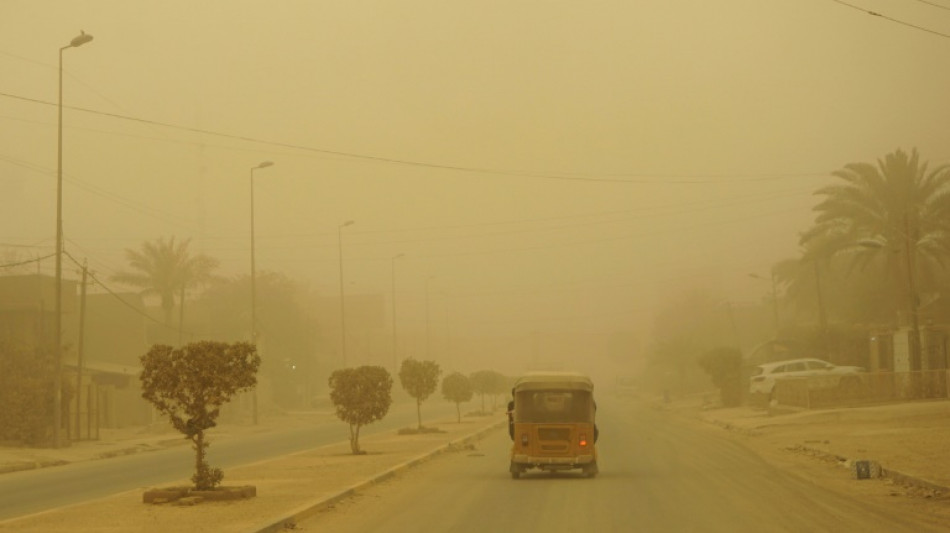
Thousands sick as latest severe sandstorm sweeps across Iraq / Photo: © AFP

 Man City chairman defiant over reported Premier League charges

 Germany ready to 'walk through fire' for Klopp, says Tah

 At least 16 killed in Russian and Ukrainian strikes

 Powerful storm pummels US Northeast

 Bangkok declares disaster after homes flooded, roads submerged by heavy rain

 Norris calls for errant Colapinto to be banned for causing Baku crash

 Russell finds himself again and prepares to heap pressure on Antonelli
 South Korea hold nerve to win Asian Games basketball gold

 Russell holds off Verstappen to claim imperious victory in Baku

 Russell holds off Verstappen to win Azerbaijan Grand Prix

 India's Kohli says 2027 ODI World Cup will be his last

 Huge crowds cheer Pope Leo along Champs-Elysees ahead of Paris mass

 Putellas wants to bring 'winning culture and mentality' to London City

 Rare Italian opera returns to Moscow after nearly 120-year hiatus

 Pope to celebrate giant Paris mass after 'peace' appeal
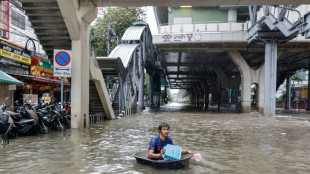 Homes flooded, roads submerged: Bangkok declares disaster over heavy rains

 Ahead of Paris mass, pope urges life together in 'dignity and peace'

 Austria 'ghetto' language classes leave children to repeat school
 S.African women runners arm themselves after string of killings

 'I felt embarrassed': Japan eSports whizz-kid, 11, wins Games gold

 Indonesia fires threatens critically-endangered orangutan: IUCN

 Bangkok declares flood disaster across city

 'World records not enough': North Korea weightlifters target Olympic gold rush

 Iran proposes Hormuz plan, Trump reportedly refuses
 El Nino rewrites the menu in the world's top restaurants

One person died in Iraq and more than 5,000 were treated in hospitals Thursday for respiratory ailments due to a sandstorm, the seventh in a month, the health ministry said.
Duststorms have increased dramatically in frequency in Iraq in recent years, driven by soil degradation and intense droughts made worse by climate change, with rising average temperatures and sharply lower rainfall.
Residents of six of Iraq's 18 provinces, including Baghdad and the vast western region of Al-Anbar, awoke once again to a thick cloud of dust blanketing the sky.
As the storm swept across Iraq, it shrouded the capital Baghdad and the holy city of Najaf in ghostly orange clouds of choking dust.
"One death has been recorded in Baghdad" and hospitals "have received no less than 5,000 cases so far," health ministry spokesman Seif al-Badr said in a statement.
Those hit hardest are people suffering from "chronic respiratory diseases such as asthma", and the elderly who suffer in particular from heart ailments, he said.
Badr added that the majority had since been discharged and most cases were of "medium or low intensity".
Dust and sandstorms have always occurred in the Middle East but grown more frequent and intense in recent years, a trend that has been associated with overuse of river water, more dams, overgrazing and deforestation.
The fine dust particles can cause health problems such as asthma and cardiovascular ailments, and also spread bacteria and viruses as well as pesticides and other toxins.
Authorities in Al-Anbar and Kirkuk provinces, north of the capital, urged people "not to leave their homes", said the official INA news agency.
The storms are expected to grow more intense with worsening climate change because higher temperatures and more irregular rainfalls dry out land faster and accelerate desertification.
Sandstorms also cause economic damage by reducing visibility, sometimes to near zero, shuttering airports and highways and causing damage to buildings, vegetation and solar panels.
- '272 days of dust' -
Hospitals in Al-Anbar province had received more than 700 patients with breathing difficulties, said Anas Qais, a health official cited by INA.
The central province of Salaheddin reported more than 300 cases, while Diwaniya and the province of Najaf, south of Baghdad, each recorded about 100 cases, the news agency added.
Oil-rich Iraq, despite its mighty Tigris and Euphrates rivers, is classified as one of the world's five countries most vulnerable to climate change and desertification.
Scientists say climate change amplifies droughts and that their intensity and frequency in turn threaten food security. Experts have said these factors threaten to bring social and economic disaster in the war-scarred country.
In November, the World Bank warned Iraq -- a country of 41 million people -- could suffer a 20-percent drop in water resources by 2050 due to climate change.
The United Nations says about one-third of Iraq's population now lives in poverty.
The effects of low rainfall have been exacerbated as the levels of the Tigris and Euphrates drop because of upstream dams in neighbouring Iran and Turkey.
The environment ministry said the weather phenomenon could be addressed by "increasing vegetation cover and creating forests that act as windbreaks".
L.Dubois--BTB