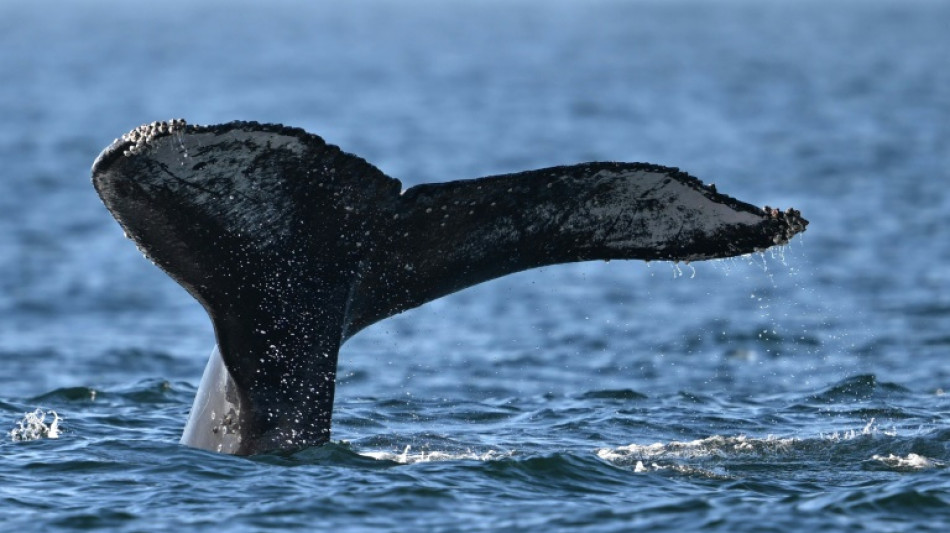
Whaling: why the practice will not go away / Photo: © AFP

 SpaceX puts Starship megarocket in orbit for first time
 Iran denies link to suspected bomb plot at UK airbase used by US
 Ex-boss Mancini says City charges 'not my concern'

 Berlin Marathon winner Assefa finished race with torn Achilles

 Comedian convicted for Erdogan 'insult' but freed pending appeal

 French prosecutors seek two-year sentence for ex-minister Dati in graft case

 Eala makes fast start as weather and transport woes hit Asian Games

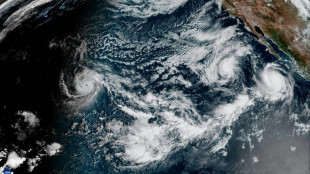 Hurricane Polo approaches Mexico, threatens severe damage

 Energy markets rally after Trump rejects Iran truce offer
 Japanese convenience store enlists Lady Gaga to bolster recruitment

 Seoul summons Ukraine envoy in row over North Korean POWs

 Ireland 'raised awareness worldwide' in Israel game: Hallgrimsson

 Colombian police capture wife, daughter of Ecuador drug lord

 More Asian Games woes as bus takes Pakistan team to wrong venue

 Radio frequencies vital to Earth observation must be protected: UN

 Comedian on trial for insulting Erdogan in standup show

 Women's Fashion Week kicks off in Paris

 Pope arrives in French border city to speak on united Europe
 The wildfires choking Indonesia, sparking regional haze

 PU Prime Deepens Argentina Presence Through FX Expo Buenos Aires 2026

 Nothing to seal here: NZ police help stranded pup home
 White House releases list of products US, China could tax less
 'Pseudo-journalism': Partisan 'news' sites target US midterms

 'Currently impossible': North Korea defections in freefall

 Erasmus sizes up 'improved' Wallabies ahead of 2027 World Cup

The detention in Greenland of anti-whaling campaigner Paul Watson pending possible extradition to Japan has turned the spotlight on the widely condemned practice of hunting whales.
A 1986 moratorium on commercial whaling allowed numbers to recover following centuries of hunting that decimated the population to near-extinction.
Today three countries still permit the practice -- Japan, Norway and Iceland.
Beyond the moral case against whaling, as made in campaigns such Watson's, what is the science driving the arguments both for and against the practice?
- 'Scientific' whaling? -
In 2019 Japan quit the International Whaling Commission moratorium and resumed commercial whaling inside its territorial waters and exclusive economic zone.
Before this, Japan had been pursuing "scientific research" whaling since 1987, arguing some data could only be collected from dead carcasses.
But the evidence to support the claim was thin, Paul Rodhouse, fellow of the Marine Biological Association in Britain, told AFP.
"There seems to be very little justification for scientific whaling and few worthwhile scientific studies," he said.
A study published in Marine Policy in 2016 found that whaling and non-whaling countries had produced similar numbers of scientific papers on whales between 1986 and 2013.
If we consider all the whales captured "and compare them to the very, very small number of scientific publications produced, we say to ourselves it really wasn't worth it and the scientific objectives were certainly not the priority of this activity", Vincent Ridoux, a marine megafauna researcher at La Rochelle university in France, told AFP.
There is also plenty of non-invasive research being carried out on living whales using increasingly sophisticated technology.
Those tools include satellite transmitters attached to the mammals, passive acoustic devices in submarine vessels, satellite imagery and artificial intelligence.
- Are whales still endangered? -
Overall, the moratorium has been successful in enabling the whale population to recover.
But there remain sharp variations between regions and species.
Japan hunts Bryde's, minke and sei whales, and wants to expand its list to include fin whales as well.
The government says the species are "abundant" and that catching them around Japan in limited numbers is sustainable.
The Bryde's and common minke are listed as being of "least concern" on the International Union for the Conservation of Nature's Red List, but globally the sei is "endangered", and fin whales are listed as "vulnerable".
Whales also face other threats besides hunting, including ship collisions, entanglements with fishing nets and rising ocean temperatures.
- Whales and ecosystems -
"Conserving biodiversity is not just a case of saving 'charismatic macrofauna' but maintaining balanced ecosystems for the continued health of nature and humans," Rodhouse said.
Abundant whales in an ecosystem "contribute to enriching the surface layers with mineral salts and mineral elements such as iron", said Ridoux.
Those elements are a key source of nutrients for some organisms.
Because whales breathe at the surface, they release much of what they consume there, providing a food source for surface-dwelling marine organisms.
- 'Disturbing' development -
In May, Japan launched a new "mothership" for its whaling fleet to replace its previous lead vessel, retired in 2023.
Weighing in at nearly 9,300 tonnes, the "Kangei Maru" is a substantial upgrade and has raised alarm in the scientific community.
"It is very disturbing because it is a ship of large dimensions, it can go very far and therefore has probably very high operating costs," said Ridoux.
"If you want to use a boat like this in a commercial logic, you need big quotas to balance the operating costs and there has to be a market for that."
Tokyo argues that eating whale is part of Japanese culture and an issue of "food security" in the resource-poor country, which imports large amounts of animal meat.
But whether or not there is a big appetite in Japan for the meat is an open question.
Consumption has declined significantly in recent decades to around 1,000 or 2,000 tonnes per year compared to around 200 times that in the 1960s.
N.Fournier--BTB


