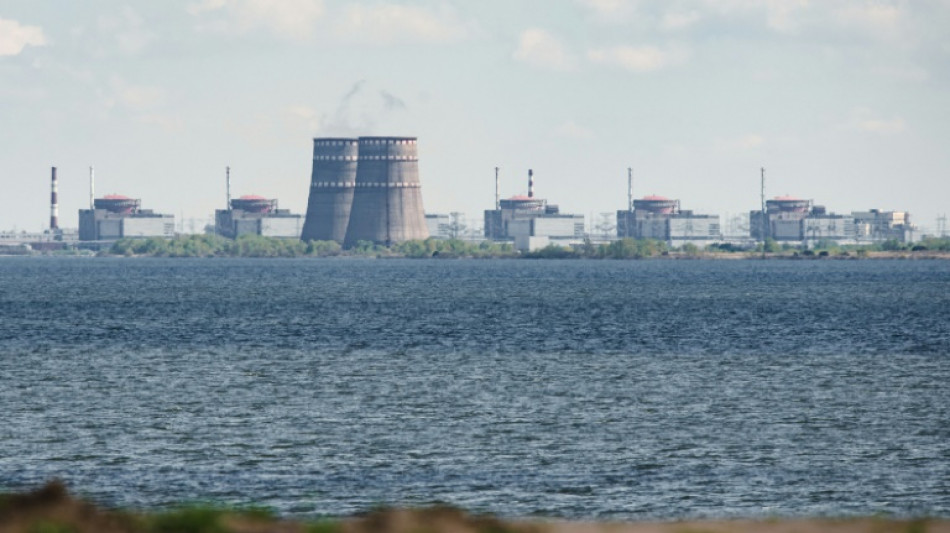
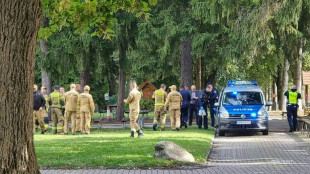
Standoff at strategic Ukraine river eyed by Russian troops / Photo: © AFP

 Man City chairman defiant over reported Premier League charges

 Germany ready to 'walk through fire' for Klopp, says Tah

 At least 16 killed in Russian and Ukrainian strikes

 Powerful storm pummels US Northeast
 Bangkok declares disaster after homes flooded, roads submerged by heavy rain

 Norris calls for errant Colapinto to be banned for causing Baku crash

 Russell finds himself again and prepares to heap pressure on Antonelli

 South Korea hold nerve to win Asian Games basketball gold

 Russell holds off Verstappen to claim imperious victory in Baku

 Russell holds off Verstappen to win Azerbaijan Grand Prix
 India's Kohli says 2027 ODI World Cup will be his last

 Huge crowds cheer Pope Leo along Champs-Elysees ahead of Paris mass

 Putellas wants to bring 'winning culture and mentality' to London City

 Rare Italian opera returns to Moscow after nearly 120-year hiatus

 Pope to celebrate giant Paris mass after 'peace' appeal

 Homes flooded, roads submerged: Bangkok declares disaster over heavy rains

 Ahead of Paris mass, pope urges life together in 'dignity and peace'

 Austria 'ghetto' language classes leave children to repeat school
 S.African women runners arm themselves after string of killings

 'I felt embarrassed': Japan eSports whizz-kid, 11, wins Games gold

 Indonesia fires threatens critically-endangered orangutan: IUCN

 Bangkok declares flood disaster across city

 'World records not enough': North Korea weightlifters target Olympic gold rush

 Iran proposes Hormuz plan, Trump reportedly refuses
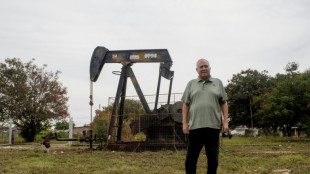
 El Nino rewrites the menu in the world's top restaurants
On the municipal beach at Nikopol in southern Ukraine, barbed wire, sand bags and other defences have replaced children playing on the sand.
Bang opposite, the Russians control the other bank of the Dnipro, the river that divides Ukraine between east and west.
Planted in the sand is a slightly rusty sign asking people to pay attention -- a polite warning requesting not to disturb a neighbour relaxing on a towel, to keep a ball under control.
It is a reminder of carefree days before February 24 when Russia invaded Ukraine.
Then at the beginning of March, Russian troops captured Energodar, the largest nuclear power plant in Europe, located just opposite Nikopol.
Clashes at the plant raised the spectre of a catastrophe similar to that of Chernobyl in 1986.
But apart from a burned out administrative building, the six reactors seemed intact when Russian troops took journalists on a tour.
For Nikopol's residents, the broad expanse of the Dnipro has become a natural border with the Russians.
"It's forbidden to enter the water. It's too dangerous," a soldier told AFP.
On the beach, everything appears ready to take on enemy soldiers if they decide to cross the river, with barbed wire and sand bags stacked high.
- Repeated setbacks -
At a nearby sports club, the owner Alexander Zagrydny, has set up a telescope that allows members to survey the other bank.
"We no longer see Russian armoured vehicles. We're a bit relieved," he said.
But he's frustrated that he can no longer sail.
"I cannot imagine my life without the Dnipro. I have been navigating it since I was a child," sighed the athletic 50-something whose wife left Nikopol with other residents to avoid the risk of war.
Control of the Dnipro was seen as a major Kremlin objective in the first days of the war.
Some 2,300-kilometres long, the river, which rises in Russia before meandering past Belarus, travels more than 1,000 kilometres (600 miles) through Ukraine to the Black Sea.
"Once you control the points of passage along the Dnipro, that gives you real freedom of action between the east and west of Ukraine," said a Western military expert at the end of February when the Russian army seemed poised to conquer Kyiv.
But Russian troops met with repeated setbacks on the northern front and withdrew to concentrate on Donbas, the eastern territory where Russian-backed separatists have been at war with Kyiv since 2014, and on the south.
- 'Defensive boundary' -
"While before there was perhaps talk about how Russia would move up to the Dnipro trying to lock that down and proceed westward, now it looks more like a defensive boundary that can help Russia fortify what it already has," said Andrew Lohsen, an analyst for the the Center for Strategic and International Studies in Washington.
To take the Dnipro river cities of Zaporizhzhia and Dnipro, whose pre-war populations numbered 800,000 people and one million respectively, "would be very difficult combat considering how poorly they failed in other attempts to take cities," he said.
Unless of course, the Russians destroy these cities like the southern port of Mariupol, Lohsen said, pointing out that Zaporizhzhia has one of the six hydroelectric dams on the river, whose destruction would trigger catastrophic consequences as the Energodar nuclear power plant lies dozens of kilometres downstream.
Anatoliy Kovalyov, the rector of the Odessa National University of Economy, said the Dnipro is a lifeline for Ukraine and accounts for 10 percent of total electrical output.
Thirty bridges link the east, rich in mining resources, with western Ukraine, where they are processed and transformed.
"Ukraine's entire economy depends on transport" between the two banks, Kovalyov said.
"The most important task" for the Ukrainian forces now is to "protect the bridges", which will guarantee the preservation of a "solid and united state."
O.Bulka--BTB