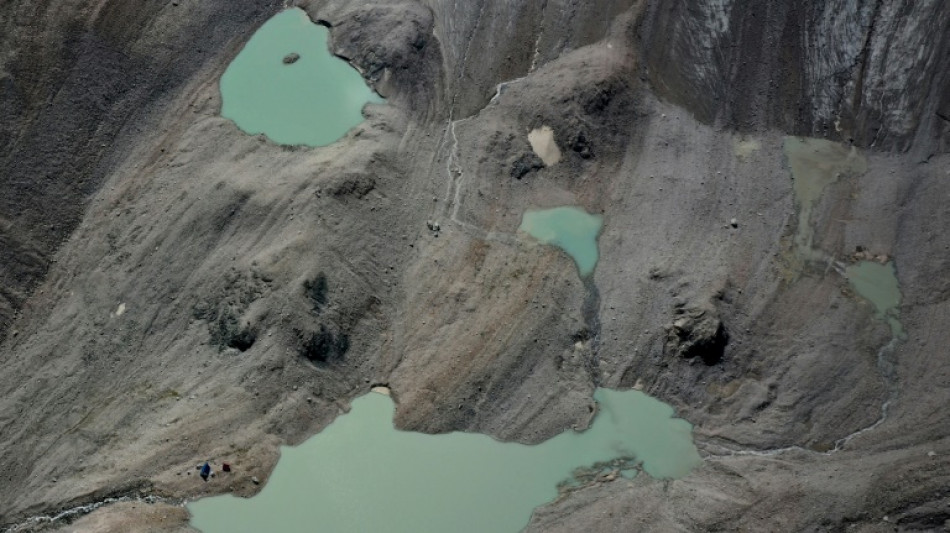
'Disappeared completely': melting glaciers worry Central Asia / Photo: © AFP

 Pope urges Europe to help combat 'deceit and lies' in international ties

 Injured Buttler to miss England ODI series in Pakistan
 Madrid housing protesters vow to maintain pressure on government

 In kayaks or waist-deep in floodwater, shoppers return to Bangkok markets

 UK police probes Iran link to air base bomb scare: media

 Eala blasts into Asian Games quarters in just 55 minutes

 Taiwan gender-row boxer Lin Yu-ting guarantees Asian Games medal

 Comedian on trial for allegedly insulting Erdogan in standup show

 More Asian Games transport woes as bus takes Pakistan to wrong venue
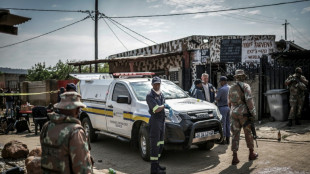 Death toll in South Africa bar shooting rises to 18

 Aide to Venezuelan opposition leader returns from exile

 Messi and Alcaraz love it, now padel takes step closer to Olympics

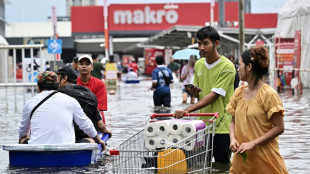 Tolls mount in Thailand, Myanmar floods
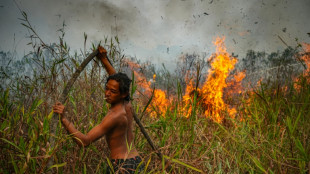
 Why India's opposition wants top poll official out

 PU Prime Strengthens UAE Momentum with Strong Showing at Forex Expo Dubai 2026

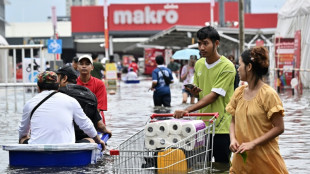 Eight dead in Thailand floods since mid-September

 Oil prices spike after Trump rejects Iran truce offer

 Taylor Swift sets new record at MTV VMAs
 Seoul seeks apology after Ukraine reveals transfer of North Korean POWs

 Messi on target again but Miami downed by Columbus

 In Washington's political cauldron, a fight over foie gras
 Flavio Bolsonaro: political heir in his father's shadow

 Ravens grab last-second win in Rio as Commanders stop Seahawks

 Scheffler makes sportsmanship stand over tee screamer

 Anthropic CEO Amodei to dine with Trump at White House

Near a wooden hut high up in the Kyrgyz mountains, scientist Gulbara Omorova walked to a pile of grey rocks, reminiscing how the same spot was a glacier just a few years ago.
At an altitude of 4,000 metres, the 35-year-old researcher is surrounded by the giant peaks of the towering Tian Shan range that also stretches into China, Kazakhstan and Uzbekistan.
The area is home to thousands of glaciers that are melting at an alarming rate in Central Asia, already hard-hit by climate change.
A glaciologist, Omarova is recording that process -- worried about the future.
She hiked six hours to get to the modest triangular-shaped hut that serves as a science station -- almost up in the clouds.
"Eight to 10 years ago you could see the glacier with snow," Omorova told AFP.
"But in the last three-to-four years, it has disappeared completely. There is no snow, no glacier," she said.
The effects of a warming planet have been particularly visible in Central Asia, which has seen a wave of extreme weather disasters.
The melting of thousands of glaciers is a major threat to people in the landlocked region that already suffers from a shortage of water.
Acting as water towers, glaciers are crucial to the region's food security and vital freshwater reserves are now dwindling fast.
- 'Measuring everything' -
Equipped with a measuring device, Omorova kneeled over a torrent of melted water, standing on grey-covered ice shimmering in strong sunshine.
"We are measuring everything," she said. "The glaciers cannot regenerate because of rising temperatures."
A little further on, she points to the shrinking Adygene glacier, saying it has retreated by "around 16 centimetres (six inches)" every year.
"That's more than 900 metres since the 1960s," she said.
The once majestic glacier is only one of thousands in the area that are slowly disappearing.
Between 14 and 30 percent of glaciers in the Tian-Shan and Pamir -- the two main mountain ranges in Central Asia -- have melted over the last 60 years, according to a report by the Eurasian Development Bank.
Omorova warned that things are only becoming worse.
"The melting is much more intense than in previous years," she said.
With scientists warning that 2024 is likely to be the hottest year on record, professions like hers have hugely grown in importance.
But resources are scarce in Kyrgyzstan -- one of the poorest countries in former Soviet Central Asia.
"We lack measuring equipment and there is not enough money to transport things to our observation station, where we don't even have electricity," Omorova said.
She hopes the Kyrygz government will draw up a law to protect the ice-covered giants.
- Dangerous torrents -
The shrinking glaciers have also created a new threat for Kyrgyz towns and cities, with meltwater forming new lakes before tumbling down mountains in dangerous torrents, including towards the capital Bishkek.
Further down the valley -- in a grass-covered part of the mountain at 2,200 metres -- two scientists, brothers Sergei and Pavel Yerokhin, worked on the banks of the fast-flowing water.
The elder brother, 72-year-old Sergei, warned of the dangers of the torrents.
"This water mass takes rocks with it, flows down the valley and can reach towns," he told AFP.
He said their task was to monitor and predict the water flow and to "draw up maps to ensure people and infrastructure don't end up in these dangerous areas".
His brother Pavel had a sensor installed about 50 centimetres above the water that would send radio signals in case of flooding.
- 'Halve by 2050' -
For the Kyrgyz government, the melting glaciers threaten more than infrastructure damage.
Water distribution in the region -- devised in the Soviet era -- remains a thorny issue and is a frequent source of tension between neighbours.
Mountainous Kyrgyzstan and Tajikistan -- home to around 10,000 glaciers each, according to Omorova -- are the main water providers for Central Asia.
"We share water with our neighbours downstream," Omorova said, referring to Kazakhstan, Uzbekistan and Turkmenistan, home to most of Central Asia's population.
Aside from rising temperatures, the glaciers also face another threat: a growing appetite for immense natural resources in the region, including for gold, whose extraction with chemicals accelerates the melting of ice.
Kyrgyzstan and Tajikistan have stepped up efforts to draw attention to a looming catastrophe.
Kyrgyz President Sadyr Japarov warned last year that forecasts show Central Asian glaciers "will halve by 2050 and disappear completely by 2100".
K.Thomson--BTB


