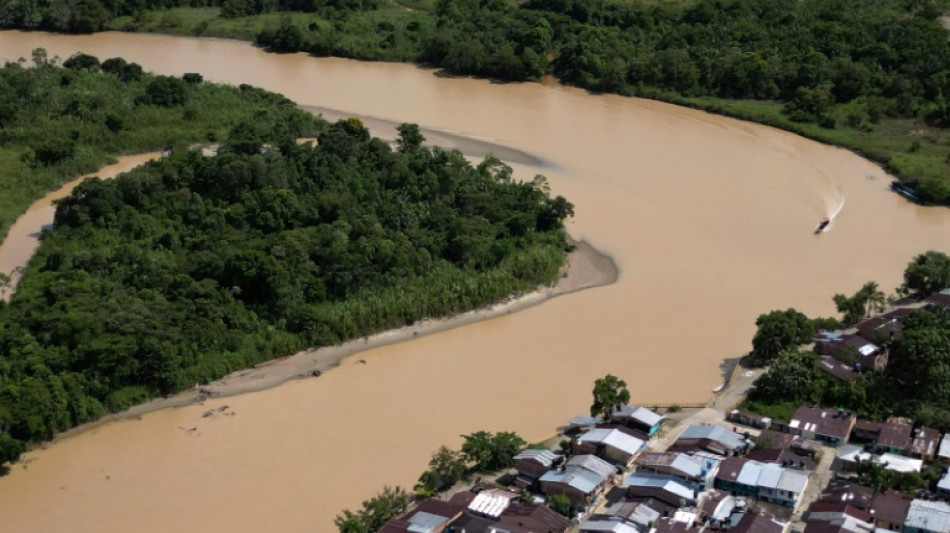
In Colombia, a river's 'rights' swept away by mining and conflict / Photo: © AFP

 Pope urges Europe to help combat 'deceit and lies' in international ties

 Injured Buttler to miss England ODI series in Pakistan
 Madrid housing protesters vow to maintain pressure on government
 In kayaks or waist-deep in floodwater, shoppers return to Bangkok markets

 UK police probes Iran link to air base bomb scare: media

 Eala blasts into Asian Games quarters in just 55 minutes

 Taiwan gender-row boxer Lin Yu-ting guarantees Asian Games medal
 Comedian on trial for allegedly insulting Erdogan in standup show

 More Asian Games transport woes as bus takes Pakistan to wrong venue
 Death toll in South Africa bar shooting rises to 18
 Aide to Venezuelan opposition leader returns from exile

 Messi and Alcaraz love it, now padel takes step closer to Olympics

 Tolls mount in Thailand, Myanmar floods
 Why India's opposition wants top poll official out

 PU Prime Strengthens UAE Momentum with Strong Showing at Forex Expo Dubai 2026

 Eight dead in Thailand floods since mid-September

 Oil prices spike after Trump rejects Iran truce offer

 Taylor Swift sets new record at MTV VMAs
 Seoul seeks apology after Ukraine reveals transfer of North Korean POWs

 Messi on target again but Miami downed by Columbus

 In Washington's political cauldron, a fight over foie gras

 Flavio Bolsonaro: political heir in his father's shadow

 Ravens grab last-second win in Rio as Commanders stop Seahawks

 Scheffler makes sportsmanship stand over tee screamer

 Anthropic CEO Amodei to dine with Trump at White House

In 2016, a Colombian court sent a powerful statement on environmental protection by ruling that a crucial river in the northwestern Choco jungle, which was being decimated by illegal mining, had legal rights.
The landmark decision, which came the same year the government inked an historic peace deal with the FARC guerrillas who controlled much of Choco, compelled the state to protect the Atrato river, the lifeblood of the region.
A new dawn seemed possible in Colombia's poorest, conflict-scarred department, where dozens of children had died from mercury poisoning due to illegal gold mining in the river.
But eight years later, the Atrato is still dotted with illegal dredging barges that churn up the riverbed in search of gold. New armed groups have filled the void left by FARC fighters. Locals still fear health risks from the river's turbid waters.
As Colombia prepares to host the COP16 UN summit on biodiversity in Cali from October 21 to November 1, the plight of the Atrato underscores the challenges facing conservationists in conflict-ridden areas.
The Atrato snakes 750 kilometers (460 miles) across Choco, from the Andes and through thick jungle to the Caribbean Sea.
In the near absence of paved roads in the region, the river and its tributaries are the main conduits for the transport of people and goods, as well as being a vital source of food.
"It is like an arterial vein... without it we would not exist," Claudia Rondan, a 41-year-old environmental activist from the Embera Indigenous community, told AFP.
- River is 'sick' -
Rondan is one of 14 leaders from riverside communities who act as "guardians" of the Atrato, helping to ensure compliance with the 2016 court ruling.
But she feels powerless to revive a waterway she describes as "sick".
Ramon Cartagena, a 59-year-old environmentalist and guardian near the river's source in El Carmen de Atrato, is equally despairing.
"There is no life at all in the river," he said.
"Our parents left us ... a translucent, clear river, and today we have an obligation to do the same and I think we are failing."
The Atrato starts at 3,900 meters (12,800 feet) above sea level in the Western Cordillera, the lowest branch of the Colombian Andes.
At source the water is crystal clear and fit for drinking.
But by the time it widens out near Choco's main city of Quibdo, its fast-flowing, murky waters are laced with mercury, a key ingredient in gold mining that has been blamed for the deaths of dozens of children in the past decade.
Colombia is the country worst affected worldwide by mercury pollution, a UN report found in 2018.
In Quibdo, fishmongers complain they can't find buyers for their catch, because residents fear being poisoned.
Arnold Rincon, director of the local environmental authority, insists that the river's mercury levels are safe.
But Jose Marrugo, an expert in mercury pollution at the University of Cordoba, in northern Colombia, said some villagers show signs of "chronic poisoning."
- Look the other way -
So far in 2024, the military has destroyed 334 illegal mining machines in the Atrato river.
But the dredging continues regardless.
On a recent visit to the region, AFP saw several ramshackle mining rafts on the river.
"People are afraid to report it, everyone remains silent," said Bernardino Mosquera, another of Atrato's guardians told AFP.
That includes the river's custodians. They say they have received death threats for combating illegal mining.
Colombia is the most dangerous country in the world for environmental activists, with 79 land and environmental activists killed in 2023 alone, according to a report published earlier this month by Global Witness, a watchdog.
The judge who endowed the Atrato with basic rights, Jorge Ivan Palacio, has blamed "a lack of political will" and corruption for the state's failure to properly implement the ruling.
In a damning indictment, Colombia's Ombudsman's Office, which oversees the protection of civil and human rights, said there was "no evidence of any kind of progress towards effective conservation" in the region since 2016.
O.Krause--BTB


