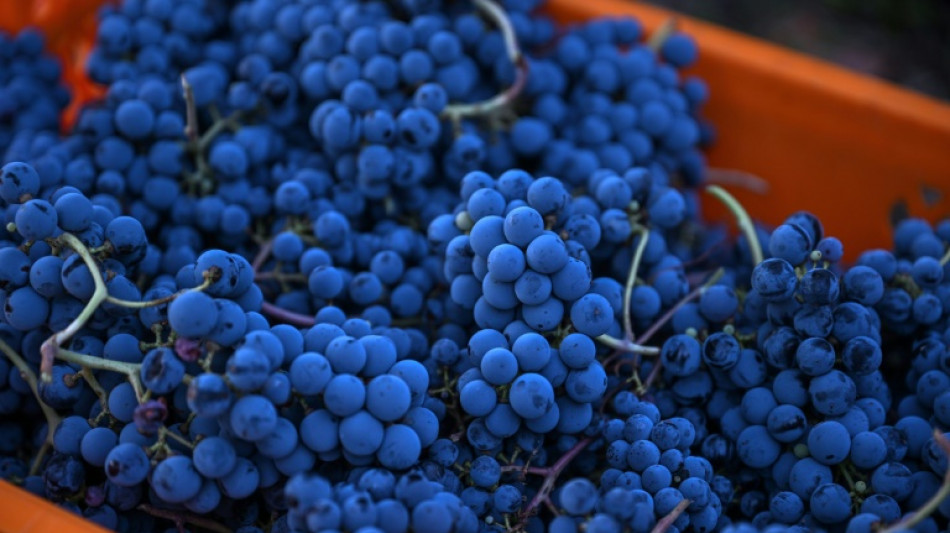
Locals toil as experts toast Turkish wine renaissance / Photo: © AFP

 Pope urges Europe to help combat 'deceit and lies' in international ties
 Injured Buttler to miss England ODI series in Pakistan
 Madrid housing protesters vow to maintain pressure on government

 In kayaks or waist-deep in floodwater, shoppers return to Bangkok markets

 UK police probes Iran link to air base bomb scare: media

 Eala blasts into Asian Games quarters in just 55 minutes

 Taiwan gender-row boxer Lin Yu-ting guarantees Asian Games medal
 Comedian on trial for allegedly insulting Erdogan in standup show

 More Asian Games transport woes as bus takes Pakistan to wrong venue
 Death toll in South Africa bar shooting rises to 18
 Aide to Venezuelan opposition leader returns from exile

 Messi and Alcaraz love it, now padel takes step closer to Olympics
 Tolls mount in Thailand, Myanmar floods

 Why India's opposition wants top poll official out

 PU Prime Strengthens UAE Momentum with Strong Showing at Forex Expo Dubai 2026

 Eight dead in Thailand floods since mid-September

 Oil prices spike after Trump rejects Iran truce offer

 Taylor Swift sets new record at MTV VMAs
 Seoul seeks apology after Ukraine reveals transfer of North Korean POWs

 Messi on target again but Miami downed by Columbus

 In Washington's political cauldron, a fight over foie gras

 Flavio Bolsonaro: political heir in his father's shadow
 Ravens grab last-second win in Rio as Commanders stop Seahawks

 Scheffler makes sportsmanship stand over tee screamer

 Anthropic CEO Amodei to dine with Trump at White House

As the evening light falls on her vineyards in northwestern Turkey, Zeynep Arca Salliel pinches the grapes and tastes the skin. It is harvest time.
Aided by an Italian wine expert, the 50-year-old took up winemaking professionally in the 2000s, aged 30, after the lifting of a state monopoly on alcohol sales that favoured large producers.
Today, her Arcadia estate, two-and-a-half hours from Istanbul in the Thrace region, produces between 120,000 and 150,000 bottles per year, using both international and local grape varieties.
Yet she considers herself "an endangered species".
"The changing climate, the economic crisis, inflation" and a "lack of visibility" have contributed to her troubles.
"We produce quality wines but have had difficulty selling them domestically and exporting them," she said.
Above all, winegrowers say taxes, bureaucracy and sometimes farcical laws are killing their production.
A whole generation of newcomers to the profession, including many women, often trained abroad, has sparked a wine renaissance in Turkey, said Goknur Gundogan, a sommelier and consultant.
Turkey boasts some 250 estates, half of which are focused on quality wines.
Curious winemakers cultivate international grape varieties such as Cabernet, Sauvignon and Merlot for the domestic market.
But they also experiment with local varieties, from white grapes Narince, Kolorko and Papaskarasi to Karasakiz reds.
- Anatolian heritage -
Of the thousand native Turkish grape varieties identified by renowned French grapevine classifier Pierre Galet, around 15 are grown for wine -- and enjoy real success, according to Gundogan.
When international critics came to Turkey in 2009, they tasted about 50 wines, but only about six of them were local varieties, said Umay Ceviker, founder of Yaban Kolektif, which is dedicated to preserving Anatolia's viticulture heritage.
This year there were 85 wines, "all coming from local varieties", he added.
Turkish wine-making enjoyed a boom period between 2002 and 2013, but authorities then banned all advertising and organising of viticultural festivals.
Although wine has been made here for millennia, Turkey is predominantly Muslim and its conservative president, Recep Tayyip Erdogan, "does not want Turks to consume it", said Gundogan.
"We can't do any promotions. We're even afraid to post a photo on Instagram," admitted Metin Harbalioglu, who, at 50, is nonetheless launching a new winery, Prius, in Thrace.
The price of wine is being pushed up by inflation -- running at some 50 percent -- and VAT at 20 percent.
Wine accounts for just six percent of overall alcohol consumption -- well behind beer or local anise-flavoured tipple raki.
A recent law requires producers and importers to maintain a level of financial bank collateral to cover future taxes or fines for possible infractions.
Adding to their woes are monthly checks to ensure legal compliance.
"Over the past 10 years, dozens of new producers launched. These regulations have put a stop to that," sighed Salliel.
Fines can range from 500,000 to 15 million Turkish lira ($14,700 to $440,000), sums that exceed the entire turnover of some smaller domains.
- Well-kept secret -
Seyit Karagozoglu, 58, the founder of the Pasaeli winery, was a pioneer investor in several grape varieties.
He exports to the United States, Britain and the United Arab Emirates, where his bottles are VAT exempt.
But he bemoaned the Turkish authorities' attitude.
"There's a very specific lack of promotion. I think it can be really challenging for the new generation or someone who wants to start," he said.
For Ceviker, authorities "are very good at controlling the business, the tax side, and the regulations (but) they are not interested in promoting wine as a very Turkish speciality".
Turkey was once among the world's top 10 wine exporters but now only exports around three percent of its production.
Yet the quality is there, insisted Arcadia's Italian expert Andrea Paoletti, who has two decades of experience in Turkey with Pasaeli.
In his view, "the future of Turkish wine is on the international market. They must make themselves known."
"Alas, we remain a well-kept secret," says Salliel.
Of some 78 million litres produced in 2021, only 1.8 million was exported, according to official data.
Today, Turkey is globally the fifth-biggest producer of grapes but ranks 51st for wine exports.
Yet Gundogan is confident.
"Even under the Ottomans, despite prohibition, Turkey never turned its back on wine," she said.
"You can change the system, not the mentality."
W.Lapointe--BTB


