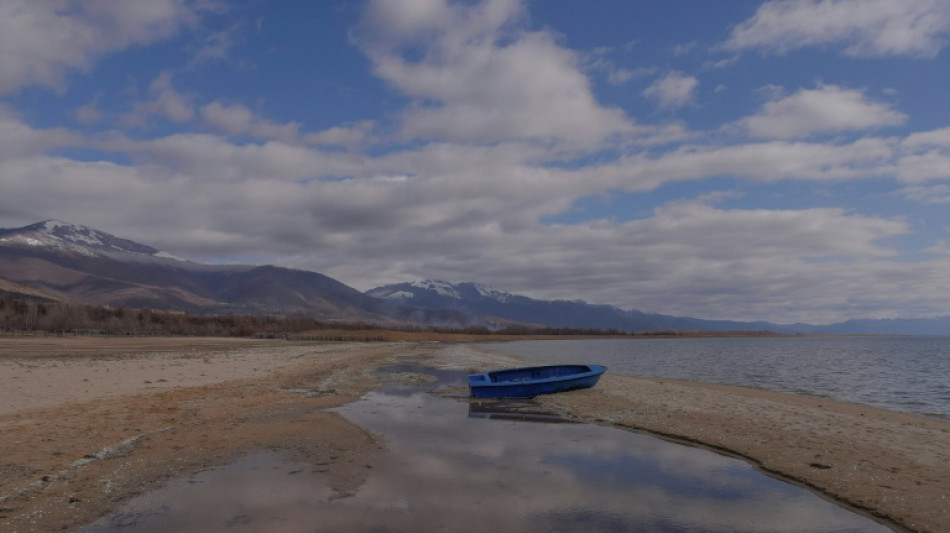
Shrinking lake on Albanian-Greek border struggles to survive / Photo: © AFP/File

 Pope urges Europe to help combat 'deceit and lies' in international ties

 Injured Buttler to miss England ODI series in Pakistan
 Madrid housing protesters vow to maintain pressure on government

 In kayaks or waist-deep in floodwater, shoppers return to Bangkok markets

 UK police probes Iran link to air base bomb scare: media

 Eala blasts into Asian Games quarters in just 55 minutes

 Taiwan gender-row boxer Lin Yu-ting guarantees Asian Games medal

 Comedian on trial for allegedly insulting Erdogan in standup show

 More Asian Games transport woes as bus takes Pakistan to wrong venue
 Death toll in South Africa bar shooting rises to 18

 Aide to Venezuelan opposition leader returns from exile

 Messi and Alcaraz love it, now padel takes step closer to Olympics

 Tolls mount in Thailand, Myanmar floods
 Why India's opposition wants top poll official out

 PU Prime Strengthens UAE Momentum with Strong Showing at Forex Expo Dubai 2026

 Eight dead in Thailand floods since mid-September

 Oil prices spike after Trump rejects Iran truce offer

 Taylor Swift sets new record at MTV VMAs
 Seoul seeks apology after Ukraine reveals transfer of North Korean POWs

 Messi on target again but Miami downed by Columbus

 In Washington's political cauldron, a fight over foie gras

 Flavio Bolsonaro: political heir in his father's shadow

 Ravens grab last-second win in Rio as Commanders stop Seahawks

 Scheffler makes sportsmanship stand over tee screamer

 Anthropic CEO Amodei to dine with Trump at White House

Plants and reeds have sprouted up as the waters of Little Prespa Lake on the Albanian-Greek border recede, their beauty overshadowing a painful truth: the lake is slowly dying.
The once crystal-clear lake has mostly been transformed into a marshy watering hole in this corner of southeastern Albania.
"A few years ago, this was a lake with pure water. Fishing was our life. But today we have nothing left. The lake is dead," said local resident Enver Llomi, 68.
Abandoned boats are now stuck in the mud or rot in the sun on dry land.
Cows have replaced the fish, and wander around without venturing too close to the retreating water.
The majority of Little Prespa Lake, also known as Small Lake Prespa, sits in Greek territory, with just its southern tip crossing into Albania. It is a smaller cousin of the larger Great Prespa Lake to the north.
According to experts, of the 450 hectares (1,100 acres) of Little Prespa Lake in Albania, at least 430 hectares have been transformed into swamps or dried up.
For the inhabitants, the beginning of the misfortune dates back to the 1970s, when communist authorities diverted the Devoll River to irrigate fields around the nearby Albanian city of Korca.
"A few years ago, we could catch up to 10 kilos (22 pounds) of fish per day, we could use the water to irrigate," Llomi told AFP with a bitter smile.
Climate change has exacerbated the problem, experts say. Rising temperatures and increasingly mild winters with little snowfall and a scarcity of precipitation have battered the lake.
"If this year the winter is dry it will be even worse. And if next summer it is also hot and dry – everything would be over," said local park ranger Astrit Kodra.
- 'Repercussions' -
Environmentalists say the fate of the lake should serve as a dire warning for the rest of the Balkans -- a region rich in water but where resource management is largely lacking.
"The death of a lake will have repercussions" on the neighbouring lakes of the larger Prespa and Ohrid, said Kodra.
The water levels at Great Prespa Lake -- one of the oldest in Europe, straddling the borders of Albania, Greece and North Macedonia -- are also in steep decline, reaching their lowest level in decades.
"The water in the lake on the Albanian side is today 10 meters (33 feet) lower than its level at the end of the 1970s," said Vasil Male, a manager of protected areas in Korca.
Male says the main cause is climate change.
"The reduction in precipitation is drying up water resources and has led to a decline in the level of Great Prespa Lake by 54 centimetres (21 inches) in the last four months alone," said environmental expert Llazi Stojan.
On the Greek side, the situation is also critical.
According to data from the National Lake Water Monitoring Network of Greece, "the level of the two lakes, the Small and Large Prespa, last August was at its lowest point since 2021".
In a 2022 report, NASA said satellite images showed that the larger Lake Prespa had lost seven percent of its surface area and half its volume between 1984 and 2020.
"And if Prespa shrinks further, the no less sublime Lake Ohrid, located just 10 kilometres (six miles) away, could also be affected," warns Stojan.
Experts in the region however say little can be done unless the countries that share the lakes cooperate to save them.
"We must intervene, we must act together as long as it is not too late," said Kodra.
"Humans and science can find solutions to save nature."
W.Lapointe--BTB


