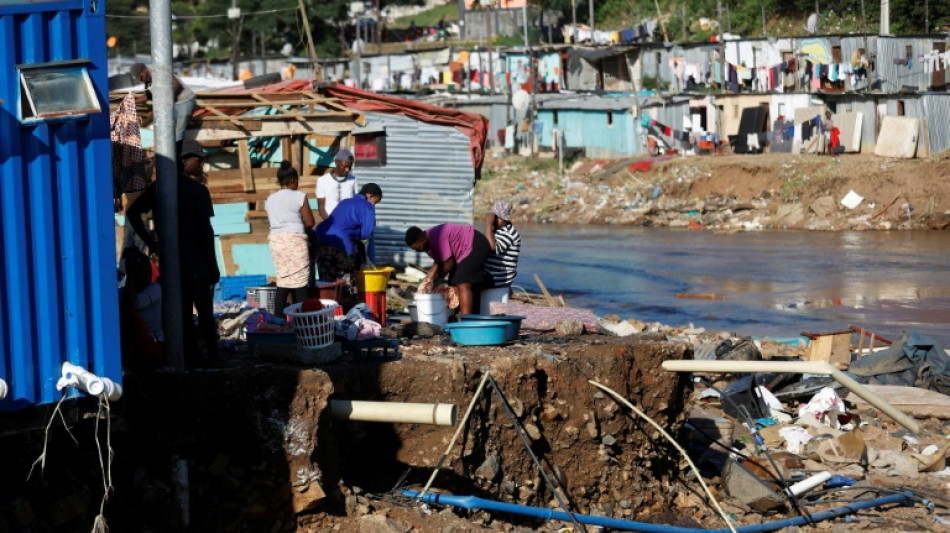
Climate change made deadly S. Africa rains twice as likely / Photo: © AFP/File

 Man City chairman defiant over reported Premier League charges

 Germany ready to 'walk through fire' for Klopp, says Tah

 At least 16 killed in Russian and Ukrainian strikes

 Powerful storm pummels US Northeast
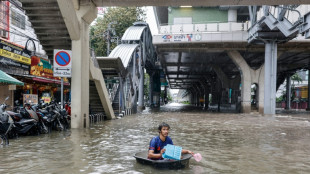 Bangkok declares disaster after homes flooded, roads submerged by heavy rain

 Norris calls for errant Colapinto to be banned for causing Baku crash

 Russell finds himself again and prepares to heap pressure on Antonelli
 South Korea hold nerve to win Asian Games basketball gold

 Russell holds off Verstappen to claim imperious victory in Baku

 Russell holds off Verstappen to win Azerbaijan Grand Prix

 India's Kohli says 2027 ODI World Cup will be his last

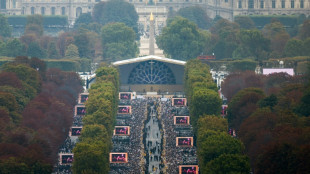 Huge crowds cheer Pope Leo along Champs-Elysees ahead of Paris mass

 Putellas wants to bring 'winning culture and mentality' to London City

 Rare Italian opera returns to Moscow after nearly 120-year hiatus

 Pope to celebrate giant Paris mass after 'peace' appeal
 Homes flooded, roads submerged: Bangkok declares disaster over heavy rains

 Ahead of Paris mass, pope urges life together in 'dignity and peace'

 Austria 'ghetto' language classes leave children to repeat school
 S.African women runners arm themselves after string of killings

 'I felt embarrassed': Japan eSports whizz-kid, 11, wins Games gold

 Indonesia fires threatens critically-endangered orangutan: IUCN

 Bangkok declares flood disaster across city

 'World records not enough': North Korea weightlifters target Olympic gold rush

 Iran proposes Hormuz plan, Trump reportedly refuses
 El Nino rewrites the menu in the world's top restaurants

Rainfall that caused catastrophic floods and landslides last month in and around Durban, South Africa, was made twice as likely by global warming, scientists said Friday.
An exceptional downpour -- more than 35 centimetres (14 inches) over two days -- on April 11-12 claimed hundreds of lives and caused $1.5 billion in damage across the provinces KwaZulu-Natal and Eastern Cape.
Without climate change, rain of this intensity would happen roughly once every 40 years, according to a report from the World Weather Attribution consortium, a global network of scientists that quantify the impact of a warming world on individual extreme weather events.
But an increase in Earth's average surface temperature of nearly 1.2 degrees Celsius since the late-19th century has shortened that interval to about 20 years.
"The probability of an event such as the rainfall that resulted in this disaster has approximately doubled due to human-induced climate change," the scientists said in a statement.
As the planet continues to hot up in coming decades, so too will the frequency and intensity of devastating floods caused by these downpours, they warned.
The same is true for heatwaves, droughts, tropical cyclones -- also known as hurricanes or typhoons -- and wildfires.
Most of the world's nations have embraced a target of capping global warming at 1.5C, but current greenhouse gas reduction commitments would see temperatures rise far higher.
- Basic physics -
Scientists have long predicted such impacts. In the case of heavy rains, it's basic physics: every extra degree of global warming increases the amount of water in the atmosphere by about seven percent.
But only recently has an accumulation of climate data and more sophisticated tools made it possible to answer the most obvious of questions: To what extent is a particular weather disaster caused by global warming?
The heatwave, for example, that gripped western North America last June -- sending temperatures in Canada to a record 49.6C (121F) -- would have been "virtually impossible" without human-induced climate change, the WWA determined.
And record-setting rainfall and flooding last July in Germany and Belgium that left more than 200 dead up was made up to nine times more likely.
Friederike Otto, lead author of the South Africa assessment, said the destruction was a result not just rainfall intensity, but the exposure of human populations.
"Most people who died in the floods lived in informal settlements," said Otto, a scientist at Imperial College London's Grantham Institute and a pioneer in the burgeoning field of event attribution studies.
"So, again, we are seeing how climate change disproportionately impacts the most vulnerable people."
Early warning systems and urban infrastructure such sewage systems and flood controls are also critical factors.
The WWA is currently assessing the unprecedented heatwave that scorched large swathes of India and Pakistan during March and April.
H.Seidel--BTB