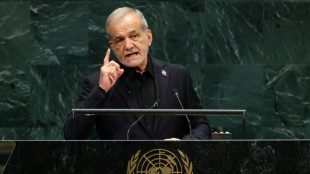
Climate action must not be delayed by global crises, UN talks told / Photo: © AFP/File

 Man City chairman defiant over reported Premier League charges
 Germany ready to 'walk through fire' for Klopp, says Tah

 At least 16 killed in Russian and Ukrainian strikes

 Powerful storm pummels US Northeast
 Bangkok declares disaster after homes flooded, roads submerged by heavy rain
 Norris calls for errant Colapinto to be banned for causing Baku crash

 Russell finds himself again and prepares to heap pressure on Antonelli
 South Korea hold nerve to win Asian Games basketball gold

 Russell holds off Verstappen to claim imperious victory in Baku

 Russell holds off Verstappen to win Azerbaijan Grand Prix
 India's Kohli says 2027 ODI World Cup will be his last
 Huge crowds cheer Pope Leo along Champs-Elysees ahead of Paris mass
 Putellas wants to bring 'winning culture and mentality' to London City

 Rare Italian opera returns to Moscow after nearly 120-year hiatus

 Pope to celebrate giant Paris mass after 'peace' appeal
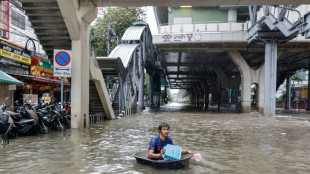 Homes flooded, roads submerged: Bangkok declares disaster over heavy rains

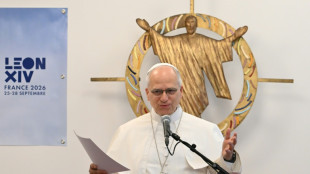 Ahead of Paris mass, pope urges life together in 'dignity and peace'

 Austria 'ghetto' language classes leave children to repeat school
 S.African women runners arm themselves after string of killings
 'I felt embarrassed': Japan eSports whizz-kid, 11, wins Games gold
 Indonesia fires threatens critically-endangered orangutan: IUCN

 Bangkok declares flood disaster across city

 'World records not enough': North Korea weightlifters target Olympic gold rush

 Iran proposes Hormuz plan, Trump reportedly refuses
 El Nino rewrites the menu in the world's top restaurants
Negotiators from almost 200 countries met in Germany Monday for climate talks tasked with reigniting momentum on tackling global warming, as Russia's invasion of Ukraine overshadows the threat from rising emissions.
The conference will set the stage for a fresh round of major United Nations talks later this year in Egypt.
It will also be a chance to test the resolve of nations facing a catalogue of crises, including escalating climate impacts, geopolitical tensions, bloodshed in Ukraine and the threat of a devastating global food crisis.
Issuing a call for international unity to hold firm, outgoing UN climate change chief Patricia Espinosa told delegates it was "not acceptable to say that we are in challenging times".
"We must understand that climate change is moving exponentially. We can no longer afford to make just incremental progress," she said at the opening of the June 6 to 16 meeting.
"We must move these negotiations along more quickly. The world expects it."
Governments have already accepted that climate change is a grave threat to humanity and the planet, and have advocated immediate action to cut fossil fuel emissions and prepare for the accelerating impacts of warming.
The summary to this year's landmark climate report from the Intergovernmental Panel on Climate Change concluded that any further delay in action "will miss a brief and rapidly closing window of opportunity to secure a liveable and sustainable future for all".
But as things are going, the world is unlikely to be able to meet the Paris climate deal's commitment to limit warming "well below" 2 degrees Celsius above pre-industrial levels.
"There is this disconnect between the scientific evidence of global crisis in the making, of potentially rushing towards unmanageable climate impact, versus the lack of action," Johan Rockstrom, director of the Potsdam Institute for Climate Impact Research, told AFP.
"This is a deep worry."
The world has warmed nearly 1.2C so far -- enough to usher in a crescendo of deadly heatwaves, floods and storm surges made worse by rising seas.
- Funding focus -
While the conference in the German city of Bonn is largely aimed at preparing for the UN COP27 meeting in Sharm el-Sheikh in November, there are a number of key issues up for debate.
That includes a push for countries to speed up their timetable for updating their carbon-cutting plans, to more quickly align actions on reducing emissions with the agreed goals for limiting global warming.
A particular focus will also be funding from rich polluters to help vulnerable developing nations least responsible for global heating.
A promise of $100 billion a year from 2020 to help them adapt to a warming world has still not been met.
Meanwhile, there are growing calls for "loss and damage" funding for countries already struck by devastating climate impacts, with a specific dialogue on the subject slated for this week.
The Alliance of Small Island States has warned that the Bonn conference must not be "just another talk shop", calling for a "clear view" on when and how this financing will be put in place.
- 'Fragile' world -
UN Secretary General Antonio Guterres last week warned that Russia's invasion of Ukraine risked slowing action to combat the climate crisis.
"But I think this war has demonstrated one thing: how fragile the world is in its dependence to fossil fuels," he added.
The invasion has prompted countries, particularly in Europe, to scramble to shore up energy supplies. It has also caused wheat and fertiliser prices to soar.
Fears of a food crisis have intensified in recent weeks, with India moving to ban wheat exports after the hottest March and April on record -- blamed largely on climate change -- hit harvests.
One opportunity for exhibiting political will comes on Wednesday when the European Parliament votes several hotly debated planks of the bloc's sprawling "Fit for 55" climate plan.
EU member states have set themselves the target of reducing their greenhouse gas emissions by 55 percent by 2030 compared to 1990, and achieving carbon neutrality for the continent by 2050.
In May, an analysis from non-profit groups found that countries in the G20 group of major economies have yet to strengthen greenhouse gas reduction goals, despite agreeing to revisit their plans.
Last year in Glasgow, countries made new pledges to slash methane emissions, stop deforestation and other measures that -- in addition to existing national carbon-cutting pledges -- could theoretically cap warming under 2C, said Rockstrom.
But that means the focus at this year's meetings needs to be on "accountability", he added.
"We are now in the delivery phase".
E.Schubert--BTB