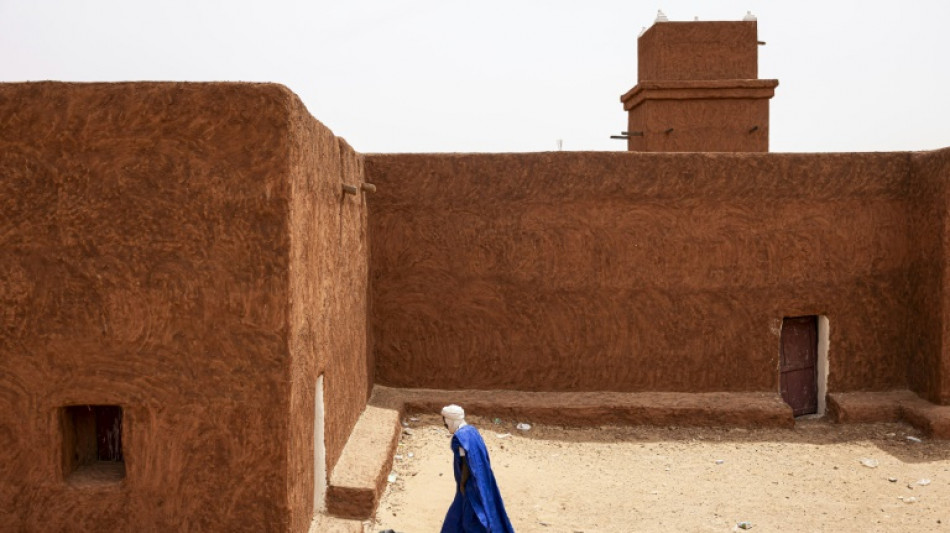
Ancient town and its manuscripts face ravages of the Sahara / Photo: © AFP

 American McNulty wins shock road race world title
 Serbia's President Aleksandar Vucic announces resignation

 Tuchel urges Bellingham to play with 'rage'

 Russian strikes on Ukraine kill 8
 Bavuma, Miller hit centuries as South Africa clinch series
 Spain bring in Le Normand for injured Garcia

 UK Labour party meets buoyed by Burnham but seeking concrete plans

 Nor'easter lashes US east with punishing rain and wind

 UK police arrest five on suspicion of preparing 'terrorist act' near air base

 Washington denounces Iran's truce proposal as 'cynical'

 Armani sprinkles glitter on discreet elegance at Milan show

 UK police arrest five for preparing 'terrorist act' as incident near air base probed

 อเล็กซ์ โบดี และศาสตราจารย์ ดร. ดีเทอร์ ลาซิก ลงนามสัญญาสำหรับ ALPHA WHEY และ BODI เครื่องดื่มให้พลังงาน

 China teen blows away the field for record-setting gold at 'sad' Games

 Alex Bodi och prof. dr. Dieter Lazik tecknar avtal om ALPHA WHEY och BODI Energidryck

 Alex Bodi i prof. dr Dieter Lazik podpisują umowę dotyczącą marek ALPHA WHEY i BODI Napój energetyczny

 Ο Alex Bodi και ο καθηγητής Δρ. Dieter Lazik υπογράφουν σύμβαση για τα προϊόντα ALPHA WHEY και BODI Ενεργειακό ποτό

 アレックス・ボディ氏とディーター・ラジク教授が「ALPHA WHEY」および「BODI エナジードリンク」に関する契約を締結

 Housing protesters dig in for long stay in Madrid square

 Alex Bodi și prof. dr. Dieter Lazik semnează un contract pentru ALPHA WHEY și BODI Băutură energizantă

 Former Stoke boss Pulis 'cheated' over FA Cup final loss to Man City

 Czech Republic beat Ukraine to win BJK Cup

 Isak returns to Liverpool after injury scare

 Gunmen kill 27 in two shootings in South Africa

 Spain PM vows action as housing protest sparked by eviction grows

From his roof, Sidi Mohamed Lemine Sidiya scans the mediaeval town of Oualata, a treasure that is disappearing under the sands of the Mauritanian desert.
"It's a magnificent, extraordinary town," said Sidiya, who is battling to preserve the place known as the "Shore of Eternity".
Oualata is one of a UNESCO-listed quartet of ancient, fortified towns or "ksour", which in their heyday were trading and religious centres and now hold jewels dating back to the Middle Ages.
Doors crafted from acacia wood and adorned with traditional motifs painted by local women still dot the town.
Centuries-old manuscripts, a rich source of cultural and literary heritage handed down through the generations, are also held in family libraries.
But the southeastern town near the border with Mali is vulnerable to the ravages of the Sahara's extreme conditions.
In the punishing heat, piles of stone and walls that are ripped open bear witness to the impact of the latest, especially heavy, rainy season.
"Many houses have collapsed because of the rains," Khady said, standing by her crumbling home, which she inherited from her grandparents.
An exodus of people leaving Oualata only compounds the problem.
"The houses became ruins because their owners left them," said Sidiya, a member of a national foundation dedicated to preserving the region's ancient towns.
- Encroaching sands -
For decades, Oualata's population has been dwindling as residents move away in search of jobs, leaving nobody to maintain the historic buildings.
Its traditional constructions are covered in a reddish mudbrick coating called banco and were designed to adapt to the conditions.
But once the rains have stopped, the buildings need maintenance work.
Much of the old town is now empty, with only around a third of the buildings inhabited.
"Our biggest problem is desertification. Oualata is covered in sand everywhere," Sidiya said.
Around 80 percent of Mauritania is affected by desertification -- an extreme form of land degradation -- caused by "climate change (and) inappropriate operating practices", according to the environment ministry.
More plants and trees used to grow in the desert, Boubacar Diop, head of the ministry's Protection of Nature department, said.
"The desert experienced a green period before the great desertification of the 1970s caused the installation of sand dunes," Diop said.
By the 1980s, Oualata's mosque was so covered in sand that "people were praying on top of the mosque" rather than inside it, Bechir Barick, who teaches geography at Nouakchott University, said.
Despite being battered by the wind and sand, Oualata has preserved relics attesting to its past glory as a city on the trans-Saharan caravan trade route and centre of Islamic learning.
"We inherited this library from our ancestors, founders of the town," Mohamed Ben Baty said, turning the pages of a 300-year-old manuscript in a banco-covered building that remains cool despite the outside temperature.
Like his forebears, the imam is the repository of almost 1,000 years of knowledge, descending from a long line of scholars of the Koran.
- 'Valuable' for researchers -
The family library has 223 manuscripts, the oldest of which dates to the 14th century, Ben Baty said.
In a tiny, cluttered room, he half-opened a cupboard to reveal its precious content: centuries-old writings whose survival might once have seemed in doubt.
"These books, at one time, were very poorly maintained and exposed to destruction," Ben Baty said, pointing to water stains on sheets slipped into plastic sleeves.
Books in the past were stored in trunks "but when it rains, the water seeps in and can spoil the books," he said.
Part of the roof collapsed eight years ago during the rainy season.
In the 1990s, Spain helped to fund the setting up of a library in Oualata which holds more than 2,000 books that were restored and digitally copied.
But lack of financing now means their continued preservation depends on the goodwill of a few enthusiasts, like Ben Baty, who does not even live in Oualata all year round.
"The library needs a qualified expert to ensure its management and sustainability because it contains a wealth of valuable documentation for researchers in various fields: languages, Koranic sciences, history, astronomy," he added.
Oualata has no real tourism to rely on -- it has no hotel and the nearest town is two hours away travelling on just a track.
It is also in an area where many countries advise against travelling to due to the threat of jihadist violence.
Faced with the encroaching desert, trees were planted around the town three decades ago but it was not enough, Sidiya said.
Several initiatives have sought to save Oualata and the three other ancient towns, which were inscribed on the UNESCO World Heritage List in 1996.
An annual festival takes place in one of the four to raise money for renovations and investment to develop the towns and encourage people to stay.
Once the sun drops behind the Dhaar mountains and the air cools, hundreds of children venture out into the streets and Oualata comes to life.
J.Bergmann--BTB



