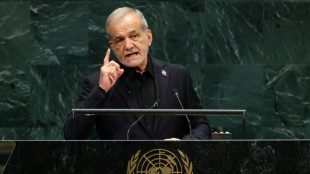
Ailing oceans in state of 'emergency', says UN chief / Photo: © AFP/File

 USA trims International lead after Presidents Cup four-balls

 Russia accuses Europe of blocking Ukraine talks, as strikes drag on

 'He said hello': Families pray with pope on Paris avenue

 Pope celebrates giant Paris mass, flies to Lourdes

 Thousands march in Madrid over eviction of 87-year-old woman
 England women back to winning ways with last-gasp defeat of New Zealand

 Trump rejects Iran proposal for deal to reopen Hormuz

 England's Cox says injured Buttler leaves 'big shoes to fill'

 Ruthless Perpignan upset sloppy Bordeaux-Begles
 Deadly abbey attack feeds anti-Ukrainian sentiment in Poland
 Antonelli says he drove 'safety-first' on his worst weekend of season

 Fernandez fights back to reach Singapore Open final

 Giant statue of Pope Leo XIV takes shape in Peru workshop

 Ukraine crush holders Italy to reach first BJK Cup final

 Pope celebrates giant Paris mass in landmark visit

 Germany selects Munich for Olympics host bid
 Sagnol sacked as Georgia boss after Nations League upset

 Man City could face 'drastic' sanctions after reported guilty verdict: ex-chairman

 Furious Fury says row between rival promoters could scupper Joshua bout

 'Invincible' 223cm teen basketball player stars as China win bronze

 Tenth woman found dead in South Africa's string of killings
 Japan schoolboy, 11, wins gold while empty seats blight Asian Games

 Japan organisers 'not satisfied' as empty seats blight Asian Games

 Canals full, roads submerged as Bangkok declares flood disaster

 China, US to open AI 'communication channel' after summit

A long-delayed conference on how to restore the faltering health of global oceans kicked off in Lisbon on Monday, with the head of the UN saying the world's seas are in crisis.
"Today we face what I would call an ocean emergency," UN Secretary General Antonio Guterres told thousands of policymakers, experts and advocates at the opening plenary, describing how seas have been hammered by climate change and pollution.
Humanity depends on healthy oceans.
They generate 50 percent of the oxygen we breathe and provide essential protein and nutrients to billions of people every day.
Covering 70 percent of Earth's surface, oceans have also softened the impact of climate change for life on land.
But at a terrible cost.
Absorbing around a quarter of CO2 pollution -- even as emissions increased by half over the last 60 years -- has turned sea water acidic, threatening aquatic food chains and the ocean's capacity to absorb carbon.
And soaking up more than 90 percent of the excess heat from global warming has spawned massive marine heatwaves that are killing off precious coral reefs and expanding dead zones bereft of oxygen.
"We have only begun to understand the extent to which climate change is going to wreak havoc on ocean health," said Charlotte de Fontaubert, the World Bank's global lead for the blue economy.
Making things worse is an unending torrent of pollution, including a garbage truck's worth of plastic every minute, according to the United Nations Environment Programme (UNEP).
On current trends, yearly plastic waste will nearly triple to one billion tonnes by 2060, according to a recent report by the Organisation for Economic Cooperation and Development (OECD).
- Wild fish stocks -
Microplastics -- now found inside Arctic ice and fish in the ocean's deepest trenches -- are estimated to kill more than a million seabirds and over 100,000 marine mammals each year.
Solutions on the table range from recycling to global caps on plastic production.
Global fisheries will also be in the spotlight during the five-day UN Ocean Conference, originally slated for April 2020 and jointly hosted by Portugal and Kenya.
"At least one-third of wild fish stocks are overfished and less than 10 percent of the ocean is protected," Kathryn Matthews, chief scientist for US-based NGO Oceana, told AFP.
"Destructive and illegal fishing vessels operate with impunity in many coastal waters and on the high seas."
One culprit is nearly $35 billion in subsidies. Baby steps taken last week by the World Trade Organization (WTO) to reduce handouts to industry will hardly make a dent, experts said.
The conference will also see a push for a moratorium on deep-sea mining of rare metals needed for a boom in electric vehicle battery construction.
Scientists say poorly understood seabed ecosystems are fragile and could take decades or longer to heal once disrupted.
Another major focus will be "blue food", the new watchword for ensuring that marine harvests from all sources -- wild caught and farmed -- are sustainable and socially responsible.
- Protected areas -
Aquaculture yields -- from salmon and tuna to shellfish and algae -- have grown by three percent a year for decades and are on track to overtake wild marine harvests that peaked in the 1990s, with each producing roughly 100 million tonnes per year.
The Lisbon meeting will be attended by ministers and even a few heads of state, including French President Emmanuel Macron, but is not a formal negotiating session.
But participants will push for a strong oceans agenda at two critical summits later this year -- the COP27 UN climate talks in November, hosted by Egypt, followed by the long-delayed COP15 UN biodiversity negotiations, recently moved from China to Montreal.
Oceans are already at the heart of a draft treaty tasked with halting what many scientists fear is the first "mass extinction" event in 65 million years. A cornerstone provision would designate 30 percent of the planet's land and ocean as protected areas.
But preparatory negotiations in Nairobi ended on Sunday in deadlock.
"The agreement is at risk of collapsing on the question of finance," the environmental diplomacy lead for WWF France told AFP.
For climate change, the focus will be on carbon sequestration -- boosting the ocean's capacity to soak up CO2, whether by enhancing natural sinks such as mangroves or through geoengineering schemes.
At the same time, scientists warn, a drastic reduction in greenhouse gases is needed to restore ocean health.
D.Schneider--BTB